







Question: ll! lRT ANWER Est' ENE [21! Ewing} INSTRUCTIONS: Write a short (GDGSGU words) well-organized essay that answers the question(s) posed in the prompt below. Well-organized
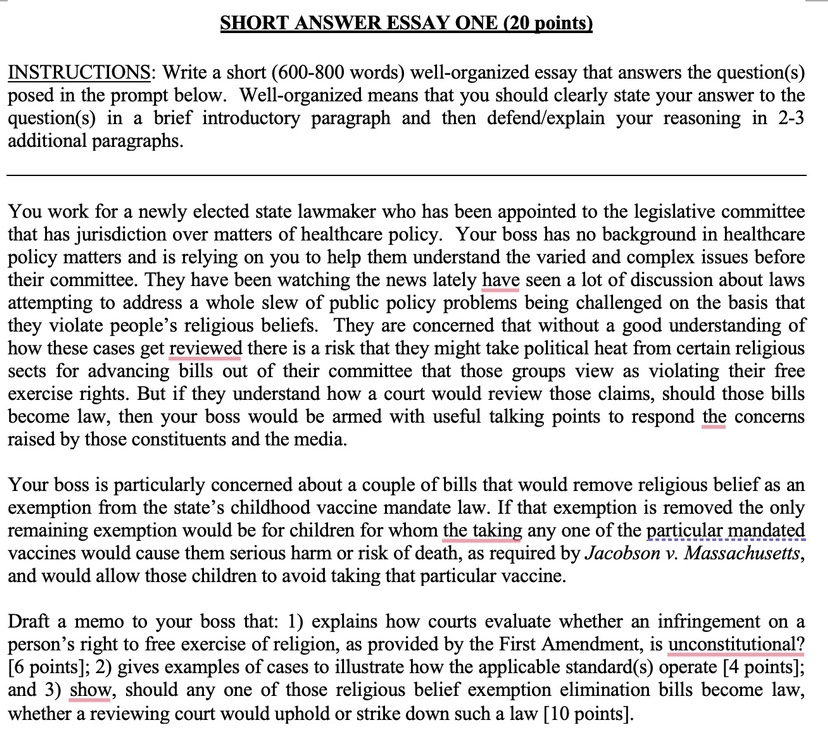
ll! lRT ANWER Est' ENE [21! Ewing} INSTRUCTIONS: Write a short (GDGSGU words) well-organized essay that answers the question(s) posed in the prompt below. Well-organized means that you should clearly state your answer to the question{s) in a brief introductory paragraph and then defendfexplain your reasoning in 23 additional paragraphs. You work for a newly elected state lawmaker who has been appointed to the legislative committee that has jurisdiction over matters of healthcare policy. Your boss has no background in healthcare policy matters and is relying on you to help them understand the varied and complex issues before their committee. They have been watching the news lately have seen a lot of discussion about laws attempting to address a whole slew of public policy problems being challenged on the basis that they violate people's religious beliefs. They are concerned that without a good understanding of how these cases get reviewed there is a risk that they might take political heat from certain religious Sects for advancing bills out of their committee that those groups view as violating their free exercise rights. But if they understand how a court would review those claims, should those bills become law, then your boss would be armed with useful talking points to respond the concerns raised by those constituents and the media. Your boss is particularly concerned about a couple of bills that would remove religious belief as an exemption from the state's childhood vaccine mandate law. If that exemption is removed the only remaining exemption would be for children for whom the taking any one of the pgrticulgrumandated vaccines would cause them serious harm or risk of death, as required by Jacobson v. Massachusetts, and would allow those children to avoid taking that particular vaccine. Draft a memo to your boss that: 1) explains how courts evaluate whether an infringement on a person's right to free exercise of religion, as provided by the First Amendment, is unconstitutional? [6 points]; 2) gives examples of cases to illustrate how the applicable standard(s) operate [4 points]; and 3) show, should any one of those religious belief exemption elimination bills become law, whether a reviewing court would uphold or strike down such a law [10 points]
Step by Step Solution
There are 3 Steps involved in it

Get step-by-step solutions from verified subject matter experts
 Study Help