Locate and summarize one additional article and tell how the formulation of a public locate and summarize one additional article and tell how the formulation of a public policy ( proposal ) could be developed to respond to the selected issue. Discuss your article in relation to the reading links posted below ( in 120 words ) site the source of your article using APA format. describe each reading picture in separate paragraphs in 100 words or more for each picture.
reading one

reading 2

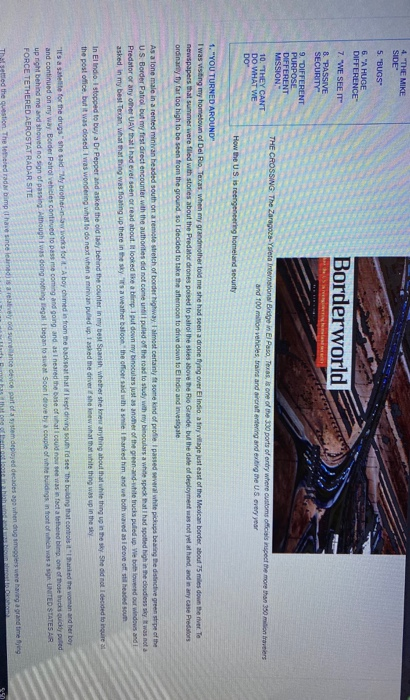
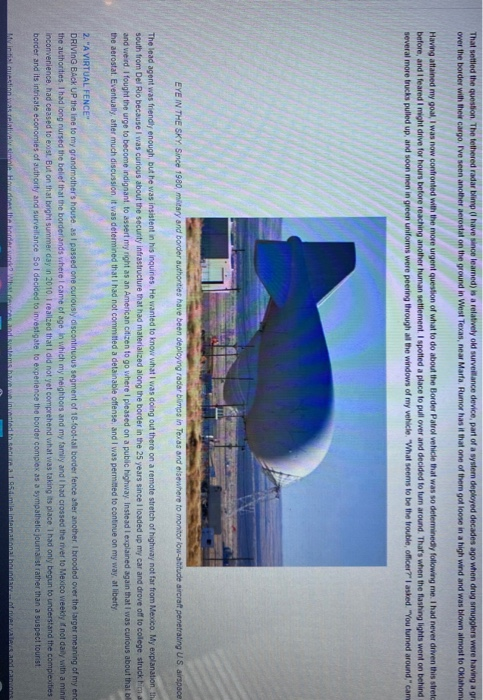
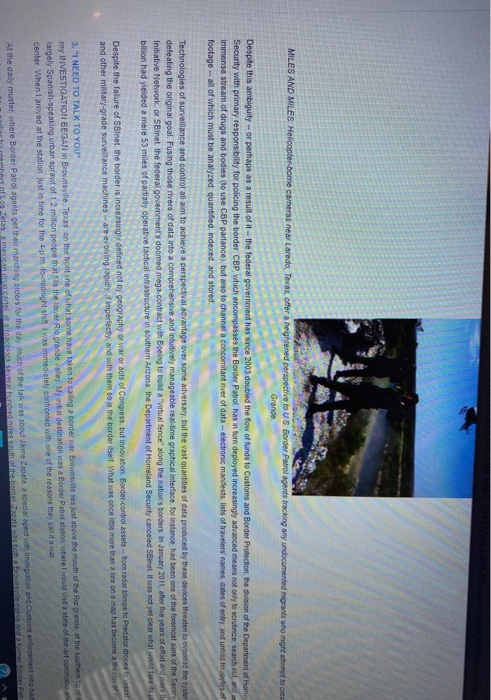
4. "THE MIKE SIDE 5. "BUGS 6. "A HUGE DIFFERENCE Borderworld SECURITY 9. DIFFERENT PURPOSLE DIFFERENT MISSION THE CROSSING The Zaragoza-seta International Bridge in El Paso, Texas is one of the 330 ports of entry where customs offices in pect the more than 350 and 100 million vehicles trains and arcraft viering and exiting the US every year 10. "THEY CANT DO WHAT WE travelers DO How the U.S.is reengeneering homeland security 1. "YOU TURNED AROUND I was visiting my hometown of Del Rio, Texas when my grandmother told me she had seen a drone ting over El Indio atiny Vilage just east of the Medican border about 75 miles down the river. To newspapers that summer were filled with stories about the Predator drones poised lo patrol the skies above the Ro Grande, but the date of deployment was not yet at hand, and in any case Predators ordinarily fly far too high to be seen from the ground, so I decided to take the afternoon to drive down to Indio and investigate As a lone male in a rented minivan headed south on a remote stretch of border highway almost certainly some kind of pro p assed several white pickups being the distinctive greenstripe of the U.S. Border Patrol but my first direct encounter with the authorities did not come until pulled of the road to study with my binoculars a white speck that I had spotted high in the clouds sky was not a Predator or any other UAV that I had ever seen or read about it looked like a bip. I put down my binoculars just another of the green and white trucks pulled up Weblowed our Windows and asked, in my best Texan, what that thing was floating up there in the sky is a weather baloon the officer said with a smile. I thanked him and we both waved as I drove of headed soun In El Indio. I stopped to buy a Dr Pepper and asked the old lady behind the counter in my best Spanish whether she knew anything about that while thing up in the sky she did not I decided to inquire at the post once, but it was closed. I was wondering what to do next when a minivan pred up I asked the driver she know what that while thing was up in the sky "It's a satellite for the drugs." she said "My brother w orks for LA boy chimed in from the backseat that kept arving sound see the building that controls t hanked the woman and her boy and continued on my way Border Patrol vehicles continued to pass coming and going and as I neared the use of all could now see was in fact atehered in one of those brucksuickly pulled up ng behind me and showed no sign of passing. Although I was doing nothing legal began to set Soonrove by a couple of w e buildings in front of which was a n UNITED STATES AR FORCE TETHERED AEROSTAT RADAR SITE e s Th gers were having a grand time yang - relatively od sun | | e d the question. The lethedradarbimp have since l ce vie part of system deployed decades ago when drug i | | | | | | | | | | | hnh That settled the question. The tethered radar Blimp (I have since teamed) is a relatively old surveillance device, part of a system deployed decades ago when drug smugglers were having a ge over the border with their cargo. Ive seen another aerostat on the ground in West Texas, near Marfa. Rumor has it that one of them got loose in a high wind and was blown almost to Oklahom Having attained my goal, I was now confronted with the more urgent question of what to do about the Border Patrol vehicle that was so determinedly following me. I had never driven this stretc before, and I feared I might drive for hours before reaching another human settlement. I spotted a place to pull over and decided to turn around. That's when the flashing lights went on behind several more trucks pulled up, and soon men in green uniforms were peeting through all the windows of my vehicle. "What seems to be the trouble, officer?" I asked, "You turned around"cam BE EYE IN THE SKY Since 1980, military and border authorities have been deploying radar blimps in Texas and elsewhere to monitor low-atitude aircraft penetrating US airspace The lead agent was friendly enough, but he was insistent in this inquiries He wanted to know what I was doing out there on a remote stretch of highway not far from Mexico. My explanation th south from Del Rio because I was curious about the security infrastructure that had materialized along the border in the 25 years since I loaded up my car and drove off to colege struck ima and weird. I fought the urge to become indignant to assert my right as an American citizen to go where I pleased on a public highway. Instead I explained again that I was curious about that bl the aerostat. Eventually, after much discussion, it was determined that I had not committed a detainable offense, and I was permitted to continue on my way, at liberty 2. "A VIRTUAL FENCE" DRIVING BACK UP the line to my grandmother's house, as I passed one curiously discontinuous segment of 15-foot-tal border fence ater another brooded over the larger meaning of my eng the authorities. I had long nursed the belief that the borderlands where I came of age in which my neighbors and my family and I had crossed the river to Mexico weekly not daily with a minir inconvenience had ceased to ext. But on that bright summer day 2010, realized that I did not yet comprehend what was taking its place. I had only begun to understand the complexities border and its intricate economies of authority and surveillance So I decided to investigate to experience the border complex as a sympathetic journalist rather than a suspect tourist domand a mento 1.06 hallinnan MILES AND MILES Helicopter bome cameras near Laredo, Texas, offer a heightened perspective to US Border Patrol agents tracking any undocumented migrants who might attempt to cros Grande. Despite this ambiguity or perhaps as a result of it - the federal government has since 2003 doubled the flow of funds to Customs and Border Protection, the division of the Department of Home Security with primary responsibility for policing the border CBP, which encompasses the Border Patrol, has in turn deployed increasingly advanced means not only to scrutinize search out and se immense stream of drugs and bodies (to use CBP parlance), but also to channel a concomitant river of data - electronic manifests lists of travelers names dates of entry and untold terabytes of footage -- all of which must be analyzed quantified, indexed and stored Technologies of surveillance and control all aim to achieve a perspectival advantage over some adversary, but the vast quantities of data produced by these devices threaten to vedead the syster defeating the original goal. Fusing those rivers of data into a comprehensive and intuitively manageable real-time graphical interface, for instance had been one of the foremost ams of the Secer Initiative Network, or SBinet the federal government's doomed mega.contract with Boeing to buld a virtual fence along the nation's borders. In January 2011, after five years of effort and more billion had yielded a mere 53 miles of partially operative tactical infrastructure in southern Arizona, the Department of Homeland Security canceled Sinet. It was not yet clear what would take its pa Despite the failure of SBinet the border is increasingly defined not by geography or war or acts of Congress, but innovation Border-control assets -- from radar blimps to Predator drones to and other military-grade surveillance machines are evolving rapidly imperfectly and with them so is the border itself what was once into more than a ine on a map has become a meal of grande, at the south of state of the commande 3."1 NEED TO TALK TO YOU" my INVESTIGATION BEGAN in Brownsville Texas on the Montline of what some have taken to calling a border war Brownsvilles just above the mouth of the targely Spanish-speaking urban sprawl of 12 million people that is the lover Rio grande valley. My intal destination was a Border Patrol station where I would center. When I arrived at the station just in time for the 4-pm.fo.midnight Shift I was immediately confronted with one of the reasons they call it a war Al the daily muster where Border Patrol agents get their marching orders for the day much of the talk was about Jaime Zapata a special agent with immigration and Customs enforcement nimemhofas mexicana de man e Somel, the border is increasingly defined not by geography or war or acts of Congress, but innovation Border control assets from radar lips to Predator and other military-grade surveillance machines -- are evolving rapidly, if imperfectly, and with them so is the border itself. What was once little more than a line on a map has become yament of Homeland Security canceled SBinet I was not yet clear what 3. "I NEED TO TALK TO YOU my INVESTIGATION BEGAN in Brownsville, Texas, on the front line of what some have taken to calling a border war. Brownsville les just above the mouth of the Rio grande, at the largely Spanish-speaking urban sprawi of 1.2 million people that is the lower Rio grande valley. My initial destination was a Border Patrol station, where I would visit a state-of-the-art center. When I arrived at the station, just in time for the 4-pm-to-midnight shift. I was immediately confronted with one of the reasons they call awar At the daily muster, where Border Patrol agents get their marching orders for the day, much of the talk was about Jaime Zapata, a special agent with Immigration and Customs enforce shot dead sex days earlier by members of Los Zetas, a mexican drug cartel at a roadblock several hundred miles south of the border Zapata was both a Brownsville Native and a forme so his murder was a major event. After his funeral, hundreds of law-enforcement vehicles, sirens waiting would pass through the city as residents lined the streets waving American flags. Some of the agents I spoke to attributed the relative quiet along the border that work to the Zapata were waiting to see what the American response would be. The guif Cartel anival organization whose own war with the Zelas for control of transborder commerce had resulted in more over the past year, denounced Zapata's killing. "It's clear that the federal government should act without delay against these assassins," the cartel said in a statement "Because the spill country is now drowning society." I was unable to attend the Zapata funeral but I would eventually see high-definition video footage of the burial ceremony taken from a CEP helicopter. The video was shot from about the moumers were probably not even aware that a helicopter was in the area. I watched playback of that video feed on the Web portal of a system called the Big Ppe a surveillance network Kenneth Knight the deputy executive director of national air security operations for the office of Air and marine Ami a lesser-known division of CBP that operates the largest law-enforce the world Knight is a physically imposing ruddy man with a disarming midwestern accent. When we met in Brownsville he was dressed in the khaki jumpsuit that all plots we and tumed helicopter pilot himself I had no idea who he was but he already knew about me. I need to talk to you" he said. decisively hijacking my tour of the station Knight was in tow to coordinate the Zapata funeral, and he didn't have much time for me right then, but he gave me a quick briefing on the Big Pipe and then invited me to Washington, where he promised to give a mere demonstration of his projects capabilities What was the Big Pipe? The answer wasn't clear at first but Knight emphasized the concept of total domain awareness and strongly suggested that he possessed the means of atten tclear at first, but Knight emphasized the on the briefing I received in Brownsville, The Big Pipe sounded like it might be the framework for the elusive common operating picture at would integrate and nations then Streams generated by our high-definition surveillance systems. Perhaps the Big Pipe could succeed where sine had failed 4. "THE MIKE SIDE LATE THAT AFTERNOON when the low angle of the sun was beginning to lengthen the shadows ont Dan man took me down to the Rio grande to get a closer look at me border growing brush often chokes the meandering banks of the Rio grande as well as the noma's.land between the river and the border fence. Cacovecandan respect that ads and passage of other such where Narrow trails shake though the far crass Contents Listen Accent 7 0 SCIENTIFIC Section: AMERICAN ONLINE Science Agenda Opinion and analysis from Scientific American's Board of Editors Pinion and analysis fro Without explicit safeguards, your personal biometric data are destined for a government database Security through biology is an enticing idea Since 2011, police departments across the US have been scanning biometric data in the field using devices such as the Mobile on Information System (MORIS), an iPhone attachment that checks fingerprints and iris scans. The FBI is currently building its Next Generation Identification database, which will con prints, iris scans, voice data and photographs of faces. Before long, even your cell phone will be secured by information that resides in a distant biometric database Unfortunately this shinto biometric enabled security creates profound threats to commonly accepted notions of privacy and security. It makes pose pracy Security Agency's data sweeps seem superficial by comparison Biometrics could turn existing surveillance systems into something categorically new - something more powerful and much more invasive. Consider the so-called Domain Awarene 3,000 surveillance cameras in New York City, Currently if someone commits a crime, cops can go back and review sections of video Equip the system with facial-recognition techn people behind the controls can actively track you throughout your daily life. "A person who lives and works in lower Manhattan would be under constant surveillance," says Jennifer Electronic Frontier Foundation, a nonprofit group. Face-in-a-crowd detection is a formidable technical problem, but researchers working on projects such as the Department of Hon Optical Surveillance System (BOSS) are making rapid progress In addition, once your face, iris or DNA profile becomes a digital file that file will be difficult to protect. As the recent NSA revelations have made clear, the boundary between comm data is porous at best. Biometric identifiers could also be stolen. It's easy to replace a swiped credit card, but good luck changing the patterns on your ins These days gathering biometric data generally requires the cooperation (or coercion) of the subject for your inis to get into a database you have to let someone take a close-up pho That will not be the case for long Department of Defense-funded researchers at Carnegie Melon University are perfecting a camera that can take rapid-fire, database-quality iris sc. crowd from a distance of 10 meters. New technologies will also make it possible to extract far more information from the biometrics we are already collecting While most law enforcement DNA databases contain only s agencies can keep the physical DNA samples in perpetuity raising the question of what future genetic analysis tools will be able to discem "Once you have somebody's DNA you h personal info." Lynch says. There is a lot of fear that people are going to start testing samples to look for a link between genes and property for crime Current law is not even remotely prepared to handle these developments The legal status of most types of biometric data is unclear. No court has addressed womere dala without a person's knowing and case law says nothinn ahotarialanti ce 4. "THE MIKE SIDE 5. "BUGS 6. "A HUGE DIFFERENCE Borderworld SECURITY 9. DIFFERENT PURPOSLE DIFFERENT MISSION THE CROSSING The Zaragoza-seta International Bridge in El Paso, Texas is one of the 330 ports of entry where customs offices in pect the more than 350 and 100 million vehicles trains and arcraft viering and exiting the US every year 10. "THEY CANT DO WHAT WE travelers DO How the U.S.is reengeneering homeland security 1. "YOU TURNED AROUND I was visiting my hometown of Del Rio, Texas when my grandmother told me she had seen a drone ting over El Indio atiny Vilage just east of the Medican border about 75 miles down the river. To newspapers that summer were filled with stories about the Predator drones poised lo patrol the skies above the Ro Grande, but the date of deployment was not yet at hand, and in any case Predators ordinarily fly far too high to be seen from the ground, so I decided to take the afternoon to drive down to Indio and investigate As a lone male in a rented minivan headed south on a remote stretch of border highway almost certainly some kind of pro p assed several white pickups being the distinctive greenstripe of the U.S. Border Patrol but my first direct encounter with the authorities did not come until pulled of the road to study with my binoculars a white speck that I had spotted high in the clouds sky was not a Predator or any other UAV that I had ever seen or read about it looked like a bip. I put down my binoculars just another of the green and white trucks pulled up Weblowed our Windows and asked, in my best Texan, what that thing was floating up there in the sky is a weather baloon the officer said with a smile. I thanked him and we both waved as I drove of headed soun In El Indio. I stopped to buy a Dr Pepper and asked the old lady behind the counter in my best Spanish whether she knew anything about that while thing up in the sky she did not I decided to inquire at the post once, but it was closed. I was wondering what to do next when a minivan pred up I asked the driver she know what that while thing was up in the sky "It's a satellite for the drugs." she said "My brother w orks for LA boy chimed in from the backseat that kept arving sound see the building that controls t hanked the woman and her boy and continued on my way Border Patrol vehicles continued to pass coming and going and as I neared the use of all could now see was in fact atehered in one of those brucksuickly pulled up ng behind me and showed no sign of passing. Although I was doing nothing legal began to set Soonrove by a couple of w e buildings in front of which was a n UNITED STATES AR FORCE TETHERED AEROSTAT RADAR SITE e s Th gers were having a grand time yang - relatively od sun | | e d the question. The lethedradarbimp have since l ce vie part of system deployed decades ago when drug i | | | | | | | | | | | hnh That settled the question. The tethered radar Blimp (I have since teamed) is a relatively old surveillance device, part of a system deployed decades ago when drug smugglers were having a ge over the border with their cargo. Ive seen another aerostat on the ground in West Texas, near Marfa. Rumor has it that one of them got loose in a high wind and was blown almost to Oklahom Having attained my goal, I was now confronted with the more urgent question of what to do about the Border Patrol vehicle that was so determinedly following me. I had never driven this stretc before, and I feared I might drive for hours before reaching another human settlement. I spotted a place to pull over and decided to turn around. That's when the flashing lights went on behind several more trucks pulled up, and soon men in green uniforms were peeting through all the windows of my vehicle. "What seems to be the trouble, officer?" I asked, "You turned around"cam BE EYE IN THE SKY Since 1980, military and border authorities have been deploying radar blimps in Texas and elsewhere to monitor low-atitude aircraft penetrating US airspace The lead agent was friendly enough, but he was insistent in this inquiries He wanted to know what I was doing out there on a remote stretch of highway not far from Mexico. My explanation th south from Del Rio because I was curious about the security infrastructure that had materialized along the border in the 25 years since I loaded up my car and drove off to colege struck ima and weird. I fought the urge to become indignant to assert my right as an American citizen to go where I pleased on a public highway. Instead I explained again that I was curious about that bl the aerostat. Eventually, after much discussion, it was determined that I had not committed a detainable offense, and I was permitted to continue on my way, at liberty 2. "A VIRTUAL FENCE" DRIVING BACK UP the line to my grandmother's house, as I passed one curiously discontinuous segment of 15-foot-tal border fence ater another brooded over the larger meaning of my eng the authorities. I had long nursed the belief that the borderlands where I came of age in which my neighbors and my family and I had crossed the river to Mexico weekly not daily with a minir inconvenience had ceased to ext. But on that bright summer day 2010, realized that I did not yet comprehend what was taking its place. I had only begun to understand the complexities border and its intricate economies of authority and surveillance So I decided to investigate to experience the border complex as a sympathetic journalist rather than a suspect tourist domand a mento 1.06 hallinnan MILES AND MILES Helicopter bome cameras near Laredo, Texas, offer a heightened perspective to US Border Patrol agents tracking any undocumented migrants who might attempt to cros Grande. Despite this ambiguity or perhaps as a result of it - the federal government has since 2003 doubled the flow of funds to Customs and Border Protection, the division of the Department of Home Security with primary responsibility for policing the border CBP, which encompasses the Border Patrol, has in turn deployed increasingly advanced means not only to scrutinize search out and se immense stream of drugs and bodies (to use CBP parlance), but also to channel a concomitant river of data - electronic manifests lists of travelers names dates of entry and untold terabytes of footage -- all of which must be analyzed quantified, indexed and stored Technologies of surveillance and control all aim to achieve a perspectival advantage over some adversary, but the vast quantities of data produced by these devices threaten to vedead the syster defeating the original goal. Fusing those rivers of data into a comprehensive and intuitively manageable real-time graphical interface, for instance had been one of the foremost ams of the Secer Initiative Network, or SBinet the federal government's doomed mega.contract with Boeing to buld a virtual fence along the nation's borders. In January 2011, after five years of effort and more billion had yielded a mere 53 miles of partially operative tactical infrastructure in southern Arizona, the Department of Homeland Security canceled Sinet. It was not yet clear what would take its pa Despite the failure of SBinet the border is increasingly defined not by geography or war or acts of Congress, but innovation Border-control assets -- from radar blimps to Predator drones to and other military-grade surveillance machines are evolving rapidly imperfectly and with them so is the border itself what was once into more than a ine on a map has become a meal of grande, at the south of state of the commande 3."1 NEED TO TALK TO YOU" my INVESTIGATION BEGAN in Brownsville Texas on the Montline of what some have taken to calling a border war Brownsvilles just above the mouth of the targely Spanish-speaking urban sprawl of 12 million people that is the lover Rio grande valley. My intal destination was a Border Patrol station where I would center. When I arrived at the station just in time for the 4-pm.fo.midnight Shift I was immediately confronted with one of the reasons they call it a war Al the daily muster where Border Patrol agents get their marching orders for the day much of the talk was about Jaime Zapata a special agent with immigration and Customs enforcement nimemhofas mexicana de man e Somel, the border is increasingly defined not by geography or war or acts of Congress, but innovation Border control assets from radar lips to Predator and other military-grade surveillance machines -- are evolving rapidly, if imperfectly, and with them so is the border itself. What was once little more than a line on a map has become yament of Homeland Security canceled SBinet I was not yet clear what 3. "I NEED TO TALK TO YOU my INVESTIGATION BEGAN in Brownsville, Texas, on the front line of what some have taken to calling a border war. Brownsville les just above the mouth of the Rio grande, at the largely Spanish-speaking urban sprawi of 1.2 million people that is the lower Rio grande valley. My initial destination was a Border Patrol station, where I would visit a state-of-the-art center. When I arrived at the station, just in time for the 4-pm-to-midnight shift. I was immediately confronted with one of the reasons they call awar At the daily muster, where Border Patrol agents get their marching orders for the day, much of the talk was about Jaime Zapata, a special agent with Immigration and Customs enforce shot dead sex days earlier by members of Los Zetas, a mexican drug cartel at a roadblock several hundred miles south of the border Zapata was both a Brownsville Native and a forme so his murder was a major event. After his funeral, hundreds of law-enforcement vehicles, sirens waiting would pass through the city as residents lined the streets waving American flags. Some of the agents I spoke to attributed the relative quiet along the border that work to the Zapata were waiting to see what the American response would be. The guif Cartel anival organization whose own war with the Zelas for control of transborder commerce had resulted in more over the past year, denounced Zapata's killing. "It's clear that the federal government should act without delay against these assassins," the cartel said in a statement "Because the spill country is now drowning society." I was unable to attend the Zapata funeral but I would eventually see high-definition video footage of the burial ceremony taken from a CEP helicopter. The video was shot from about the moumers were probably not even aware that a helicopter was in the area. I watched playback of that video feed on the Web portal of a system called the Big Ppe a surveillance network Kenneth Knight the deputy executive director of national air security operations for the office of Air and marine Ami a lesser-known division of CBP that operates the largest law-enforce the world Knight is a physically imposing ruddy man with a disarming midwestern accent. When we met in Brownsville he was dressed in the khaki jumpsuit that all plots we and tumed helicopter pilot himself I had no idea who he was but he already knew about me. I need to talk to you" he said. decisively hijacking my tour of the station Knight was in tow to coordinate the Zapata funeral, and he didn't have much time for me right then, but he gave me a quick briefing on the Big Pipe and then invited me to Washington, where he promised to give a mere demonstration of his projects capabilities What was the Big Pipe? The answer wasn't clear at first but Knight emphasized the concept of total domain awareness and strongly suggested that he possessed the means of atten tclear at first, but Knight emphasized the on the briefing I received in Brownsville, The Big Pipe sounded like it might be the framework for the elusive common operating picture at would integrate and nations then Streams generated by our high-definition surveillance systems. Perhaps the Big Pipe could succeed where sine had failed 4. "THE MIKE SIDE LATE THAT AFTERNOON when the low angle of the sun was beginning to lengthen the shadows ont Dan man took me down to the Rio grande to get a closer look at me border growing brush often chokes the meandering banks of the Rio grande as well as the noma's.land between the river and the border fence. Cacovecandan respect that ads and passage of other such where Narrow trails shake though the far crass Contents Listen Accent 7 0 SCIENTIFIC Section: AMERICAN ONLINE Science Agenda Opinion and analysis from Scientific American's Board of Editors Pinion and analysis fro Without explicit safeguards, your personal biometric data are destined for a government database Security through biology is an enticing idea Since 2011, police departments across the US have been scanning biometric data in the field using devices such as the Mobile on Information System (MORIS), an iPhone attachment that checks fingerprints and iris scans. The FBI is currently building its Next Generation Identification database, which will con prints, iris scans, voice data and photographs of faces. Before long, even your cell phone will be secured by information that resides in a distant biometric database Unfortunately this shinto biometric enabled security creates profound threats to commonly accepted notions of privacy and security. It makes pose pracy Security Agency's data sweeps seem superficial by comparison Biometrics could turn existing surveillance systems into something categorically new - something more powerful and much more invasive. Consider the so-called Domain Awarene 3,000 surveillance cameras in New York City, Currently if someone commits a crime, cops can go back and review sections of video Equip the system with facial-recognition techn people behind the controls can actively track you throughout your daily life. "A person who lives and works in lower Manhattan would be under constant surveillance," says Jennifer Electronic Frontier Foundation, a nonprofit group. Face-in-a-crowd detection is a formidable technical problem, but researchers working on projects such as the Department of Hon Optical Surveillance System (BOSS) are making rapid progress In addition, once your face, iris or DNA profile becomes a digital file that file will be difficult to protect. As the recent NSA revelations have made clear, the boundary between comm data is porous at best. Biometric identifiers could also be stolen. It's easy to replace a swiped credit card, but good luck changing the patterns on your ins These days gathering biometric data generally requires the cooperation (or coercion) of the subject for your inis to get into a database you have to let someone take a close-up pho That will not be the case for long Department of Defense-funded researchers at Carnegie Melon University are perfecting a camera that can take rapid-fire, database-quality iris sc. crowd from a distance of 10 meters. New technologies will also make it possible to extract far more information from the biometrics we are already collecting While most law enforcement DNA databases contain only s agencies can keep the physical DNA samples in perpetuity raising the question of what future genetic analysis tools will be able to discem "Once you have somebody's DNA you h personal info." Lynch says. There is a lot of fear that people are going to start testing samples to look for a link between genes and property for crime Current law is not even remotely prepared to handle these developments The legal status of most types of biometric data is unclear. No court has addressed womere dala without a person's knowing and case law says nothinn ahotarialanti ce




