



Question: Logarithm defined as an integral: Typically, we see the (natural) logarithm defined as the inverse of the exponential function. However, there are two drawbacks to
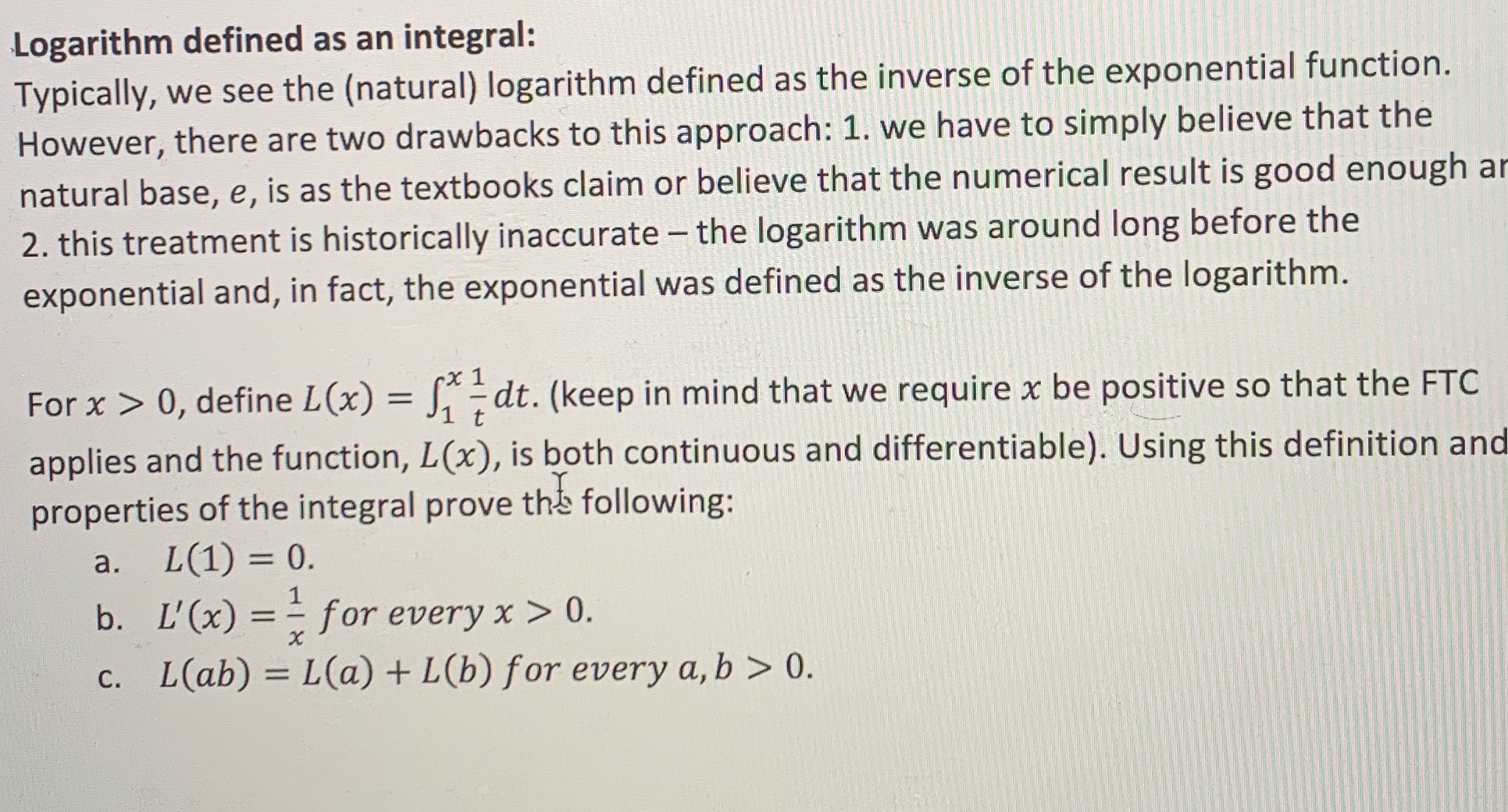
Logarithm defined as an integral: Typically, we see the (natural) logarithm defined as the inverse of the exponential function. However, there are two drawbacks to this approach: 1 we have to simply believe that the natural base, 8, is as the textbooks claim or believe that the numerical result Is good enough ar 2. this treatment is historically inaccurate the logarithm was around long before the exponential and, In fact, the exponential was defined as the inverse of the logarithm. For x > 0, define L(x) = f1.dtt (keep In mind that we require x be positive so that the FTC applies and the function, L(x), is both continuous and differentiable) Using this definition and properties of the integral prove th1~ following: a. LCD = b. ' L'Cx) =:; for everyx > 0. c. L(ab) = L(a) + L(b) for every (1,!) > 0
Step by Step Solution
There are 3 Steps involved in it

Get step-by-step solutions from verified subject matter experts