Question: Look at Chapter 10, specifically at the list Working with the Media beginning on page 230. of the 10 listed suggestions, choose one and offer
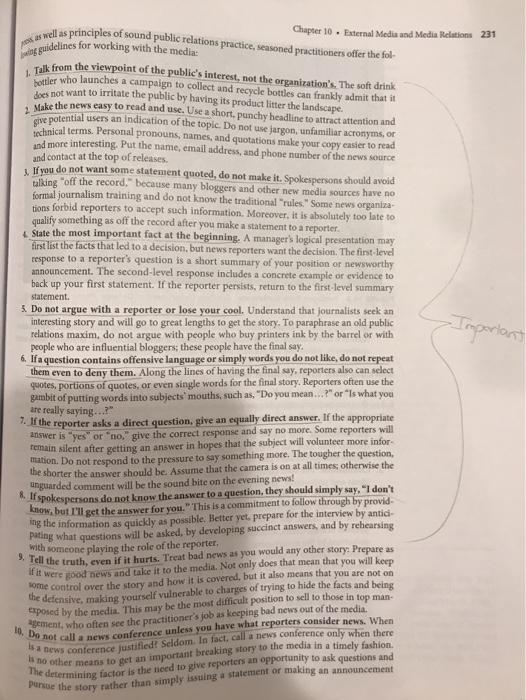
Look at Chapter 10, specifically at the list "Working with the Media" beginning on page 230. of the 10 listed suggestions, choose one and offer an example of when it was used appropriately or Inappropriately. What was the perceived result of the interaction? is a news conference justified! Seldom. In fact, call a news conference only when there The determining factor is the need to give reporters an opportunity to ask questions and Of well as principles of sound public relations practice, seasoned practitioners offer the fol og guidelines for working with the media: Talk from the viewpoint of the public's interest, not the organization's. The soft drink Chapter 10. External Media and Media Relations 231 hotler who launches a campaign to collect and recycle bottles can frankly admit that it 2. Make the news easy to read and use. Use a short. punchy headline to attract attention and give potential users an indication of the topic. Do not use jargon, unfamiliar acronyms, or sechnical terms. Personal pronouns, names, and quotations make your copy easier to read and more interesting. Put the name, email address, and phone number of the news source and contact at the top of releases If you do not want some statement quoted, do not make it. Spokesperson should avoid talking off the record." because many bloggers and other new media sources have no formal journalism training and do not know the traditional rules. Some news organiza tions forbid reporters to accept such information. Moreover, it is absolutely too late to qualify something as off the record after you make a statement to a reporter. State the most important fact at the beginning. A manager's logical presentation may first list the facts that led to a decision, but news reporters want the decision. The first level response to a reporter's question is a short summary of your position or newsworthy announcement. The second-level response includes a concrete example or evidence to back up your first statement. If the reporter persists, return to the first-level summary statement Do not argue with a reporter or lose your cool. Understand that journalists seek an interesting story and will go to great lengths to get the story. To paraphrase an old public relations maxim, do not argue with people who buy printers ink by the barrel or with people who are influential bloggers, these people have the final say, 6. If a question contains offensive language or simply words you do not like, do not repeat them even to deny them. Along the lines of having the final say, reporters also can select quotes, portions of quotes, or even single words for the final story. Reporters often use the gambit of putting words into subjects' mouths, such as, "Do you mean...?" or "Is what you are really saying...?" 7. If the reporter asks a direct question, give an equally direct answer. If the appropriate answer is "yes" or "no" give the correct response and say no more. Some reporters will femain silent after getting an answer in hopes that the subject will volunteer more infor mation. Do not respond to the pressure to say something more. The tougher the question, the shorter the answer should be assume that the camera is on at all times, otherwise the unguarded comment will be the sound bite on the evening news! If spokespersons do not know the answer to a question, they should simply say, "I don't know, but I'll get the answer for you." This is a commitment to follow through by provid ing the information as quickly as possible. Better yet, prepare for the interview by antici pating what questions will be asked, by developing succinct answers, and by rehearsing Tell the truth, even if it hurts. Treat bad news as you would any other story: Prepare as Important ll it were good news and take it to the media. Not only does that mean that you will keep kome control over the story and how it is covered, but it also means that you are not on the defensive, making yourself vulnerable to charges of trying to hide the facts and being posed by the media. This may be the most difficult position to sell to those in top man Do not call a news conference unless you have what reporters consider news. When is no other means to get an important breaking story to the media in a timely fashion Pure the story rather than simply issuing a statement or making an announcement










 Study Help