







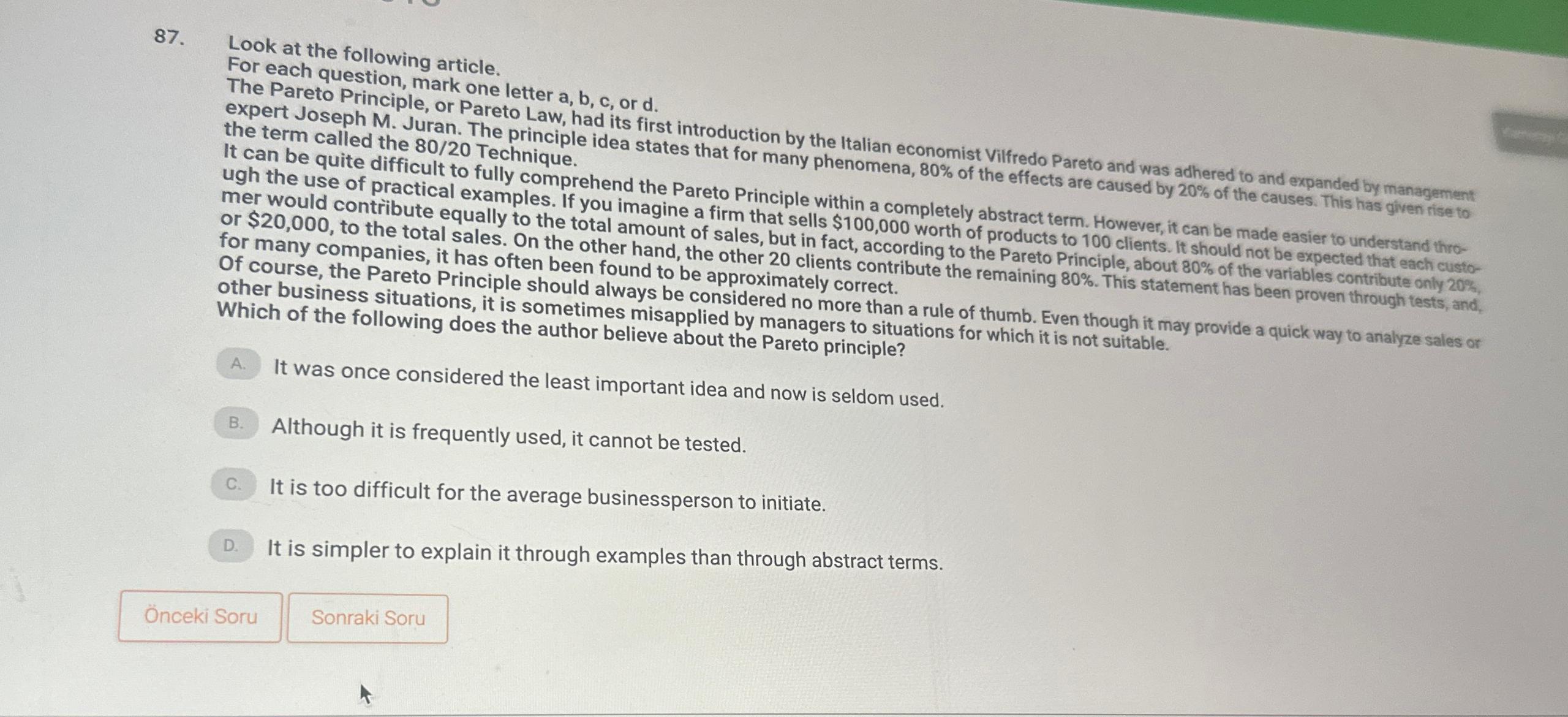
Question: Look at the following article. For each question, mark one letter a , b , c , or d . The Pareto Principle, or Pareto
Look at the following article.
For each question, mark one letter or
The Pareto Principle, or Pareto Law, had its first introduction by the Italian economist Vilfredo Pareto and was adhered to and expanded by management expert Joseph M Juran. The principle idea states that for many phenomena, of the effects are caused by of the causes. This has given rise to the term called the Technique.
It can be quite difficult to fully comprehend the Pareto Principle within a completely abstract term. However, it can be made easier to understand through the use of practical examples. If you imagine a firm that sells $ worth of products to clients. It should not be expected that each customer would contribute equally to the total amount of sales, but in fact, according to the Pareto Principle, about of the variables contribute only or $ to the total sales. On the other hand, the other clients contribute the remaining This statement has been proven through tests, and, for many companies, it has often been found to be approximately correct.
Of course, the Pareto Principle should always be considered no more than a rule of thumb. Even though it may provide a quick way to analyze sales or other business situations, it is sometimes misapplied by managers to situations for which it is not suitable.
Which of the following does the author believe about the Pareto principle?
It was once considered the least important idea and now is seldom used.
Although it is frequently used, it cannot be tested.
It is too difficult for the average businessperson to initiate.
It is simpler to explain it through examples than through abstract terms.
Step by Step Solution
There are 3 Steps involved in it
1 Expert Approved Answer
Step: 1 Unlock

Question Has Been Solved by an Expert!
Get step-by-step solutions from verified subject matter experts
Step: 2 Unlock
Step: 3 Unlock
 Study Help