Question: Part 3 Questions 13-18 Read the article below about interview plans and the questions on the opposite page. For each question 13 - 18, mark
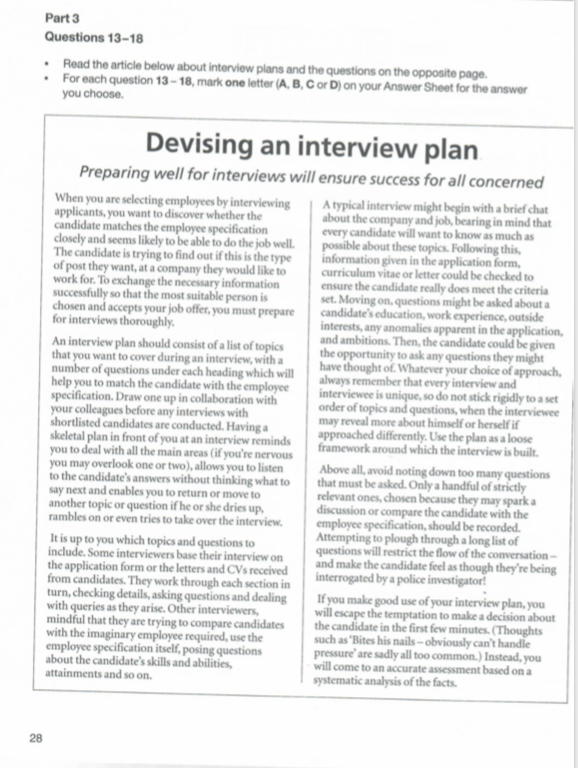
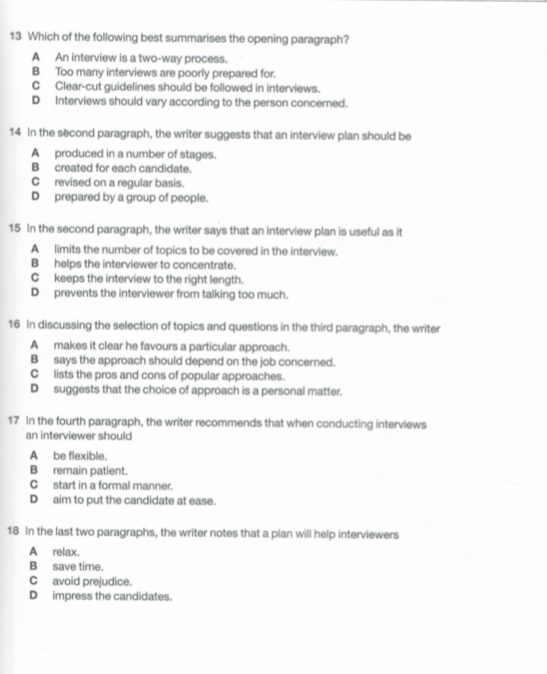
Part 3 Questions 13-18 Read the article below about interview plans and the questions on the opposite page. For each question 13 - 18, mark one letter (A, B, C or D) on your Answer Sheet for the answer you choose Devising an interview plan Preparing well for interviews will ensure success for all concerned When you are selecting employees by interviewing A typical interview might begin with a brief chat applicants, you want to discover whether the about the company and job, bearing in mind that candidate matches the employee specification every candidate will want to know as much as closely and seems likely to be able to do the job well. possible about these topics. Following this, The candidate is trying to find out if this is the type information given in the application form, of post they want, at a company they would like to curriculum vitae or letter could be checked to work for. To exchange the necessary information ensure the candidate really does meet the criteria successfully so that the most suitable person is set. Moving on, questions might be asked about a chosen and accepts your job offer, you must prepare candidate's education, work experience, outside for interviews thoroughly interests, any anomalies apparent in the application, An interview plan should consist of a list of topics and ambitions. Then, the candidate could be given that you want to cover during an interview, with a the opportunity to ask any questions they might have thought of. Whatever your choice of approach number of questions under each heading which will help you to match the candidate with the employee always remember that every interview and specification. Draw one up in collaboration with interviewee is unique, so do not stick rigidly to a set order of topics and questions, when the interviewee your colleagues before any interviews with shortlisted candidates are conducted. Having a may reveal more about himself or herself if approached differently. Use the plan as a loose skeletal plan in front of you at an interview reminds you to deal with all the main areas (if you're nervous framework around which the interview is built. you may overlook one or two), allows you to listen Above all, avoid noting down too many questions to the candidate's answers without thinking what to that must be asked. Only a handful of strictly say next and enables you to return or move to relevant ones, chosen because they may sparka another topic or question if he or she dries up, discussion or compare the candidate with the rambles on or even tries to take over the interview. employee specification, should be recorded. It is up to you which topics and questions to Attempting to plough through a long list of include. Some interviewers base their interview on questions will restrict the flow of the conversation the application form or the letters and CVs received and make the candidate feel as though they're being from candidates. They work through each section in interrogated by a police investigator! turn, checking details, asking questions and dealing If you make good use of your interview plan, you with queries as they arise. Other interviewers, will escape the temptation to make a decision about mindful that they are trying to compare candidates the candidate in the first few minutes. (Thoughts with the imaginary employee required, use the such as 'Bites his nails- obviously can't handle employee specification itself, posing questions pressure are sadly all too common. Instead, you about the candidate's skills and abilities, will come to an accurate assessment based on a attainments and so on. systematic analysis of the facts. 28 13 Which of the following best summarises the opening paragraph? A An interview is a two-way process. B Too many interviews are poorly prepared for CClear-cut guidelines should be followed in interviews. D Interviews should vary according to the person concerned. 14 In the second paragraph, the writer suggests that an interview plan should be A produced in a number of stages. B created for each candidate. C revised on a regular basis. D prepared by a group of people. 15 In the second paragraph, the writer says that an interview plan is useful as it A limits the number of topics to be covered in the interview. B helps the interviewer to concentrate. C keeps the interview to the right length. D prevents the interviewer from talking too much. 16 In discussing the selection of topics and questions in the third paragraph, the writer A makes it clear he favours a particular approach. B says the approach should depend on the job concerned. clists the pros and cons of popular approaches. Dsuggests that the choice of approach is a personal matter. 17 In the fourth paragraph, the writer recommends that when conducting interviews an interviewer should A be flexible. Bremain patient. cstart in a formal manner. Daim to put the candidate at ease. 18 In the last two paragraphs, the writer notes that a plan will help interviewers A relax B save time. Cavoid prejudice. Dimpress the candidates









 Study Help