







Question: Looking at the ABC analysis, I see two problems. First, we do many more activities than the ones you have listed. If you had included
Looking at the ABC analysis, I see two problems. First, we do many more activities than the ones you have listed. If you had included all activities, maybe your conclusions would be different. Second, you used number of setups and number of inspections as allocation bases. The numbers would be different had you used setup-hours and inspection-hours instead. I know that measurement problems precluded you from using these other cost-allocation bases, but I believe you ought to make some adjustments to our current numbers to compensate for these issues. I know you can do better. We can't afford to phase out either product."
Jacobs knows that his numbers are fairly accurate. As a quick check, he calculates the profitability of Maximum and Mammoth using more and different allocation bases. The set of activities and activity rates he had used results in numbers that closely approximate those based on more detailed analyses. He is confident that headquarters, knowing that Maximum was introduced only recently, will not ask Plum to phase it out. He is also aware that a sizable portion of Clark's bonus is based on division revenues. Phasing out either product would adversely affect his bonus. Still, he feels some pressure from Clark to do something.
Required
1. Using activity-based costing, calculate the gross margin per unit of the Maximum and Mammoth models. 2. Solve it using simple costing method.
Explain briefly why these numbers differ from the gross margin per unit of the Maximum and Mammoth models calculated using Plum's existing simple costing system.
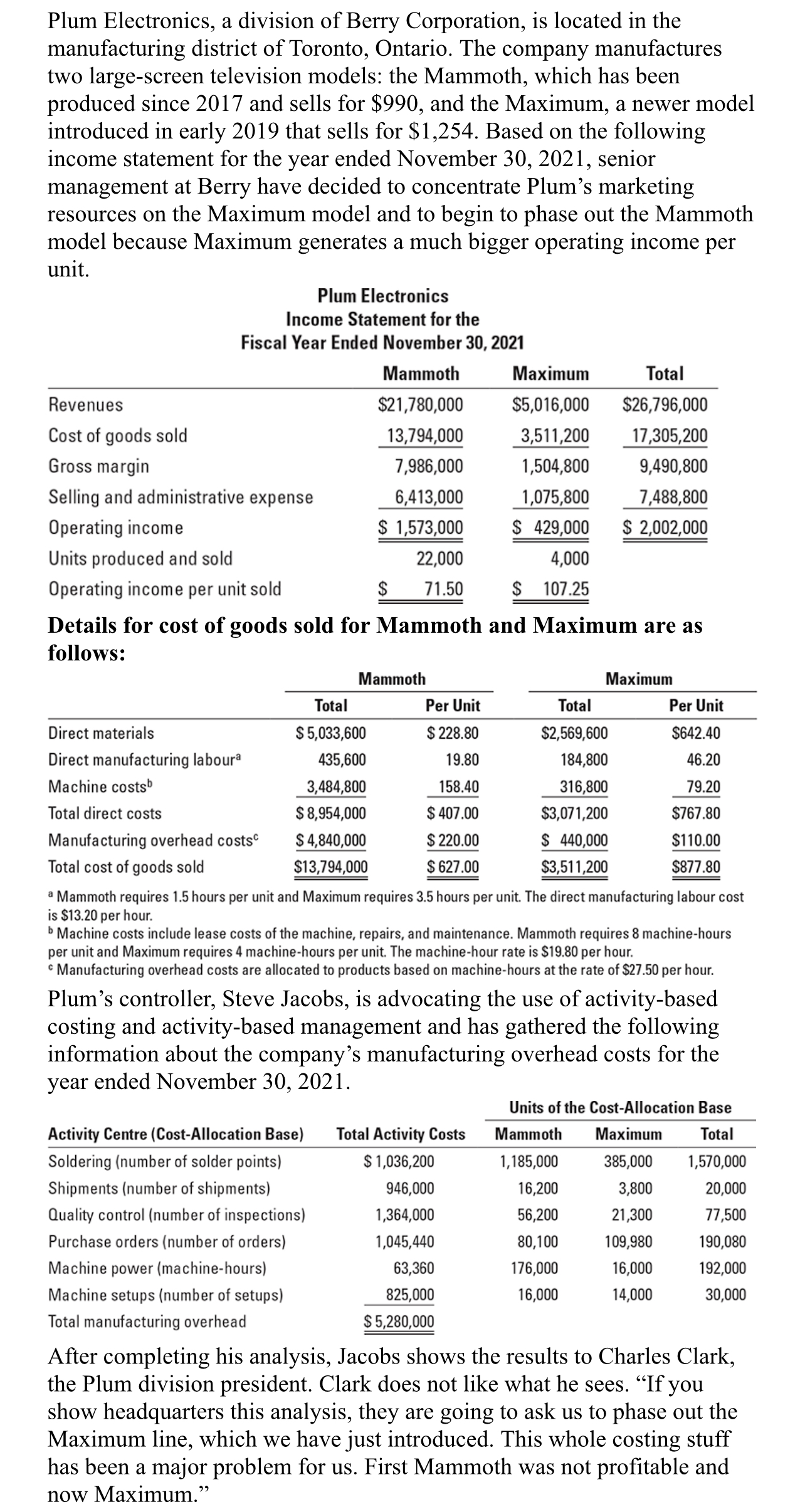
Plum Electronics, a division of Berry Corporation, is located in the manufacturing district of Toronto, Ontario. The company manufactures two large-screen television models: the Mammoth, which has been produced since 2017 and sells for $990, and the Maximum, a newer model introduced in early 2019 that sells for $1,254. Based on the following income statement for the year ended November 30, 2021, senior management at Berry have decided to concentrate Plum's marketing resources on the Maximum model and to begin to phase out the Mammoth model because Maximum generates a much bigger operating income per unit. Plum Electronics Income Statement for the Fiscal Year Ended November 30, 2021 Mammoth Maximum Total Revenues $21,780,000 $5,016,000 $26,796,000 Cost of goods sold 13,794,000 3,511,200 17,305,200 Gross margin 7,986,000 1,504,800 9,490,800 Selling and administrative expense 6,413,000 1,075,800 7,488,800 Operating income $ 1,573,000 $ 429,000 $ 2,002,000 Units produced and sold 22,000 4,000 Operating income per unit sold $ 71.50 $ 107.25 Details for cost of goods sold for Mammoth and Maximum are as follows: Mammoth Maximum Total Per Unit Total Per Unit Direct materials $5,033,600 $228.80 $2,569,600 $642.40 Direct manufacturing labour? 435,600 19.80 184,800 46.20 Machine costs 3,484,800 158.40 316,800 _79.20 Total direct costs $8,954,000 $407.00 $3,071,200 $767.80 Manufacturing overhead costs $ 4,840,000 220.00 $ 440,000 $110.00 Total cost of goods sold $13,794,000 $627.00 $3,511,200 $877.80 @ Mammoth requires 1.5 hours per unit and Maximum requires 3.5 hours per unit. The direct manufacturing labour cost is $13.20 per hour. Machine costs include lease costs of the machine, repairs, and maintenance. Mammoth requires 8 machine-hours per unit and Maximum requires 4 machine-hours per unit. The machine-hour rate is $19.80 per hour. Manufacturing overhead costs are allocated to products based on machine-hours at the rate of $27.50 per hour. Plum's controller, Steve Jacobs, is advocating the use of activity-based costing and activity-based management and has gathered the following information about the company's manufacturing overhead costs for the year ended November 30, 2021. Units of the Cost-Allocation Base Activity Centre (Cost-Allocation Base) Total Activity Costs Mammoth Maximum Total Soldering (number of solder points) $ 1,036,200 1,185,000 385,000 1,570,000 Shipments (number of shipments) 946,000 16,200 3,800 20,000 Quality control {number of inspections) 1,364,000 56,200 21,300 77,500 Purchase orders (number of orders) 1,045,440 80,100 109,980 190,080 Machine power (machine-hours) 63,360 176,000 16,000 192,000 Machine setups (number of setups) 825,000 16,000 14,000 30,000 Total manufacturing overhead $5,280,000 After completing his analysis, Jacobs shows the results to Charles Clark, the Plum division president. Clark does not like what he sees. \"If you show headquarters this analysis, they are going to ask us to phase out the Maximum line, which we have just introduced. This whole costing stuff has been a major problem for us. First Mammoth was not profitable and now Maximum.\
Step by Step Solution
There are 3 Steps involved in it

Get step-by-step solutions from verified subject matter experts
 Study Help