







Question: LSAT Prep 101 section 4 Evaluating Your Chile Fragments and Run... APA Title Page 7th E... | Free APA Citation G.. G CRA Instructional A..
LSAT Prep 101 section 4
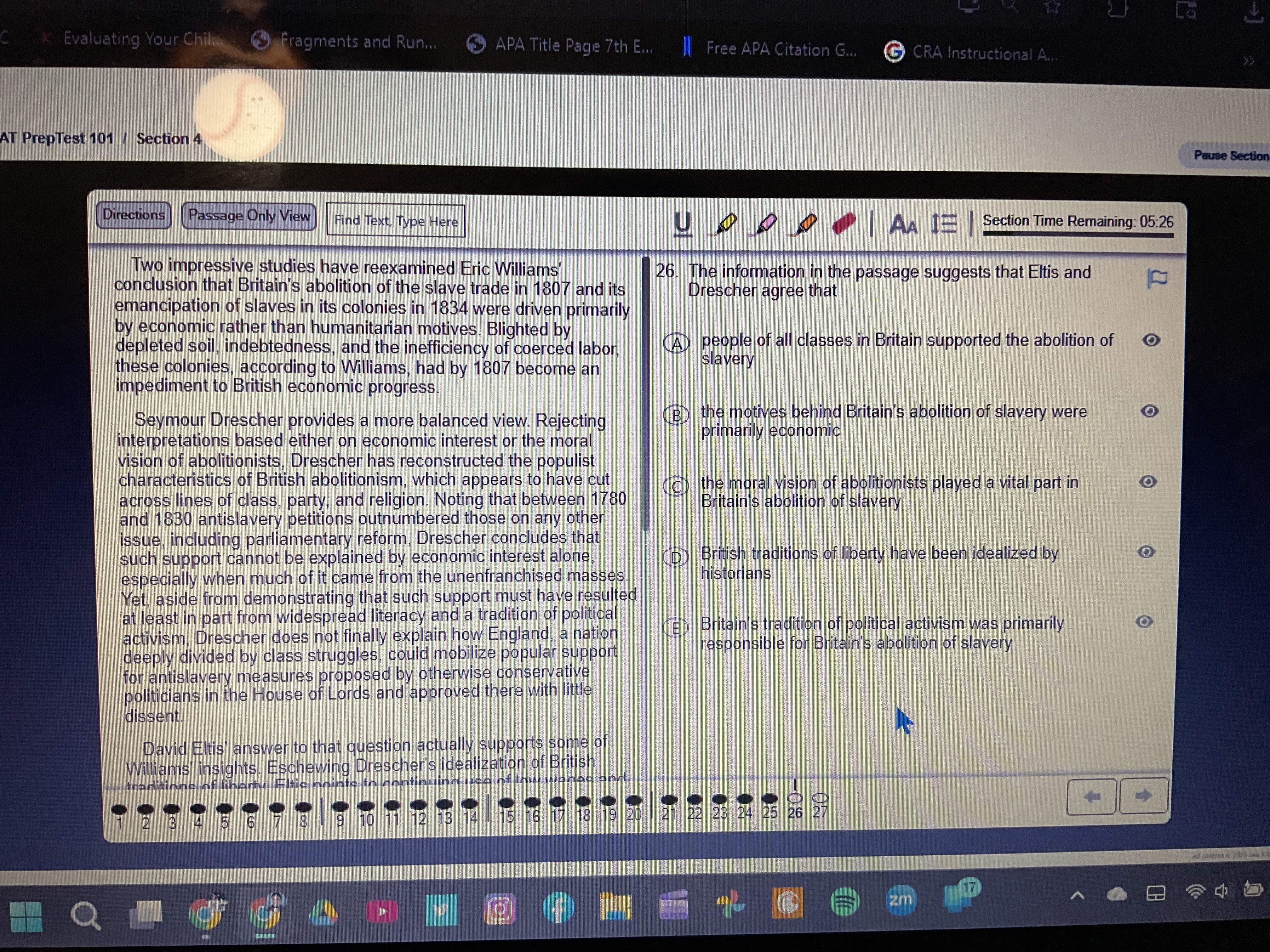 Evaluating Your Chile Fragments and Run... APA Title Page 7th E... | Free APA Citation G.. G CRA Instructional A.. AT PrepTest 101 / Section 4 Pause Section Directions Passage Only View Find Text. Type Here U DD . | AAI Section Time Remaining: 05:26 Two impressive studies have reexamined Eric Williams' 26. The information in the passage suggests that Eltis and conclusion that Britain's abolition of the slave trade in 1807 and its Drescher agree that emancipation of slaves in its colonies in 1834 were driven primarily by economic rather than humanitarian motives. Blighted by depleted soil, indebtedness, and the inefficiency of coerced labor, A people of all classes in Britain supported the abolition of O these colonies, according to Williams, had by 1807 become an slavery impediment to British economic progress. Seymour Drescher provides a more balanced view. Rejecting B the motives behind Britain's abolition of slavery were O interpretations based either on economic interest or the moral primarily economic vision of abolitionists, Drescher has reconstructed the populist characteristics of British abolitionism, which appears to have cut the moral vision of abolitionists played a vital part in O across lines of class, party, and religion. Noting that between 1780 Britain's abolition of slavery and 1830 antislavery petitions outnumbered those on any other issue, including parliamentary reform, Drescher concludes that such support cannot be explained by economic interest alone, D British traditions of liberty have been idealized by especially when much of it came from the unenfranchised masses. historians Yet, aside from demonstrating that such support must have resulted at least in part from widespread literacy and a tradition of political activism, Drescher does not finally explain how England, a nation E Britain's tradition of political activism was primarily O deeply divided by class struggles, could mobilize popular support esponsible for Britain's abolition of slavery for antislavery measures proposed by otherwise conservative politicians in the House of Lords and approved there with little dissent. David Eltis answer to that question actually supports some of Williams insights. Eschewing Drescher's idealization of British traditione of libach, Fitie nainte to continuing area of low wanae and 30- 2 3 4 5 6 14 21 26 27 zm 17
Step by Step Solution
There are 3 Steps involved in it
1 Expert Approved Answer
Step: 1 Unlock

Question Has Been Solved by an Expert!
Get step-by-step solutions from verified subject matter experts
Step: 2 Unlock
Step: 3 Unlock
 Study Help