







Question: Lunch rush ~ A local restaurant is trying to optimize their scheduling of employee work shifts in a tight labor market. Management believes that their
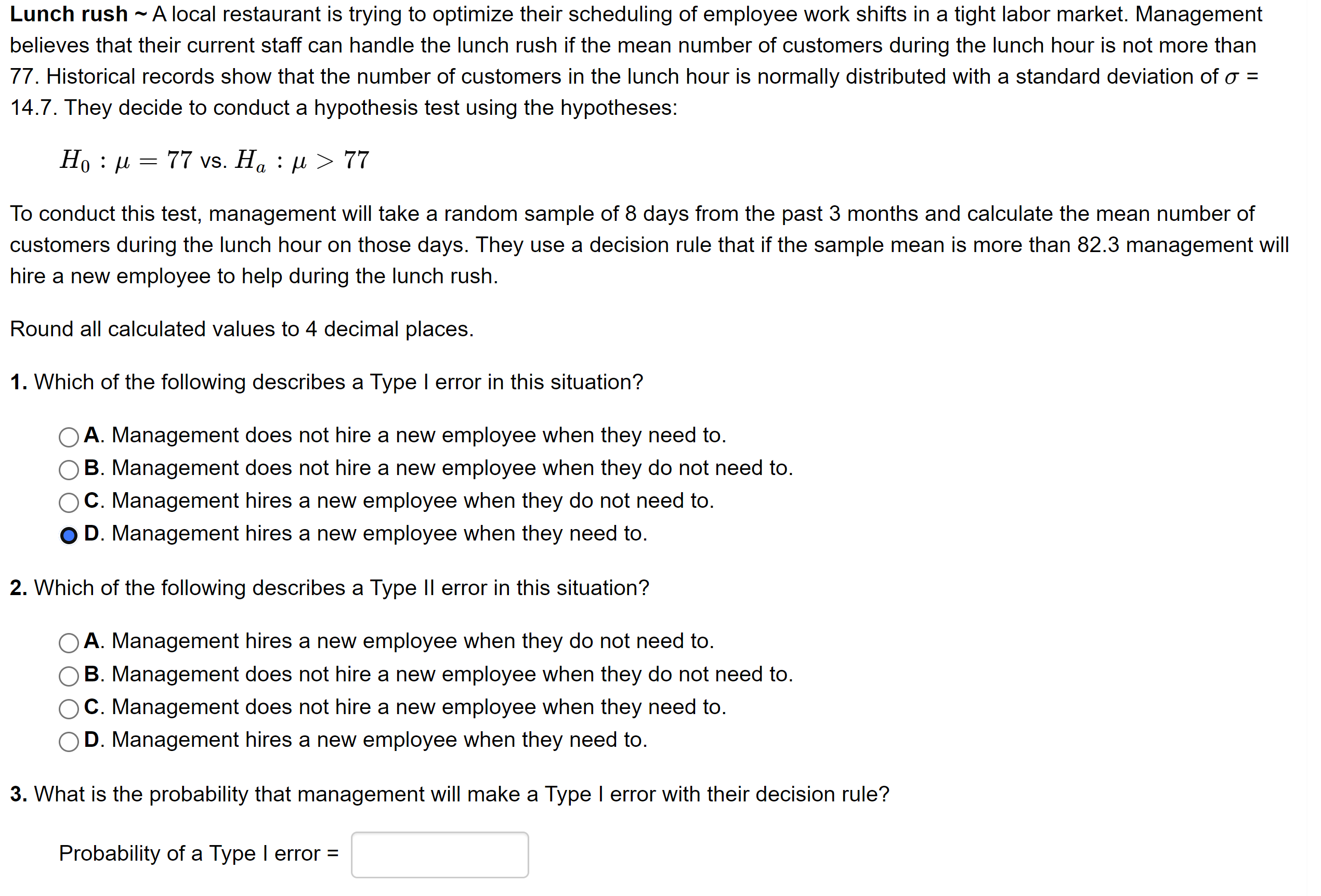

Lunch rush ~ A local restaurant is trying to optimize their scheduling of employee work shifts in a tight labor market. Management believes that their current staff can handle the lunch rush if the mean number of customers during the lunch hour is not more than 77. Historical records show that the number of customers in the lunch hour is normally distributed with a standard deviation of a = 14.7. They decide to conduct a hypothesis test using the hypotheses: H0:,u:77vs.I-Ia:u>77 To conduct this test, management will take a random sample of 8 days from the past 3 months and calculate the mean number of customers during the lunch hour on those days. They use a decision rule that if the sample mean is more than 82.3 management will hire a new employee to help during the lunch rush. Round all calculated values to 4 decimal places. 1. Which of the following describes a Type I error in this situation? QA. Management does not hire a new employee when they need to. Q B. Management does not hire a new employee when they do not need to. Q C. Management hires a new employee when they do not need to. 0 D. Management hires a new employee when they need to. 2. Which of the following describes a Type II error in this situation? QA. Management hires a new employee when they do not need to. Q B. Management does not hire a new employee when they do not need to. O C. Management does not hire a new employee when they need to. O D. Management hires a new employee when they need to. 3. What is the probability that management will make a Type I error with their decision rule? Probability of a Type I error = 4. Using their decision rule, what is the power of the hypothesis test if the mean number of customers during the lunch hour is actually 86.6? Power =
Step by Step Solution
There are 3 Steps involved in it

Get step-by-step solutions from verified subject matter experts
 Study Help