







Question: Luxor Technologies Case Study Between 1992 and 1996, Luxor Technologies had seen their business almost quadruple in the wireless communications area. Luxors success was attributed
Luxor Technologies Case Study
Between 1992 and 1996, Luxor Technologies had seen their business almost quadruple in the wireless communications area. Luxors success was attributed largely to the strength of its technical community, which was regarded as second to none. The technical community was paid very well and given the freedom to innovate. Even though Luxors revenue came from manufacturing, Luxor was regarded by Wall Street as being a technology-driven company. The majority of Luxors products were based upon low cost, high quality applications of the state- of-the-art technology, rather than advanced state-of-the-art technological breakthroughs. Applications engineering and process improvement were major strengths at Luxor. Luxor possessed patents in technology breakthrough, applications engineering, and even process improvement. Luxor refused to license their technology to other firms, even if the applicant was not a major competitor. Patent protection and design secrecy were of paramount importance to Luxor. In this regard, Luxor became vertically integrated, manufacturing and assembling all components of their products internally. Only off-the-shelf components were purchased. Luxor believed that if they were to use outside vendors for sensitive component procurement, they would have to release critical and proprietary data to the vendors. Since these vendors most likely also serviced Luxors competitors, Luxor maintained the approach of vertical integration to maintain secrecy. Being the market leader technically afforded Luxor certain luxuries. Luxor saw no need for expertise in technical risk management. In cases where the technic community was only able to achieve 7580 percent of the desired specification limit, the product was released as it stood, accompanied by an announcement that there would be an upgrade the following year to achieve the remaining 2025 percent of the specification limit, together with other features. Enhancements and upgrades were made on a yearly basis. By the fall of 1996, however, Luxors fortunes were diminishing. The competition was catching up quickly, thanks to major technological breakthroughs. Marketing estimated that by 1998, Luxor would be a follower rather than a market leader. Luxor realized that something
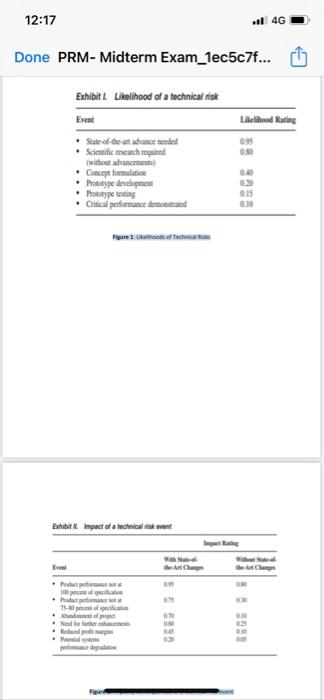
must be done, and quickly. In January 1999, Luxor hired an expert in risk analysis and risk management to help Luxor assess the potential damage to the firm and to assist in development of a mitigation plan. The consultant reviewed project histories and lessons learned on all projects undertaken from 1992 through 1998. The consultant concluded that the major risk to Luxor would be the technical risk and prepared Exhibits I and II (see Figures 1&2). Exhibit I shows the likelihood of a technical risk event occurring. The consultant identified the six most common technical risk events that could occur at Luxor over the next several years, based upon the extrapolation of past and present data into the future. Exhibit II shows the impact/consequences that a technical risk event could have on each project. Because of the high probability/likelihood of state-of-the-art advancements needed in the future (i.e., 95 percent from Exhibit I), the consultant identified the impact/ consequences in Exhibit II for both with and without state-of-the-art advancement needed. Exhibits I and II confirmed managements fear that Luxor was in trouble. A strategic decision had to be made concerning the technical risks identified in Exhibit I, specifically the first two risks. The competition had caught up to Luxor in applications engineering and was now surpassing Luxor in patents involving state-of-the-art advancements. From 1992 to 1998, time was considered as a luxury for the technical community at Luxor. Now time was a serious constraint. The strategic decision facing management was whether Luxor should struggle to remain a technical leader in wireless communications technology or simply console itself with a future as a follower. Marketing was given the task of determining the potential impact of a change in strategy from a market leader to a market follower. The following list was prepared and presented to management by marketing:
1. The companys future growth rate will be limited.
2. Luxor will still remain strong in applications engineering but will need to outsource state-of-the-art development work.
3. Luxor will be required to provide outside vendors with proprietary information. 4. Luxor may no longer be vertically integrated (i.e., have backward integration). 5. Final product costs may be heavily influenced by the costs of subcontractors.
6. Luxor may not be able to remain a low cost supplier.
7. Layoffs will be inevitable, but perhaps not in the near term.
8. The marketing and selling of products may need to change.
9. Price-cutting by Luxors competitors could have a serious impact on Luxors future ability to survive. The list presented by marketing demonstrated that there was a serious threat to Luxors growth and even survival.
Engineering then prepared a list of alternative courses of action that would enable Luxor to maintain its technical leadership position:
1. Luxor could hire (away from the competition) more staff personnel with pure and applied R&D skills. This would be a costly effort.
2. Luxor could slowly retrain part of its existing labor force using existing, experienced R&D personnel to conduct the training.
3. Luxor could fund seminars and university courses on general R&D methods, as well as R&D methods for telecommunications projects. These programs were available locally.
4. Luxor could use tuition reimbursement funds to pay for distance learning courses (conducted over the Internet). These were full semester programs.
5. Luxor could outsource technical development.
6. Luxor could purchase or license technology from other firms, including competitors. This assumed that competitors would agree to this at a reasonable price.
7. Luxor could develop joint ventures/mergers with other companies, which, in turn, would probably require Luxor to disclose much of its proprietary knowledge. With marketings and engineerings lists before them, Luxors management had to decide which path would be best for the long term.
Figure 1: Likelihoods of Technical Risks
Figure 2: Impacts/Consequences of a technical risk event
Questions:
You are required to create a case report for Luxor Technology Case Study, by answering the following questions:
1. Write the problem statement of the case study?
2. What is/are the objective (s) of the risk assessment?
3. What is the risk assessment approach (risk analysis)?
4. Based on the scales against likelihoods and impacts/consequences, shown in Exhibit I&II. Illustrate the suitable range of CRITERIA of Context?
5. What type of Risk Identification tools or techniques the Luxor Company has used?
6. According to the prepared list of alternative courses actions by engineers, categorize the risk treatment options? (Hint: Lecture 10).
Step by Step Solution
There are 3 Steps involved in it
1 Expert Approved Answer
Step: 1 Unlock

Question Has Been Solved by an Expert!
Get step-by-step solutions from verified subject matter experts
Step: 2 Unlock
Step: 3 Unlock
 Study Help