







Question: m U.S. Customs and Border Protection has been testing automated kiosks that may be able to detect lies (www.wired.com/threatlevel/2013/01/ff-lie-detector/all/). One measurement used (among several) is
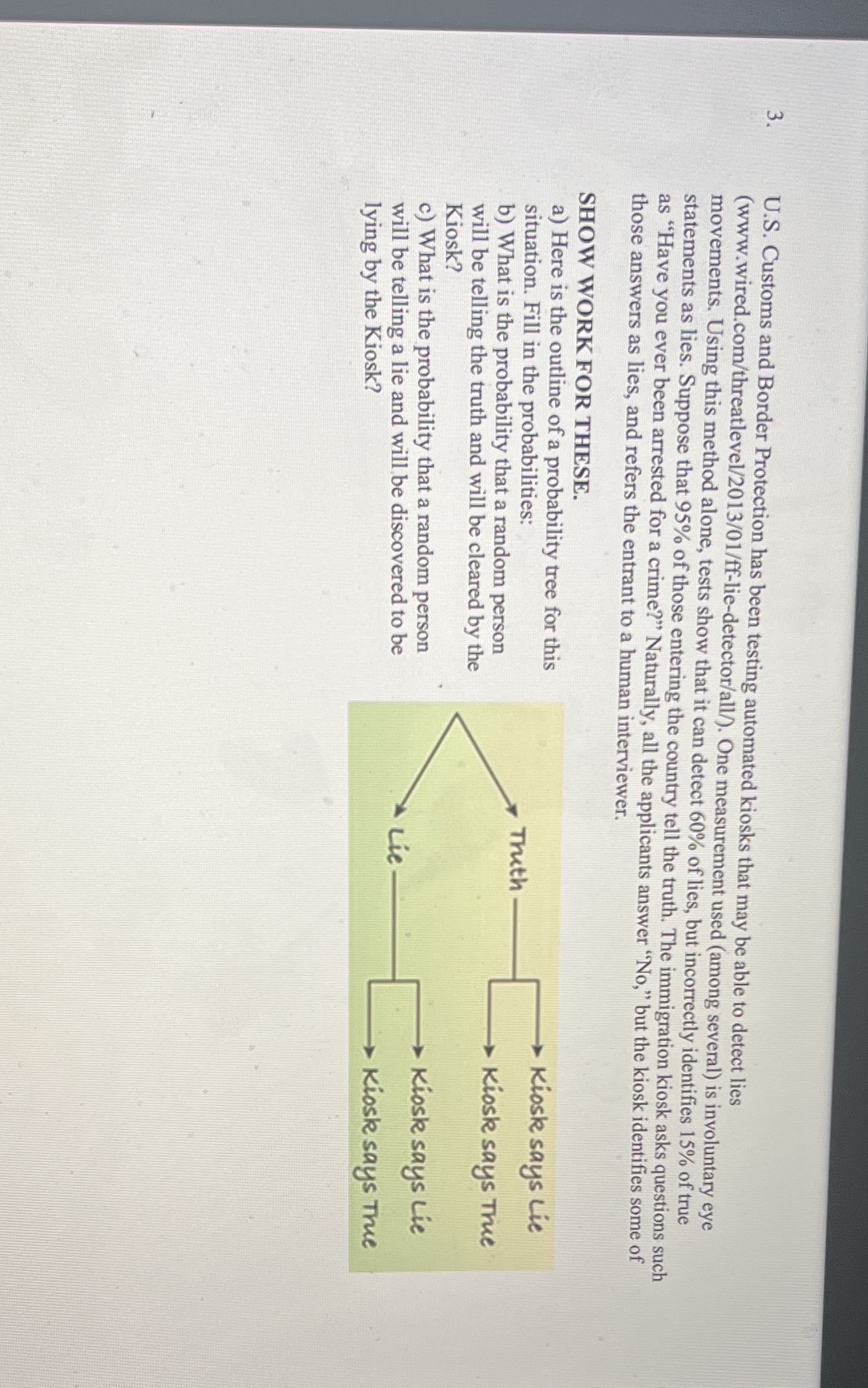
m U.S. Customs and Border Protection has been testing automated kiosks that may be able to detect lies (www.wired.com/threatlevel/2013/01/ff-lie-detector/all/). One measurement used (among several) is involuntary eye movements. Using this method alone, tests show that it can detect 60% of lies, but incorrectly identifies 15% of true statements as lies. Suppose that 95% of those entering the country tell the truth. The immigration kiosk asks questions such as "Have you ever been arrested for a crime?" Naturally, all the applicants answer "No," but the kiosk identifies some of those answers as lies, and refers the entrant to a human interviewer. SHOW WORK FOR THESE. a) Here is the outline of a probability tree for this - Kiosk says Lie situation. Fill in the probabilities: Truth - b) What is the probability that a random person - Kiosk says True will be telling the truth and will be cleared by the Kiosk? c) What is the probability that a random person - Kiosk says Lie will be telling a lie and will be discovered to be Lie lying by the Kiosk? Kiosk says True
Step by Step Solution
There are 3 Steps involved in it

Get step-by-step solutions from verified subject matter experts
 Study Help