







Question: MA LAB 8 2. Let C be the curve (oriented in the counterclockwise direction) which is the boundary of the of the square, whose
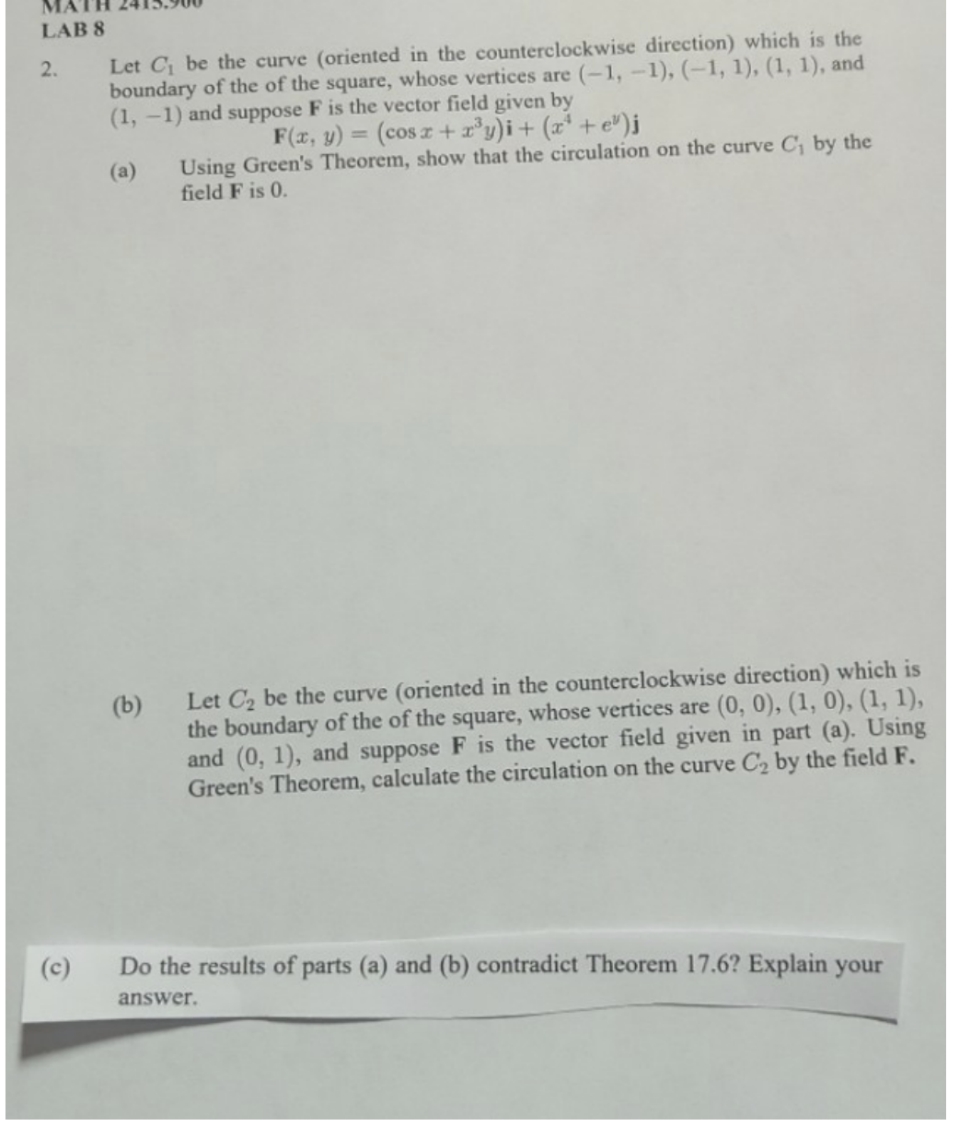
MA LAB 8 2. Let C be the curve (oriented in the counterclockwise direction) which is the boundary of the of the square, whose vertices are (-1, -1), (-1, 1), (1, 1), and (1,-1) and suppose F is the vector field given by (a) F(x, y) = (cosz + y)i+ (z +e")j Using Green's Theorem, show that the circulation on the curve C by the field F is 0. (b) Let C be the curve (oriented in the counterclockwise direction) which is the boundary of the of the square, whose vertices are (0, 0), (1, 0), (1, 1), and (0, 1), and suppose F is the vector field given in part (a). Using Green's Theorem, calculate the circulation on the curve C by the field F. Do the results of parts (a) and (b) contradict Theorem 17.6? Explain your answer.
Step by Step Solution
There are 3 Steps involved in it

Get step-by-step solutions from verified subject matter experts
 Study Help