



Question: Macroeconomics 1. Consider the life-cycle model discussed in Lecture 3-5. Now suppose that each member of each generation chooses how much labour to supply when
Macroeconomics
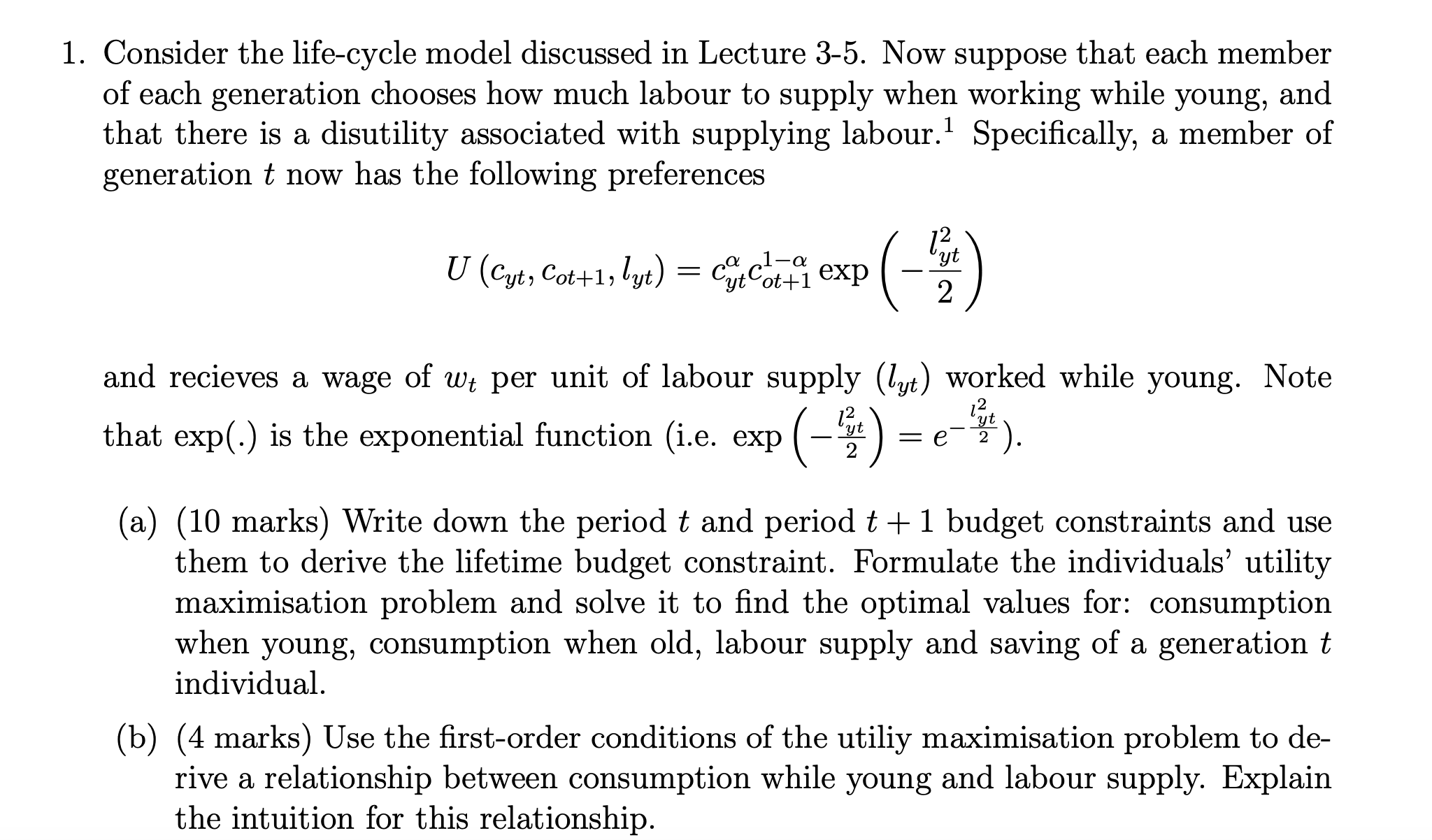
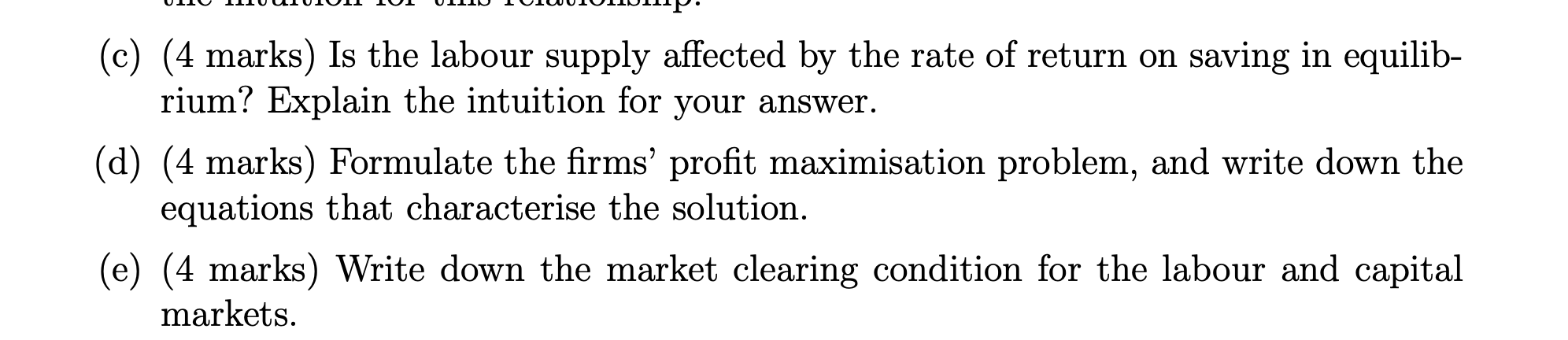

1. Consider the life-cycle model discussed in Lecture 3-5. Now suppose that each member of each generation chooses how much labour to supply when working while young, and that there is a disutility associated with supplying labour.1 Specically, a member of generation t now has the following preferences l2 1 yt U (Cr/ta Cot+lv lyt) = Cgtcot exp ( 2 and recieves a wage of wt per unit of labour supply (lyt) worked while young. Note that exp(.) is the exponential function (i.e. exp (i*) = e' 2 ). (a) (10 marks) Write down the period t and period t+ 1 budget constraints and use them to derive the lifetime budget constraint. Formulate the individuals' utility maximisation problem and solve it to nd the optimal values for: consumption when young, consumption when old, labour supply and saving of a generation t individual. (b) (4 marks) Use the rstorder conditions of the utiliy maximisation problem to de rive a relationship between consumption while young and labour supply. Explain the intuition for this relationship. (c) (4 marks) Is the labour supply affected by the rate of return on saving in equilib rium? Explain the intuition for your answer. (d) (4 marks) Formulate the firms' profit maximisation problem, and write down the equations that characterise the solution. (e) (4 marks) Write down the market clearing condition for the labour and capital markets.(f) (4 marks) Combine the equations obtained in (a)-(e) to find the transition equa- tion that describes how kt = 4 evolves over time
Step by Step Solution
There are 3 Steps involved in it

Get step-by-step solutions from verified subject matter experts