







Question: You saw in class that the standard algorithm to INCREMENT a binary counter runs in 0(1) amortized time. Now suppose we also want to
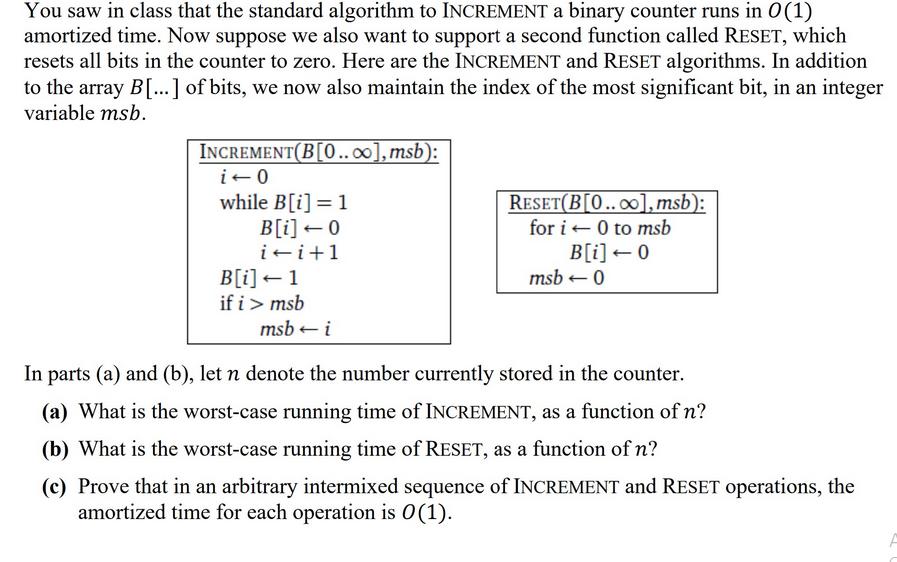
You saw in class that the standard algorithm to INCREMENT a binary counter runs in 0(1) amortized time. Now suppose we also want to support a second function called RESET, which resets all bits in the counter to zero. Here are the INCREMENT and RESET algorithms. In addition to the array B[...] of bits, we now also maintain the index of the most significant bit, in an integer variable msb. INCREMENT(B[0..], msb): i-0 while B[i] = 1 B[i] - 0 ii+1 B[i] - 1 if i > msb msb-i RESET(B[0..],msb): for i - 0 to msb B[i] - 0 msb-0 In parts (a) and (b), let n denote the number currently stored in the counter. (a) What is the worst-case running time of INCREMENT, as a function of n? (b) What is the worst-case running time of RESET, as a function of n? (c) Prove that in an arbitrary intermixed sequence of INCREMENT and RESET operations, the amortized time for each operation is 0(1).
Step by Step Solution
There are 3 Steps involved in it
Step 1 a The INCREMENT algorithm has a worstcase running time of On where n is the number currently recorded in the counter Explanation If the number ... View full answer

Get step-by-step solutions from verified subject matter experts
 Study Help