


Question: major axis of the ellipsoid whose surface passes through P. Because of 9 =90 - B, we may equivalently write x = Vu2 + E2
major axis of the ellipsoid whose surface passes
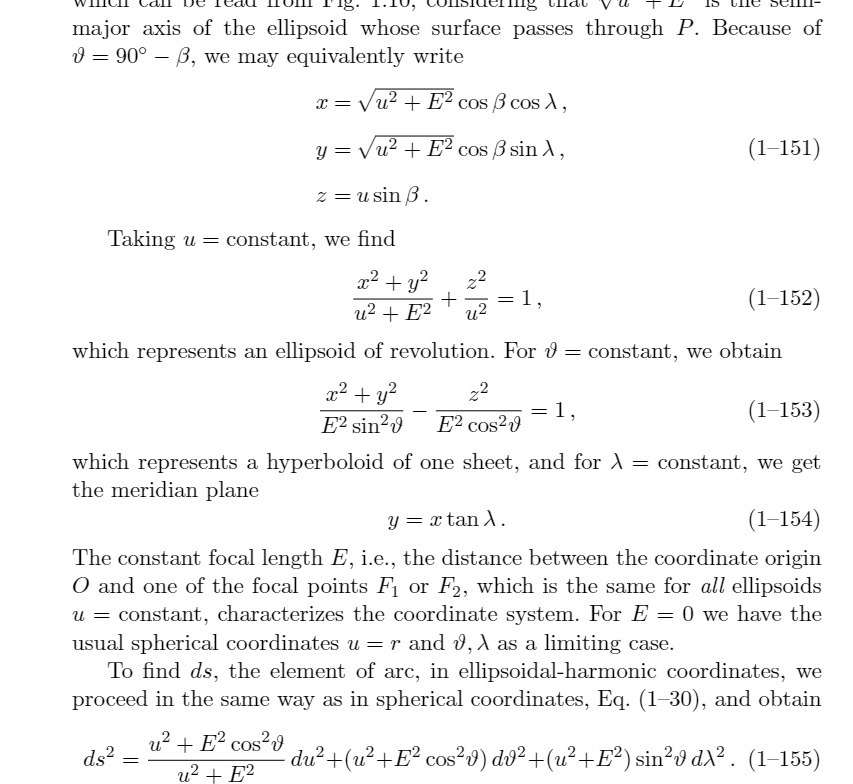
major axis of the ellipsoid whose surface passes through P. Because of 9 =90 - B, we may equivalently write x = Vu2 + E2 cos B cos ), y = vu2 + E2 cos B sin ), (1-151) z = usin 3. Taking u = constant, we find 22 u2 + E2 + = 1, (1-152) which represents an ellipsoid of revolution. For v = constant, we obtain x2 + 92 22 E2 sin29 E2 cos2, = 1, (1-153) which represents a hyperboloid of one sheet, and for A = constant, we get the meridian plane y = xtan 1. (1-154) The constant focal length E, i.e., the distance between the coordinate origin O and one of the focal points F1 or F2, which is the same for all ellipsoids u = constant, characterizes the coordinate system. For E = 0 we have the usual spherical coordinates u = r and v, A as a limiting case. To find ds, the element of arc, in ellipsoidal-harmonic coordinates, we proceed in the same way as in spherical coordinates, Eq. (1-30), and obtain ds2- u2 + Ez cos20 u2+ E2 du2+(u2+ E2 cos29) do2 + (u2+ E2) sin2 dx2. (1-155)

Step by Step Solution

There are 3 Steps involved in it

1 Expert Approved Answer
Step: 1 Unlock blur-text-image

Question Has Been Solved by an Expert!

Get step-by-step solutions from verified subject matter experts

Step: 2 Unlock
Step: 3 Unlock

Students Have Also Explored These Related Mathematics Questions!