Question: Make a 3 paragraph post according to what is ask. Paragraph 1 should give a brief background of the Diagnostic Model, star model to ensure
Make a 3 paragraph post according to what is ask.
Paragraph 1 should give a brief background of the Diagnostic Model, star model to ensure the reader understands the context.
Paragraph 2 should address the story surfacing assumptions about change given in the picture. Give a brief background of the story, to understands the context.
Paragraph 3 should address how you would use the Diagnostic model star model to diagnose the problem, and determine what to change.
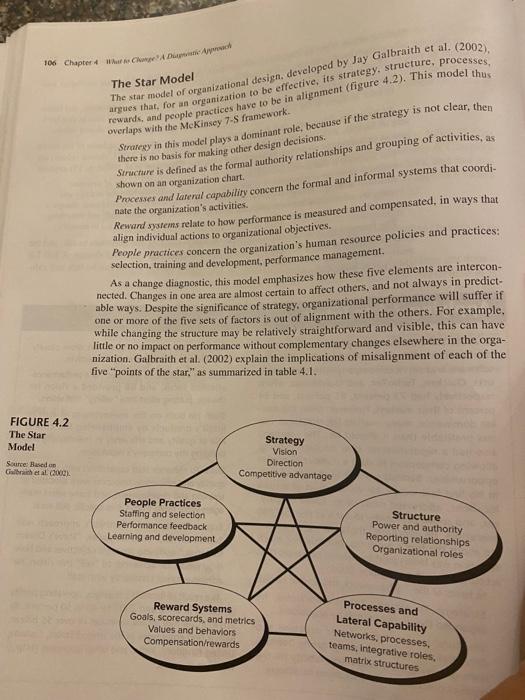
106 Chapter II Auf CDA The Star Model The star model of organizational design, developed by Jay Galbraith et al. (2002), argues that for an organization to be effective, its strategy, structure, processes, rewards, and people practices have to be in alignment (figure 4.2). This model thus overlaps with the McKinsey 7-S framework Strategy in this model plays a dominant role, because if the strategy is not clear, then there is no basis for making other design decisions. Structure is defined as the formal authority relationships and grouping of activities, as shown on an organization chart. Processes and lateral capability concern the formal and informal systems that coordi- nate the organization's activities. align individual actions to organizational objectives. Roward systems relate to how performance is measured and compensated, in ways that People practices concern the organization's human resource policies and practices: selection, training and development, performance management. As a change diagnostic, this model emphasizes how these five elements are intercon- nected. Changes in one area are almost certain to affect others, and not always in predict- able ways. Despite the significance of strategy, organizational performance will suffer if one or more of the five sets of factors is out of alignment with the others. For example, while changing the structure may be relatively straightforward and visible, this can have little or no impact on performance without complementary changes elsewhere in the orga- nization. Galbraith et al. (2002) explain the implications of misalignment of each of the five "points of the star," as summarized in table 4.1. FIGURE 4.2 The Star Model Strategy Vision Direction Competitive advantage Source Based on Galbraith et al. (2000) People Practices Staffing and selection Performance feedback Learning and development Structure Power and authority Reporting relationships Organizational roles Reward Systems Goals, scorecards, and metrics Values and behaviors Compensation/rewards Processes and Lateral Capability Networks, processes. teams, integrative roles. matrix structures Surfacing Assumptions about Change The six-images framework guides us in reflecting on the images and assumptions we hold about managing change. As we noted at the start of this chapter, we all have mental models and these help us to simplify and to make sense of the complex organizational worlds in which we operate. At the same time as they simplify and illuminate, they turn our attention toward some things and away from others. Being aware of the mental models with which we work helps us think more carefully about their relevance-and the extent to which the assumptions they entail are really ones that are going to be of assistance to us in approaching organizational change. Being aware of these images enables change managers to assess the assumptions that are being made by others with whom they are working or interacting or from whom they are taking advice. Resulting from this assessment may be actions to reorient the images others have of the particular change in which they are involved by providing new images through which the change can be seen. For example, a change manager working with a navigator image may get others, who may view change through a director image, to acknowledge that unanticipated outcomes may occur as change unfolds. The navigator may persuade others to accept that one pos- sibility of engaging in a change is that their current view of what is desired at the end may shift as the process unfolds and new possibilities emerge. In this sense, awareness of differing change management images can lead to an educational process within a change team. It requires encouragement of conversations around images and assumptions about the anticipated change, testing these with the group, and ensuring that all members of the team share common change image(s). This ensures that individual change managers are not talking past one another and making assumptions that are not shared by others. Channa









 Study Help