



Question: Make a 3 paragraph post that addresses the following. The first paragraph should explain the concept Technology-Based Training Methods in detail and should include at
Make a 3 paragraph post that addresses the following.
The first paragraph should explain the concept Technology-Based Training Methods in detail and should include at least two quotes.
The second paragraph discusses current a current example or examples in significant depth.
The third paragraph explores future application of your selected concept for both you as an individual business professional as well as any other element of the business environment.
Using Technology for Training Pays Off for PayPalPayPals digital payment platform gives its over 200 million active account holders in markets around the world the confidence to connect and transact in new waysonline, on mobile devices, using an app, or in person. Using technological inno-vation and strategic partnerships, PayPal has created better ways to manage and move money and offers choice and flexibility when sending payments, paying, or getting paid around the world. The PayPal platform, which includes Braintree, Venmo, and Xoom, allows consumers and businesses to receive money, withdraw funds, and hold balances in many different monetary currencies. Although PayPal is considered a state-of-the art payment service when it comes to using technology to digitize how we pay for products and services, it was not considered cutting edge in its use of technology for training. However, that has changed as PayPal Learning has infused learning technology into its employee training programs. PayPal decided to incorporate social media into its training because it is easy to use and its over 5,000 employees are familiar with it. PayPal created a private Facebook group where employees can connect with each other and it invited experts to ask questions and gain (and share) knowledge. PayPal also encourages workers to use Twitters video service to watch short training modules. PayPal pro-vides employees with access to Udemy for Business, a supplier of massive open online courses (MOOC). Employees can access 1,600 courses on a variety of topics and have complete control over when to complete them. They can bookmark important tutorials or save lectures for future reference.As a result of incorporating technology into its training, PayPal has found that the number of employees who complete two training courses every six months (referred to as active learners) has doubled. Also, the company has realized a 25percent savings in training costs.
INTRODUCTION As the opening vignette illustrates, technology is having a major influence on how training is delivered. PayPal is using technology-based training methods to provide a learning envi-ronment that offers benefits similar to well-designed face-to-face instruction (practice, feed-back, learner involvement) but overcomes the cost and time challenges related to trying to bring employees together in one physical location for training. Online learning provides trainees with access to training at any time and place. The effective development and use of technology for delivering training such as online learning requires collaboration among the areas of training, information technology, and top management. In addition, needs assessment, design, transfer, and evaluation (training design) are critical components of the effective use of technology-based training. Although technologies such as social media, tablet computers, and virtual reality provide exciting capabilities and possibilities, it is criti-cal that companies use training technologies that support both business and learner needs.PayPal is not alone in adopting new training technologies. Due to job demands, employ-ees often dont have the time to find or attend classes and small companies have diffi-culty funding formal off-site training courses.1 Technology can help give employees access to learning on the job when they need it. For example, employees can be given access to portals that recommend courses and show what other employees in their business func-tion are using for learning. Vendors such as Lynda.com, Skillsoft, and Grovo provide the opportunity for employees to pinpoint courses that will advance their skill in a specific area of expertise. Short training modules for machine maintenance, manufacturing pro-cesses, or safety are available that take 15 minutes or less to complete and include activi-ties built in to employees schedules to apply what they have learned. Also, technologies such as artificial intelligence and augmented reality can provide employees with on-the-job performance support. noe43746_ch08_338-395.indd340 12/11/18 08:27 AMAs we discussed in Chapter Seven, Traditional Training Methods, instructor-led class-room training is still the most popular training method. However, the use of technology for training delivery and instruction is increasing and anticipated to grow in the future. Table 8.1 provides a snapshot of the use of new technology in training. The use of training technolo-gies is expected to increase dramatically in the next decade as technology improves; the cost of technology decreases; companies recognize the potential cost savings of training via tablets, mobile phones, and social media; and the need for customized training increases.2 As you will see later in this chapter, new training technologies are unlikely to totally replace face-to-face instruction. Rather, face-to-face instruction will be combined with new training technologies (a combination known as blended learning) to maximize learning.The development, availability, and use of social media such as Twitter and Facebook have the potential to significantly influence training and learning. These tools are used by many people in their daily lives, especially the millennial generation. Many companies are using these tools for recruiting new employees and marketing and developing products and services. These tools are also increasingly being used for learning. Social media tools reshape learning by giving employees access to and control of their own learning through relationships and collaborations with others. Social media tools, including shared work-spaces, social networks, wikis, blogs, podcasts, and microblogs, are being used for learning. Shared workspaces, social networks, and wikis are the most commonly used social media for learning.3There appear to be generational differences in using and realizing the potential benefits of social media tools. Generation Zers and millennials believe that social media tools are helpful for learning and getting work done, and they use those tools to a greater extent than baby boomers or Generation Xers. Because Generation Zers and millennials are more likely to use social media tools in their personal lives, they are perhaps more comfortable using them at work. This chapter begins by discussing the influence of new technology on training delivery, support, and administration. How technology has changed the learning environment also is addressed. Next, the chapter explores computer-based training, online learning, and e-learning. E-learning emphasizes learning through interaction with training content, sharing with other trainees, and using Internet resources. The use of technologies, including social media, tablets such as iPads, and mobile smartphones, for training delivery and instruction are introduced. Next, the use of expert systems, intelligent tutoring systems, artificial intelligence, and augmented reality as training methods and for on-the-job performance support is discussed. The chapter also shows how learning management systems aid in the delivery and administration of training programs. The last section of the chapter compares the various training methods that are based on new technology. A blended learning approach combining traditional face-to-face and technology-based training methods may be the best way to capitalize on the strengths of available training methods.
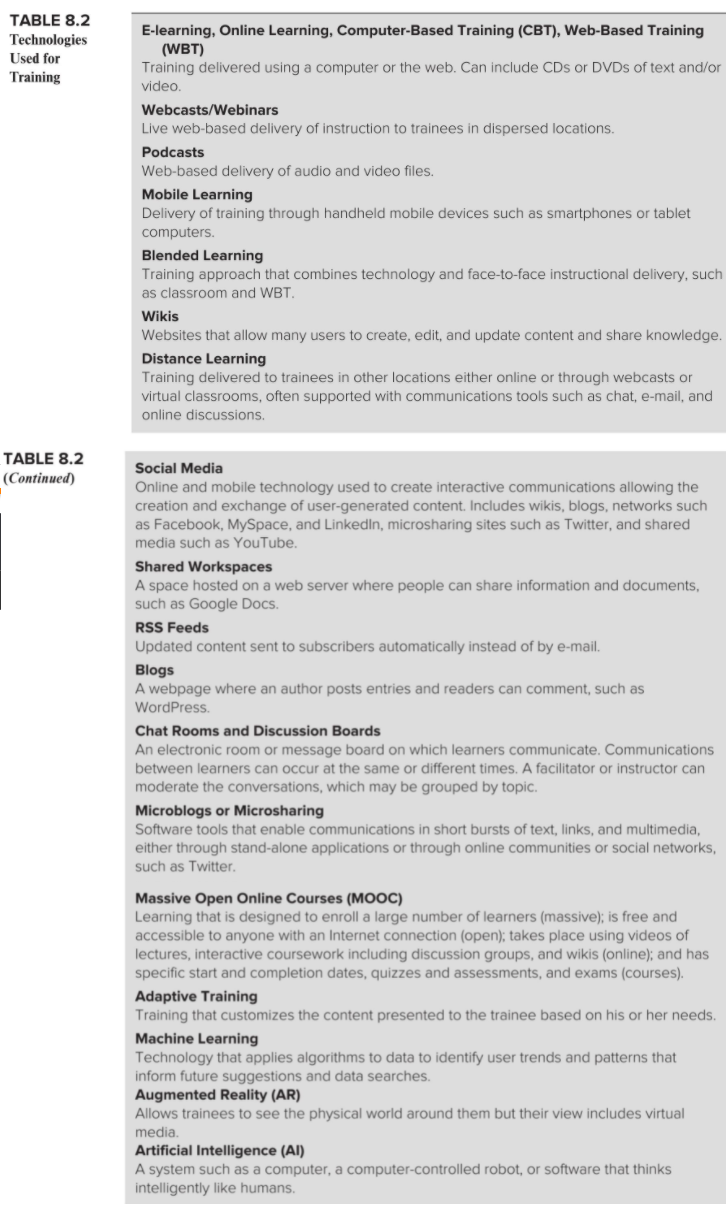
TECHNOLOGYS INFLUENCE ON TRAINING AND LEARNING For training to help a company gain a competitive advantage, it needs to sup-port business goals and be delivered as needed to geographically dispersed employees who may be working at home or in another country. Training costs (such as travel costs) should be minimized and maximum benefits gained, including learning and transfer of training. For learning and transfer to occur (i.e., for the benefits of training to be realized), the train-ing environment must include learning principles such as practice, feedback, meaningful material, and the ability to learn by interacting with others.New technologies have made it possible to reduce the costs associated with delivering training to employees, increase the effectiveness of the learning environment, and ensure that training contributes to business goals. Table 8.2 lists, describes, and provides examples of some of the new technology training methods discussed in this chapter. New technologies have influenced the delivery of training, training administration, and training support. Technology has made several benefits possible:4 Employees can gain control over when and where they receive training. Employees can access knowledge and expert systems on an as-needed basis. Through the use of avatars, virtual reality, and simulations, the learning environment can look, feel, and sound just like the work environment. Employees can choose the type of media (print, sound, video, etc.) that they want to use in a training program. Course enrollment, testing, and training records can be handled electronically, reducing the paperwork and time needed for administrative activities. Employees accomplishments during training can be monitored. Traditional training methods, such as classroom instruction and behavior modeling, can be delivered to trainees rather than requiring them to come to a central training location.Three of the most important ways that technology has influenced training and learning are: (1) it provides for greater collaboration, (2) it creates a more dynamic learning envi-ronment, and (3) it enhances learner control. Technology Facilitates Collaboration Technology allows digital collaboration to occur. Digital collaboration is the use of technol-ogy to enhance and extend employees abilities to work together regardless of their geo-graphic proximity.6 Digital collaboration includes electronic messaging systems; electronic meeting systems; online communities of learning organized by subject, where employees can access interactive discussion areas and share training content and web links; social networks; and document-handling systems with collaboration technologies that allow interpersonal interaction. Digital collaboration requires a computer, tablet, or phone with a web browser or app, and communication among users can be either synchronous or asynchronous.7 In synchronous communication, trainers, experts, and learners interact with each other live and in real time, the same way they would in face-to-face classroom instruc-tion. Technologies such as video teleconferencing and live online courses (virtual class-rooms) make synchronous communication possible. Asynchronous communication refers to non-real-time interactions. That is, persons are not online and cannot communicate with each other without a time delay, but learners can still access information resources when they desire them. E-mail, self-paced courses on the web or on CD-ROM, discussion groups, and virtual libraries allow asynchronous communication.
Step by Step Solution
There are 3 Steps involved in it

Get step-by-step solutions from verified subject matter experts