







Question: make sure answers are correct and show work please Question 1) The following gives the number of pints of type B blood used at Woodlawn
make sure answers are correct and show work please 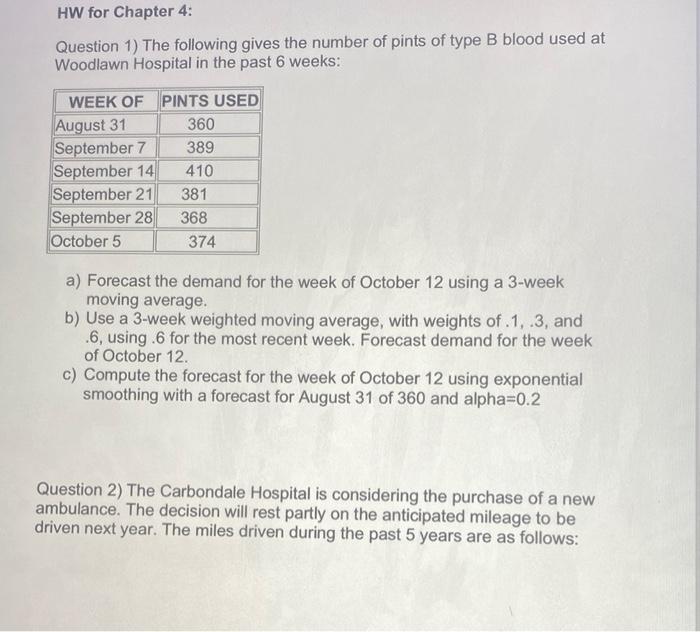
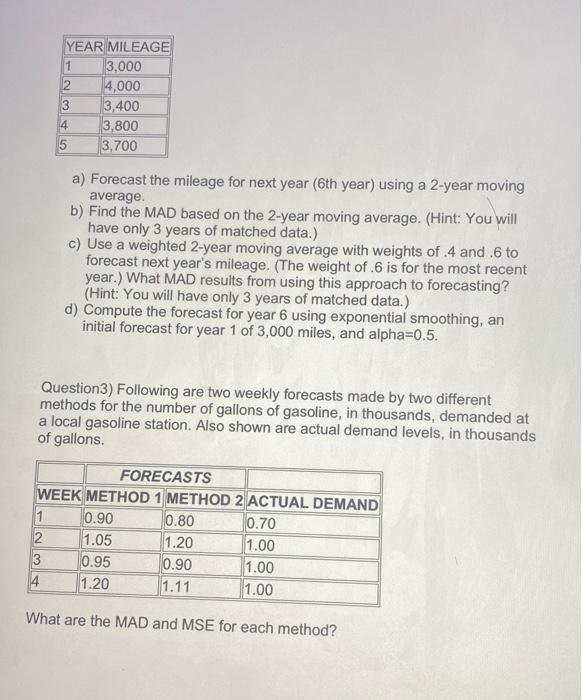
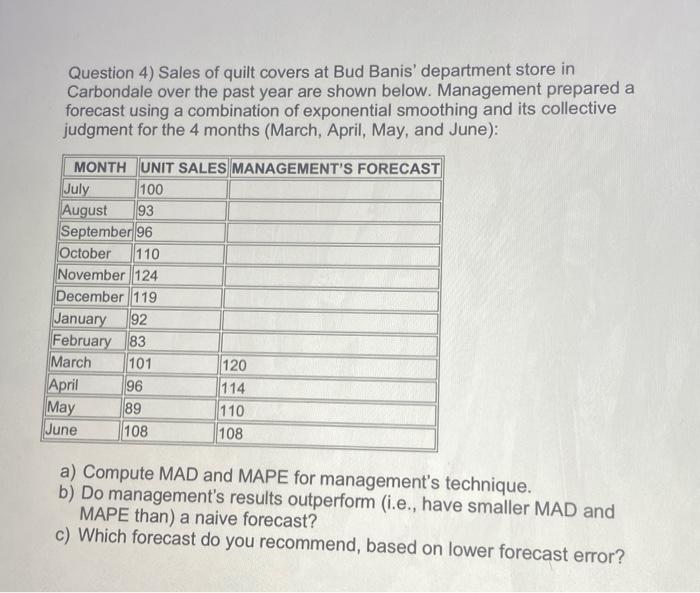
Question 1) The following gives the number of pints of type B blood used at Woodlawn Hospital in the past 6 weeks: a) Forecast the demand for the week of October 12 using a 3-week moving average. b) Use a 3-week weighted moving average, with weights of . 1, .3, and .6, using .6 for the most recent week. Forecast demand for the week of October 12. c) Compute the forecast for the week of October 12 using exponential smoothing with a forecast for August 31 of 360 and alpha=0.2 Question 2) The Carbondale Hospital is considering the purchase of a new ambulance. The decision will rest partly on the anticipated mileage to be driven next year. The miles driven during the past 5 years are as follows: a) Forecast the mileage for next year (6th year) using a 2 -year moving average. b) Find the MAD based on the 2-year moving average. (Hint: You will have only 3 years of matched data.) c) Use a weighted 2-year moving average with weights of 4 and .6 to forecast next year's mileage. (The weight of 6 is for the most recent year.) What MAD results from using this approach to forecasting? (Hint: You will have only 3 years of matched data.) d) Compute the forecast for year 6 using exponential smoothing, an initial forecast for year 1 of 3,000 miles, and alpha=0.5. Question3) Following are two weekly forecasts made by two different methods for the number of gallons of gasoline, in thousands, demanded at a local gasoline station. Also shown are actual demand levels, in thousands of gallons. What are the MAD and MSE for each method? Question 4) Sales of quilt covers at Bud Banis' department store in Carbondale over the past year are shown below. Management prepared a forecast using a combination of exponential smoothing and its collective judgment for the 4 months (March, April, May, and June): a) Compute MAD and MAPE for management's technique. b) Do management's results outperform (i.e., have smaller MAD and MAPE than) a naive forecast? c) Which forecast do you recommend, based on lower forecast error
Step by Step Solution
There are 3 Steps involved in it
1 Expert Approved Answer
Step: 1 Unlock

Question Has Been Solved by an Expert!
Get step-by-step solutions from verified subject matter experts
Step: 2 Unlock
Step: 3 Unlock
 Study Help