



Question: Making changes to a firm's credit policy involves trade-offs. Assuming that all other factors remain constant, which of the following are outcomes expected to result
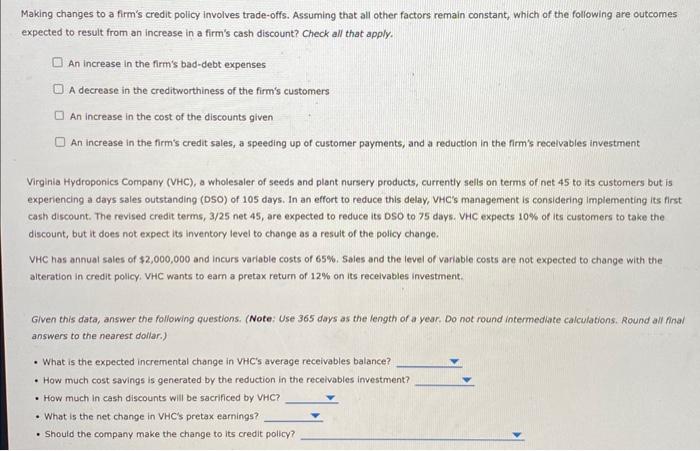
Making changes to a firm's credit policy involves trade-offs. Assuming that all other factors remain constant, which of the following are outcomes expected to result from an increase in a firm's cash discount? Check all that apply. An increase in the firm's bad-debt expenses A decrease in the creditworthiness of the firm's customers An increase in the cost of the discounts given An increase in the firm's credit sales, a speeding up of customer payments, and a reduction in the firm's recelvables investment Virginia Hydroponics Company (VHC), a wholesaler of seeds and plant nursery products, currently sells on terms of net 45 to its customers but is experiencing a days sales outstanding (DSO) of 105 days. In an effort to reduce this delay, VHC's management is considering implementing its first cash discount. The revised credit terms, 3/25 net 45 , are expected to reduce its DSO to 75 days. VHC expects 10% of its customers to take the discount, but it does not expect its inventory level to change as a result of the policy change. VHC has annual sales of $2,000,000 and incurs variable costs of 65%. Sales and the level of variable costs are not expected to change with the aiteration in credit policy. VHC wants to eam a pretax return of 12% on its receivables investment. Given this data, answer the following questions. (Note: Use 365 days as the length of a year. Do not round intermediate calculations. Round all final answers to the nearest dollar.) - What is the expected incremental change in VHC's average receivables balance? - How much cost savings is generated by the reduction in the recelvables imvestment? - How much in cash discounts will be sacrificed by VHC? - What is the net change in VHC's pretax earnings
Step by Step Solution
There are 3 Steps involved in it

Get step-by-step solutions from verified subject matter experts