Question: Management in Action Chapter 11. Please answer application of chapter content 1-5. the snapshot of the questions WAS uploaded 4. How do you distinguish values
Management in Action Chapter 11. Please answer application of chapter content 1-5.
the snapshot of the questions WAS uploaded
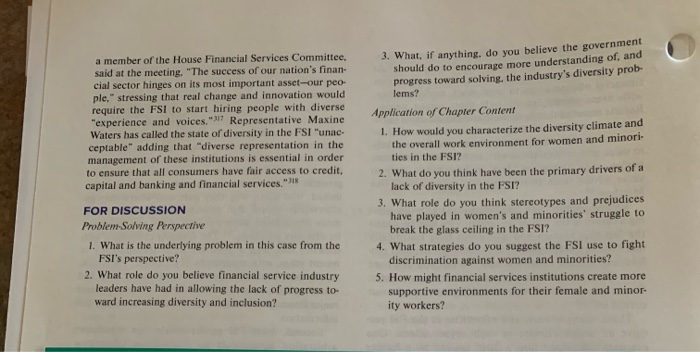
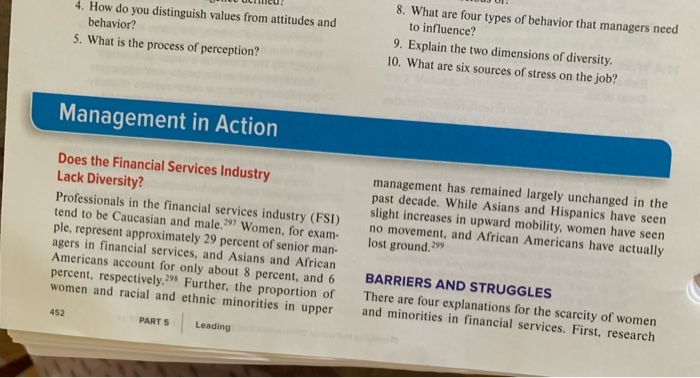
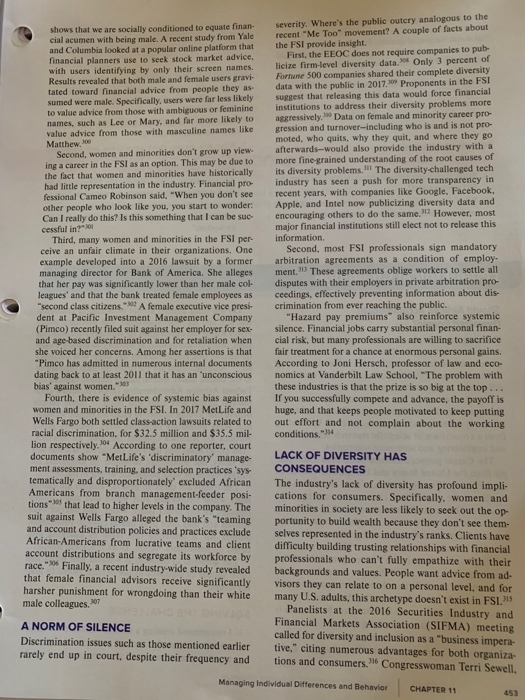
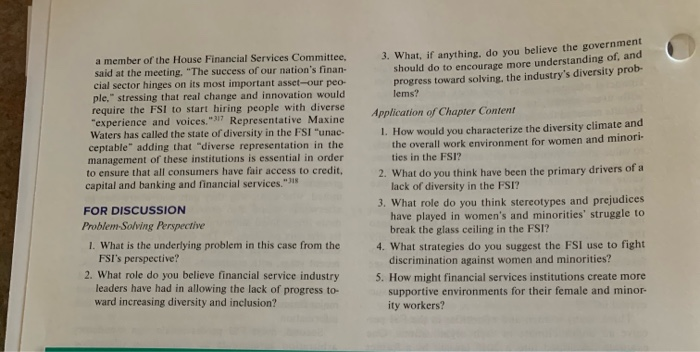
4. How do you distinguish values from attitudes and behavior? 5. What is the process of perception? 8. What are four types of behavior that managers need to influence? 9. Explain the two dimensions of diversity. 10. What are six sources of stress on the job? Management in Action Does the Financial Services Industry Lack Diversity? Professionals in the financial services industry (FSI) tend to be Caucasian and male.?? Women, for exam. ple, represent approximately 29 percent of senior man agers in financial services, and Asians and African Americans account for only about 8 percent, and 6 percent, respectively,2" Further, the proportion of women and racial and ethnic minorities in upper management has remained largely unchanged in the past decade. While Asians and Hispanics have seen slight increases in upward mobility, women have seen no movement, and African Americans have actually lost ground. 299 BARRIERS AND STRUGGLES There are four explanations for the scarcity of women and minorities in financial services. First, research 452 PART 5 Leading shows that we are socially conditioned to equate finan severity. Where's the public outcry analogous to the cial acumen with being male. A recent study from Yale recent "Me Too" movement? A couple of facts about the FSI provide insight. and Columbia looked at a popular online platform that First, the EEOC does not require companies to pub- financial planners use to seek stock market advice. with users identifying by only their screen names licize firm-level diversity data. Only 3 percent of Results revealed that both male and female users gravi Fortune 500 companies shared their complete diversity tated toward financial advice from people they as data with the public in 2017.10 Proponents in the FSI suggest that releasing this data would force financial sumed were male. Specifically, users were far less likely institutions to address their diversity problems more to value advice from those with ambiguous or feminine names, such as Lee or Mary, and far more likely to aggressively. Data on female and minority career pro- value advice from those with masculine names like gression and turnover-including who is and is not pro- Matthew 100 moted, who quits, why they quit, and where they go Second, women and minorities don't grow up view. afterwards-would also provide the industry with a ing a career in the FSI as an option. This may be due to more fine-grained understanding of the root causes of the fact that women and minorities have historically its diversity problems. The diversity-challenged tech had little representation in the industry. Financial pro industry has seen a push for more transparency in fessional Cameo Robinson said, "When you don't see recent years, with companies like Google, Facebook, other people who look like you, you start to wonder: Apple, and Intel now publicizing diversity data and Can I really do this? Is this something that I can be suo encouraging others to do the same. However, most cessful in major financial institutions still elect not to release this Third, many women and minorities in the FSI per information, ceive an unfair climate in their organizations. One Second, most FSI professionals sign mandatory example developed into a 2016 lawsuit by a former arbitration agreements as a condition of employ- managing director for Bank of America. She alleges ment. These agreements oblige workers to settle all that her pay was significantly lower than her male col disputes with their employers in private arbitration pro- leagues' and that the bank treated female employees as ceedings, effectively preventing information about dis- "second class citizens. A female executive vice presi crimination from ever reaching the public. dent at Pacific Investment Management Company "Hazard pay premiums also reinforce systemic (Pimco) recently filed suit against her employer for sex silence. Financial jobs carry substantial personal finan- and age-based discrimination and for retaliation when cial risk, but many professionals are willing to sacrifice she voiced her concerns. Among her assertions is that fair treatment for a chance at enormous personal gains. "Pimco has admitted in numerous internal documents According to Joni Hersch, professor of law and eco- dating back to at least 2011 that it has an unconscious nomics at Vanderbilt Law School. The problem with bias' against women." these industries is that the prize is so big at the top... Fourth, there is evidence of systemie bias against If you successfully compete and advance, the payoff is women and minorities in the FSI. In 2017 MetLife and huge, and that keeps people motivated to keep putting Wells Fargo both settled class-action lawsuits related to out effort and not complain about the working racial discrimination, for $32.5 million and $35.5 mil conditions, 314 lion respectively. 14 According to one reporter, court documents show "MetLife's 'discriminatory' manage- LACK OF DIVERSITY HAS ment assessments, training, and selection practices sys CONSEQUENCES tematically and disproportionately excluded African The industry's lack of diversity has profound impli- Americans from branch management-feeder posi cations for consumers. Specifically, women and tions that lead to higher levels in the company. The minorities in society are less likely to seek out the op- suit against Wells Fargo alleged the bank's "teaming and account distribution policies and practices exclude portunity to build wealth because they don't see them- selves represented in the industry's ranks. Clients have African-Americans from lucrative teams and client account distributions and segregate its workforce by difficulty building trusting relationships with financial professionals who can't fully empathize with their race."** Finally, a recent industry-wide study revealed that female financial advisors receive significantly backgrounds and values. People want advice from ad- harsher punishment for wrongdoing than their white visors they can relate to on a personal level, and for many U.S. adults, this archetype doesn't exist in FSI.15 male colleagues. 307 Panelists at the 2016 Securities Industry and A NORM OF SILENCE Financial Markets Association (SIFMA) meeting Discrimination issues such as those mentioned earlier called for diversity and inclusion as a "business impera- rarely end up in court, despite their frequency and tive," citing numerous advantages for both organiza tions and consumers. 16 Congresswoman Terri Sewell Managing Individual Differences and Behavior CHAPTER 11 3. What, if anything, do you believe the government should do to encourage more understanding of, and progress toward solving, the industry's diversity prob- a member of the House Financial Services Committee, said at the meeting. "The success of our nation's finan- cial sector hinges on its most important asset-our peo- ple," stressing that real change and innovation would require the FSI to start hiring people with diverse "experience and voices."317 Representative Maxine Waters has called the state of diversity in the FSI "unac- ceptable" adding that "diverse representation in the management of these institutions is essential in order to ensure that all consumers have fair access to credit, capital and banking and financial services." lems? Application of Chapter Content 1. How would you characterize the diversity climate and the overall work environment for women and minori- ties in the FSI? 2. What do you think have been the primary drivers of a lack of diversity in the FSI? 3. What role do you think stereotypes and prejudices have played in women's and minorities' struggle to break the glass ceiling in the FSI? 4. What strategies do you suggest the FSI use to fight discrimination against women and minorities? 5. How might financial services institutions create more supportive environments for their female and minor- ity workers? FOR DISCUSSION Problem Solving Perspective 1. What is the underlying problem in this case from the FSI's perspective? 2. What role do you believe financial service industry leaders have had in allowing the lack of progress to- ward increasing diversity and inclusion? 3. What, if anything, do you believe the government should do to encourage more understanding of, and progress toward solving, the industry's diversity prob- a member of the House Financial Services Committee, said at the meeting. "The success of our nation's finan- cial sector hinges on its most important asset-our peo- ple," stressing that real change and innovation would require the FSI to start hiring people with diverse "experience and voices."317 Representative Maxine Waters has called the state of diversity in the FSI "unac- ceptable" adding that "diverse representation in the management of these institutions is essential in order to ensure that all consumers have fair access to credit, capital and banking and financial services." lems? Application of Chapter Content 1. How would you characterize the diversity climate and the overall work environment for women and minori- ties in the FSI? 2. What do you think have been the primary drivers of a lack of diversity in the FSI? 3. What role do you think stereotypes and prejudices have played in women's and minorities' struggle to break the glass ceiling in the FSI? 4. What strategies do you suggest the FSI use to fight discrimination against women and minorities? 5. How might financial services institutions create more supportive environments for their female and minor- ity workers? FOR DISCUSSION Problem Solving Perspective 1. What is the underlying problem in this case from the FSI's perspective? 2. What role do you believe financial service industry leaders have had in allowing the lack of progress to- ward increasing diversity and inclusion









 Study Help