Question: Management in Action Chapter 14. Please answer discussion questions 1-3. J. LAPA LICITIUSL ESSCILA CUISILICIUS ! building a group into an effective team. 10. How
Management in Action Chapter 14. Please answer discussion questions 1-3.
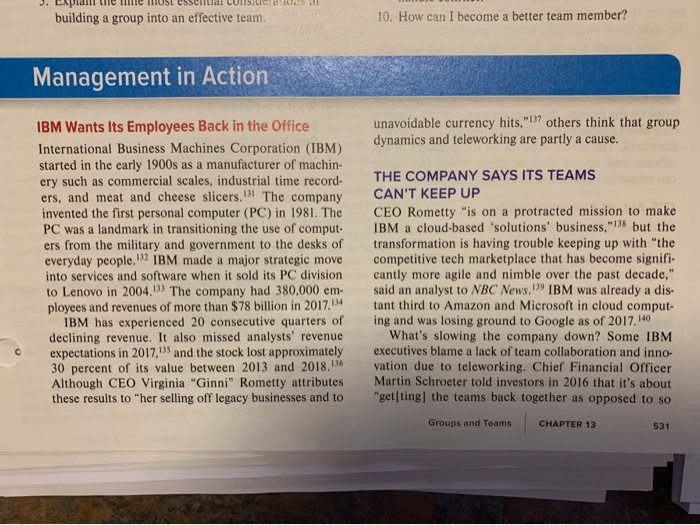
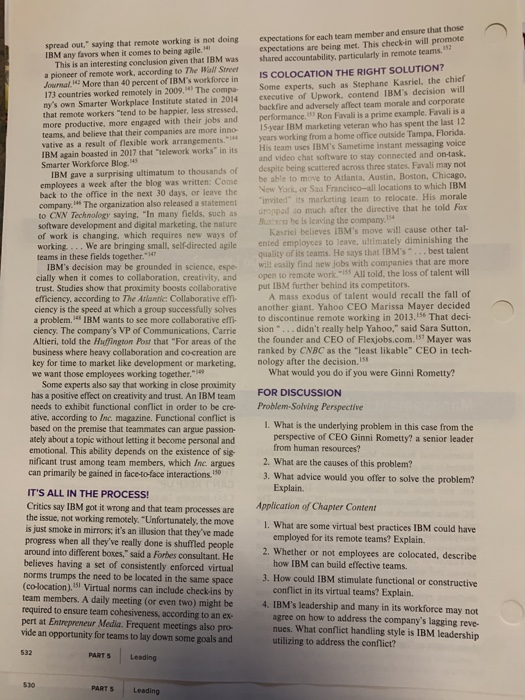
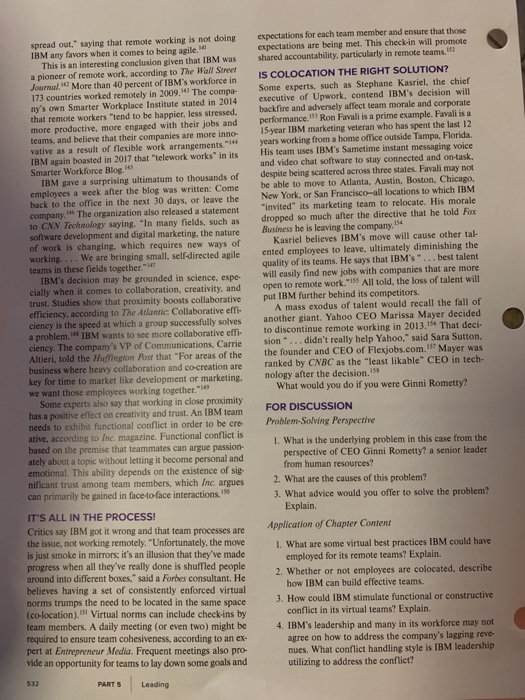
J. LAPA LICITIUSL ESSCILA CUISILICIUS ! building a group into an effective team. 10. How can I become a better team member? Management in Action unavoidable currency hits,"137 others think that group dynamics and teleworking are partly a cause. IBM Wants Its Employees Back in the Office International Business Machines Corporation (IBM) started in the early 1900s as a manufacturer of machin- ery such as commercial scales, industrial time record ers, and meat and cheese slicers. The company invented the first personal computer (PC) in 1981. The PC was a landmark in transitioning the use of comput ers from the military and government to the desks of everyday people.2 IBM made a major strategic move into services and software when it sold its PC division to Lenovo in 2004.133 The company had 380,000 em- ployees and revenues of more than $78 billion in 2017.134 IBM has experienced 20 consecutive quarters of declining revenue. It also missed analysts' revenue expectations in 2017, 135 and the stock lost approximately 30 percent of its value between 2013 and 2018.136 Although CEO Virginia "Ginni" Rometty attributes these results to "her selling off legacy businesses and to THE COMPANY SAYS ITS TEAMS CAN'T KEEP UP CEO Rometty "is on a protracted mission to make IBM a cloud-based 'solutions' business,"138 but the transformation is having trouble keeping up with the competitive tech marketplace that has become signifi- cantly more agile and nimble over the past decade," said an analyst to NBC News, 139 IBM was already a dis- tant third to Amazon and Microsoft in cloud comput. ing and was losing ground to Google as of 2017.10. What's slowing the company down? Some IBM executives blame a lack of team collaboration and inno vation due to teleworking. Chief Financial Officer Martin Schroeter told investors in 2016 that it's about "getting the teams back together as opposed to so Groups and Teams CHAPTER 13 531 spread out." saying that remote working is not doing IBM any favors when it comes to being agile, This is an interesting conclusion given that IBM was a pioneer of remote work, according to The Wall Street Journal. More than 40 percent of IBM's workforce in 173 countries worked remotely in 2009. The compa ny's own Smarter Workplace Institute stated in 2014 that remote workers tend to be happier, less stressed more productive, more engaged with their jobs and teams, and believe that their companies are more inno vative as a result of flexible work arrangements."144 IBM again boasted in 2017 that "telework works" in its Smarter Workforce Blog.145 IBM gave a surprising ultimatum to thousands of employees a week after the blog was written: Come back to the office in the next 30 days, or leave the company. The organization also released a statement to CNN Technology saying, "In many fields, such as software development and digital marketing, the nature of work is changing, which requires new ways of working.... We are bringing small, self-directed agile teams in these fields together."147 IBM's decision may be grounded in science, espe cially when it comes to collaboration, creativity, and trust. Studies show that proximity boosts collaborative eficiency, according to the Atlantic: Collaborative cf- ciency is the speed at which a group successfully solves a problem. 14 IBM wants to see more collaborative effi- ciency. The company's VP of Communications, Carrie Altieri, told the Huffington Pour that "For areas of the business where heavy collaboration and co-creation are key for time to market like development or marketing. we want those employees working together." Some experts also say that working in close proximity has a positive effect on creativity and trust. An IBM team needs to exhibit functional conflict in order to be cre ative, according to Inc. magazine. Functional conflict is based on the premise that teammates can argue passion- ately about a topic without letting it become personal and emotional. This ability depends on the existence of sig- nificant trust among team members, which Incargues can primarily be gained in face-to-face interactions.150 expectations for each team member and ensure that those expectations are being met. This check-in will promote shared accountability, particularly in remote teams. IS COLOCATION THE RIGHT SOLUTION? Some experts, such as Stephane Kasriel, the chief executive of Upwork, contend IBM's decision will backfire and adversely affect team morale and corporate performance. Ron Favali is a prime example, Favall is a 15 year IBM marketing veteran who has spent the last 12 years working from a home office outside Tampa, Florida. His team uses IBM's Sametime instant messaging voice and video chat software to stay connected and on-task. despite being scattered across three states Favali may not be able to move to Atlanta, Austin, Boston, Chicago, New York, or San Francisco-all locations to which IBM invited its marketing team to relocate. His morale Dronnad so much after the directive that he told Fox he is leaving the company Kasriel believes IBM's move will cause other tal- ented employees to leave, ultimately diminishing the quality of its teams. He says that IBM's"... best talent will easily find new jobs with companies that are more open to remote work.15 All told, the loss of talent will put IBM further behind its competitors. A mass exodus of talent would recall the fall of another giant. Yahoo CEO Marissa Mayer decided to discontinue remote working in 2013,156 That deci. sion "... didn't really help Yahoo," said Sara Sutton. the founder and CEO of Flexjobs.com.157 Mayer was ranked by CNBC as the least likable" CEO in tech- nology after the decision 158 What would you do if you were Ginni Rometty? FOR DISCUSSION Problem Solving Perspective 1. What is the underlying problem in this case from the perspective of CEO Ginni Rometty? a senior leader from human resources? 2. What are the causes of this problem? 3. What advice would you offer to solve the problem? Explain. IT'S ALL IN THE PROCESS! Critics say IBM got it wrong and that team processes are the issue, not working remotely. Unfortunately, the move is just smoke in mirrors it's an illusion that they've made progress when all they've really done is shuffled people around into different boxes," said a Forbes consultant. He believes having a set of consistently enforced virtual norms trumps the need to be located in the same space (co location). Virtual norms can include check-ins by team members. A daily meeting (or even two) might be required to ensure team cohesiveness, according to an ex pert at Entrepreneur Media. Frequent meetings also pro vide an opportunity for teams to lay down some goals and 532 PARTS Leading Application of Chapter Content 1. What are some virtual best practices IBM could have employed for its remote teams? Explain. 2. Whether or not employees are colocated, describe how IBM can build effective teams. 3. How could IBM stimulate functional or constructive conflict in its virtual teams? Explain. 4. IBM's leadership and many in its workforce may not agree on how to address the company's lagging reve nues. What conflict handling style is IBM leadership utilizing to address the conflict? 530 PARTS Leading spread out," saying that remote working is not doing IBM any favors when it comes to being agile. This is an interesting conclusion given that IBM was a pioneer of remote work, according to The Wall Street Journal. More than 40 percent of IBM's workforce in 173 countries worked remotely in 2009.10 The compa- ny's own Smarter Workplace Institute stated in 2014 that remote workers tend to be happier, less stressed. more productive, more engaged with their jobs and teams, and believe that their companies are more inno- vative as a result of flexible work arrangements." IBM again boasted in 2017 that "telework works" in its Smarter Workforce Blog IBM gave a surprising ultimatum to thousands of employees a week after the blog was written: Come back to the office in the next 30 days, or leave the company. The organization also released a statement to CNN Technology saying. "In many fields, such as software development and digital marketing, the nature of work is changing, which requires new ways of working.... We are bringing small, self-directed agile teams in these fields together."147 IBM's decision may be grounded in science, espe- cially when it comes to collaboration, creativity, and trust. Studies show that proximity boosts collaborative efficiency, according to the Atlantic: Collaborative el- ciency is the speed at which a group successfully solves a problem. IBM wants to see more collaborative effi- ciency. The company's VP of Communications, Carrie Altieri, told the Huffington Post that "For areas of the business where heavy collaboration and co-creation are key for time to market like development or marketing. we want those employees working together." Some experts also say that working in close proximity has a positive effect on creativity and trust. An IBM team needs to exhibit functional conflict in order to be cre- ative, according to Inc magazine. Functional conflict is based on the premise that teammates can argue passion- ately about a topic without letting it become personal and emotional. This ability depends on the existence of sig- nificant trust among team members, which Inc argues can primarily be gained in face-to-face interactions. expectations for each team member and ensure that those expectations are being met. This check-in will promote shared accountability, particularly in remote teams. IS COLOCATION THE RIGHT SOLUTION? Some experts, such as Stephane Kasriel, the chief executive of Upwork, contend IBM's decision will backfire and adversely affect team morale and corporate performance.15) Ron Favali is a prime example. Favali is a 15 year IBM marketing veteran who has spent the last 12 years working from a home office outside Tampa, Florida His team uses IBM's Sametime instant messaging voice and video chat software to stay connected and on-task, despite being scattered across three states. Favali may not be able to move to Atlanta, Austin, Boston, Chicago. New York, or San Francisco-all locations to which IBM invited" its marketing team to relocate. His morale dropped so much after the directive that he told Fox Business he is leaving the company. 14 Kasriel believes IBM's move will cause other tal- ented employees to leave, ultimately diminishing the quality of its teams. He says that IBM's"... best talent will easily find new jobs with companies that are more open to remote work." All told, the loss of talent will put IBM further behind its competitors. A mass exodus of talent would recall the fall of another giant. Yahoo CEO Marissa Mayer decided to discontinue remote working in 2013.14 That deci- sion "... didn't really help Yahoo," said Sara Sutton. the founder and CEO of Flexjobs.com.17 Mayer was ranked by CNBC as the "least likable" CEO in tech- nology after the decision. 158 What would you do if you were Ginni Rometty? FOR DISCUSSION Problem Solving Perspective 1. What is the underlying problem in this case from the perspective of CEO Ginni Rometty? a senior leader from human resources? 2. What are the causes of this problem? 3. What advice would you offer to solve the problem! Explain. Application of Chapter Content 1. What are some virtual best practices IBM could have employed for its remote teams? Explain. 2. Whether or not employees are colocated, describe how IBM can build effective teams. 3. How could IBM stimulate functional or constructive conflict in its virtual teams? Explain. 4. IBM's leadership and many in its workforce may not agree on how to address the company's lagging reve nues. What conflict handling style is IBM leadership utilizing to address the conflict? IT'S ALL IN THE PROCESS! Critics say IBM got it wrong and that team processes are the issue, not working remotely. "Unfortunately, the move is just smoke in mirrors, it's an illusion that they've made progress when all they've really done is shuffled people around into different boxes," said a Forbes consultant. He believes having a set of consistently enforced virtual norms trumps the need to be located in the same space (co-location). Virtual norms can include check-ins by team members. A daily meeting (or even two) might be required to ensure team cohesiveness, according to an ex- pert at Entrepreneur Media. Frequent meetings also pro- vide an opportunity for teams to lay down some goals and PARTS Leading









 Study Help