Question: Manufacturing engineering 1 I need a solution as soon as possible Please work individually answer all questions please don't copy answers from anyone place. 1
Manufacturing engineering 1
I need a solution as soon as possible
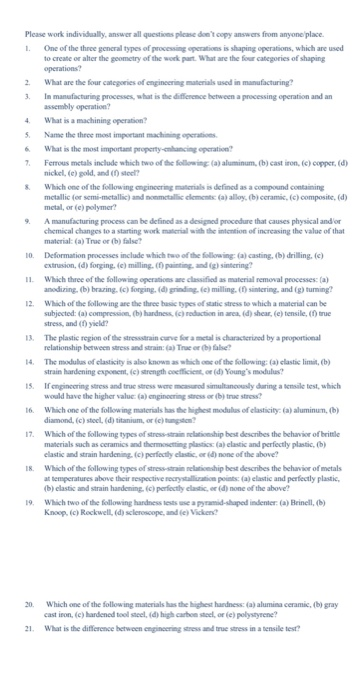
Please work individually answer all questions please don't copy answers from anyone place. 1 One of the three general types of processing operations is shaping operations, which are used to create or alter the geometry of the work part. What are the four categories of shaping operations? 2 What are the four categories of engineering materials used in manufacturing 3 In manufacturing processes, what is the difference between a processing operation and an assembly operation? 4 What is a machining operation? 5. Name the three most important machining operations What is the most important property-clancing operation 7. Ferrous metals include which two of the following (a) aluminum, (b) cast iron, (e) copper, (d) nickel, (c) gold, and (eel? 8 Which one of the following engineering materials is defined as a compound containing metallic (or semi-metallic) and nonmetallic elements: (a) alloy, (b) ceramic. (c) composite, (d) metal, or (e) polymer? 9. A manufacturing process can be defined as a designed procedure that causes physical and or chemical changes to a starting work material with the intention of increasing the value of that material: (a) True or (b) false? 10. Deformation processes include which two of the following: (a) casting. (b) drilling. (e) extrusion, (d) forging. (e) milling. (painting, and (g) sintering? II. Which three of the following operations are classified as material removal processes: (a) anodizing. (b) brazing. (c) forging. (d) grinding. (c) milling. (t) sintering, and (g) tuming? 12. Which of the following are the three basic types of static stress to which a material can be subjected: (a) compression, (b) hardness. (c) reduction in area, (d) shear, (e) tensile, (h) true stress, and yield? 13. The plastic region of the stressstrain curve for a metal is characterized by a proportional relationship between stress and strain: (a) True false! 14. The modulus of clasticity is also known as which one of the following: (a) clastic limit, (b) strain hardening exponent, (c) strength coefficient. (d) Young's modulus? 15. If engineering stress and true stress were measured simultaneously during a tensile test, which would have the higher value: (a) engineering stress or (b) true stress? 16. Which one of the following materials as the highest modulus of elasticity (a) aluminum, (b) diamond. (c) steel. (d) titanium, or (e)tuntem? 17. Which of the following types of stress-strain relationship best describes the behavior of brittle materials such as ceramics and theresetting plastic (a) clastic and perfectly plastic, (b) clastic and strain hardening. (c) perfectly elastico) none of the above? 18. Which of the following types of stressstrain relationship best describes the behavior of metals at temperatures above their respective recrystallization points (clastic and perfectly plastic b) elastic and strain handening. (c) perfectly classic or (d) none of the above! 19. Which two of the following hardness tests use a pyramid-shaped indenter: (a) Brinell, (b) Knoop. (c) Rockwell, (d) scleroscope, and (c) Vicken! 20 Which one of the following materials has the highest hardness: (a) alumina ceramic, (b) gray cast iron. (c) hardened tool steel. (d) high carbon steel, or e) polystyrene? 21. What is the difference between engineering stress and true stress in a tensile test? Please work individually answer all questions please don't copy answers from anyone place. 1 One of the three general types of processing operations is shaping operations, which are used to create or alter the geometry of the work part. What are the four categories of shaping operations? 2 What are the four categories of engineering materials used in manufacturing 3 In manufacturing processes, what is the difference between a processing operation and an assembly operation? 4 What is a machining operation? 5. Name the three most important machining operations What is the most important property-clancing operation 7. Ferrous metals include which two of the following (a) aluminum, (b) cast iron, (e) copper, (d) nickel, (c) gold, and (eel? 8 Which one of the following engineering materials is defined as a compound containing metallic (or semi-metallic) and nonmetallic elements: (a) alloy, (b) ceramic. (c) composite, (d) metal, or (e) polymer? 9. A manufacturing process can be defined as a designed procedure that causes physical and or chemical changes to a starting work material with the intention of increasing the value of that material: (a) True or (b) false? 10. Deformation processes include which two of the following: (a) casting. (b) drilling. (e) extrusion, (d) forging. (e) milling. (painting, and (g) sintering? II. Which three of the following operations are classified as material removal processes: (a) anodizing. (b) brazing. (c) forging. (d) grinding. (c) milling. (t) sintering, and (g) tuming? 12. Which of the following are the three basic types of static stress to which a material can be subjected: (a) compression, (b) hardness. (c) reduction in area, (d) shear, (e) tensile, (h) true stress, and yield? 13. The plastic region of the stressstrain curve for a metal is characterized by a proportional relationship between stress and strain: (a) True false! 14. The modulus of clasticity is also known as which one of the following: (a) clastic limit, (b) strain hardening exponent, (c) strength coefficient. (d) Young's modulus? 15. If engineering stress and true stress were measured simultaneously during a tensile test, which would have the higher value: (a) engineering stress or (b) true stress? 16. Which one of the following materials as the highest modulus of elasticity (a) aluminum, (b) diamond. (c) steel. (d) titanium, or (e)tuntem? 17. Which of the following types of stress-strain relationship best describes the behavior of brittle materials such as ceramics and theresetting plastic (a) clastic and perfectly plastic, (b) clastic and strain hardening. (c) perfectly elastico) none of the above? 18. Which of the following types of stressstrain relationship best describes the behavior of metals at temperatures above their respective recrystallization points (clastic and perfectly plastic b) elastic and strain handening. (c) perfectly classic or (d) none of the above! 19. Which two of the following hardness tests use a pyramid-shaped indenter: (a) Brinell, (b) Knoop. (c) Rockwell, (d) scleroscope, and (c) Vicken! 20 Which one of the following materials has the highest hardness: (a) alumina ceramic, (b) gray cast iron. (c) hardened tool steel. (d) high carbon steel, or e) polystyrene? 21. What is the difference between engineering stress and true stress in a tensile test









 Study Help