







Question: Mark Brown started Firelight began with a simple idea: Home Cooking, Delivered. But now Firelight was experiencing turbulence and flagging. With funds running run out
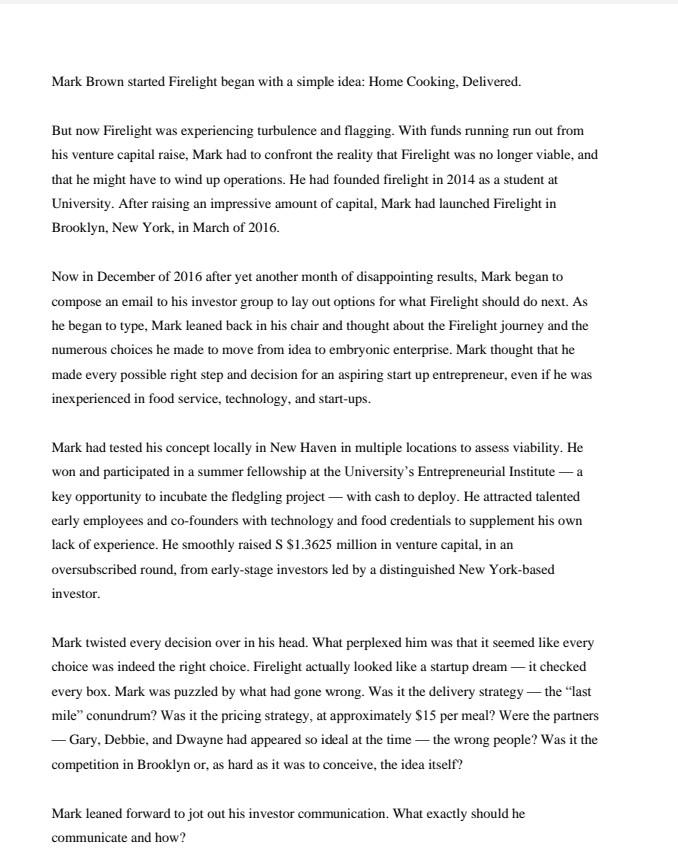
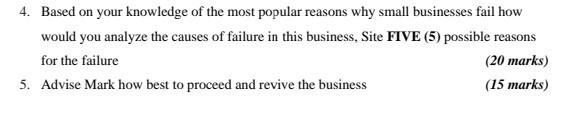
Mark Brown started Firelight began with a simple idea: Home Cooking, Delivered. But now Firelight was experiencing turbulence and flagging. With funds running run out from his venture capital raise, Mark had to confront the reality that Firelight was no longer viable, and that he might have to wind up operations. He had founded firelight in 2014 as a student at University. After raising an impressive amount of capital, Mark had launched Firelight in Brooklyn, New York, in March of 2016. Now in December of 2016 after yet another month of disappointing results, Mark began to compose an email to his investor group to lay out options for what Firelight should do next. As he began to type, Mark leaned back in his chair and thought about the Firelight journey and the numerous choices he made to move from idea to embryonic enterprise. Mark thought that he made every possible right step and decision for an aspiring start up entrepreneur, even if he was inexperienced in food service, technology, and start-ups. Mark had tested his concept locally in New Haven in multiple locations to assess viability. He won and participated in a summer fellowship at the University's Entrepreneurial Institute - a key opportunity to incubate the fledgling project with cash to deploy. He attracted talented early employees and co-founders with technology and food credentials to supplement his own lack of experience. He smoothly raised S $1.3625 million in venture capital, in an oversubscribed round, from early-stage investors led by a distinguished New York-based investor. Mark twisted every decision over in his head. What perplexed him was that it seemed like every choice was indeed the right choice. Firelight actually looked like a startup dream-it checked every box. Mark was puzzled by what had gone wrong. Was it the delivery strategy - the "last mile conundrum? Was it the pricing strategy, at approximately $15 per meal? Were the partners - Gary, Debbie, and Dwayne had appeared so ideal at the time the wrong people? Was it the competition in Brooklyn or, as hard as it was to conceive, the idea itself? Mark leaned forward to jot out his investor communication. What exactly should he communicate and how? 4. Based on your knowledge of the most popular reasons why small businesses fail how would you analyze the causes of failure in this business, Site FIVE (5) possible reasons for the failure (20 marks) 5. Advise Mark how best to proceed and revive the business (15 marks)
Step by Step Solution
There are 3 Steps involved in it
1 Expert Approved Answer
Step: 1 Unlock

Question Has Been Solved by an Expert!
Get step-by-step solutions from verified subject matter experts
Step: 2 Unlock
Step: 3 Unlock
 Study Help