







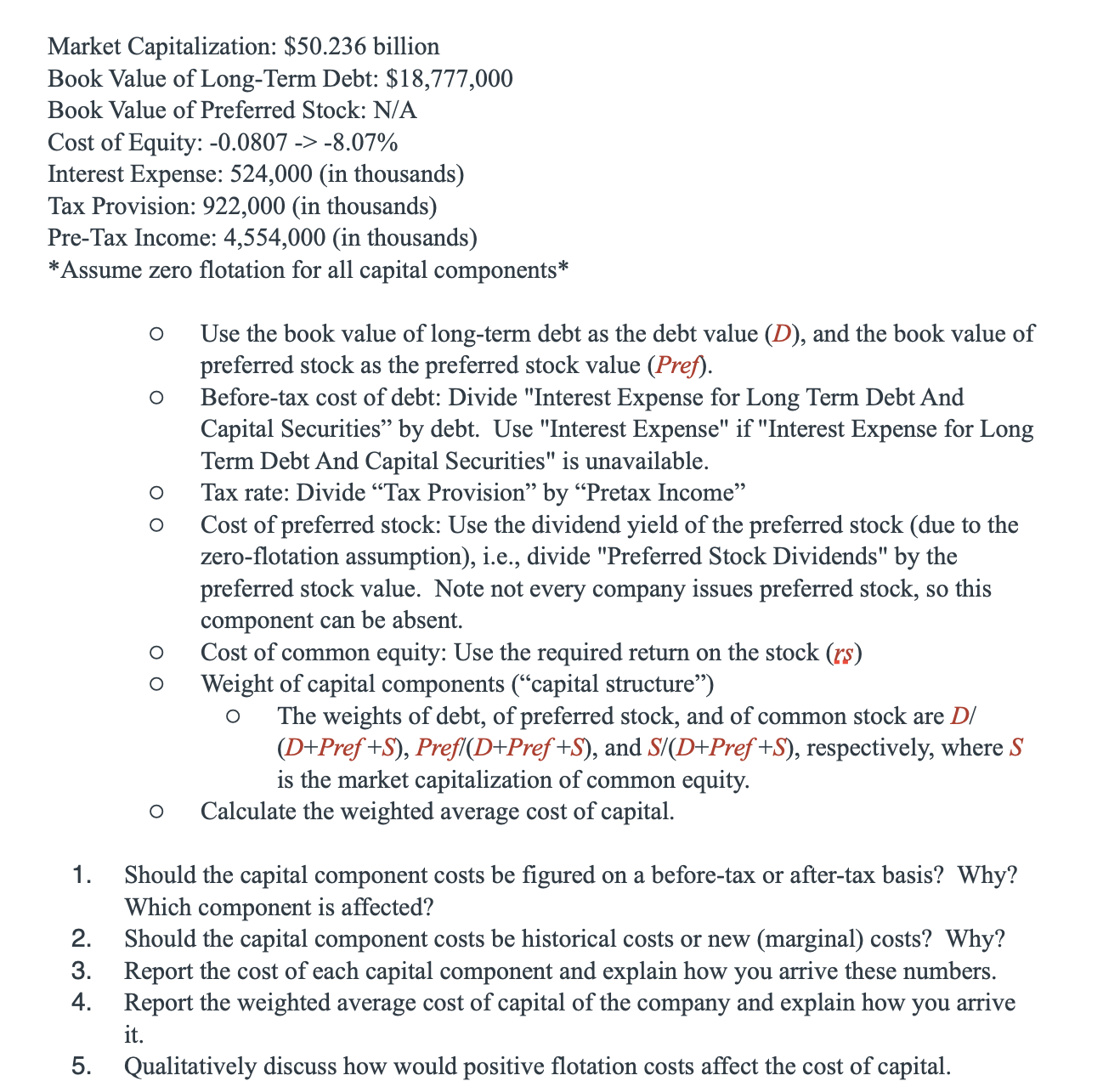
Question: Market Capitalization: $ 5 0 . 2 3 6 billion Book Value of Long - Term Debt: $ 1 8 , 7 7 7 ,
Market Capitalization: $ billion
Book Value of LongTerm Debt: $
Book Value of Preferred Stock: NA
Cost of Equity:
Interest Expense: in thousands
Tax Provision: in thousands
PreTax Income: in thousands
O Use the book value of longterm debt as the debt value and the book value of
preferred stock as the preferred stock value Pref
Beforetax cost of debt: Divide "Interest Expense for Long Term Debt And
Capital Securities" by debt. Use "Interest Expense" if "Interest Expense for Long
Term Debt And Capital Securities" is unavailable.
Tax rate: Divide "Tax Provision" by "Pretax Income"
Cost of preferred stock: Use the dividend yield of the preferred stock due to the
zeroflotation assumption ie divide "Preferred Stock Dividends" by the
preferred stock value. Note not every company issues preferred stock, so this
component can be absent
Cost of common equity: Use the required return on the stock
Weight of capital components capital structure"
The weights of debt, of preferred stock, and of common stock are
Pref Prefl Pref and Pref respectively, where
is the market capitalization of common equity.
Calculate the weighted average cost of capital.
Should the capital component costs be figured on a beforetax or aftertax basis? Why?
Which component is affected?
Should the capital component costs be historical costs or new marginal costs? Why?
Report the cost of each capital component and explain how you arrive these numbers.
Report the weighted average cost of capital of the company and explain how you arrive
it
Qualitatively discuss how would positive flotation costs affect the cost of capital.
Step by Step Solution
There are 3 Steps involved in it
1 Expert Approved Answer
Step: 1 Unlock

Question Has Been Solved by an Expert!
Get step-by-step solutions from verified subject matter experts
Step: 2 Unlock
Step: 3 Unlock
 Study Help