







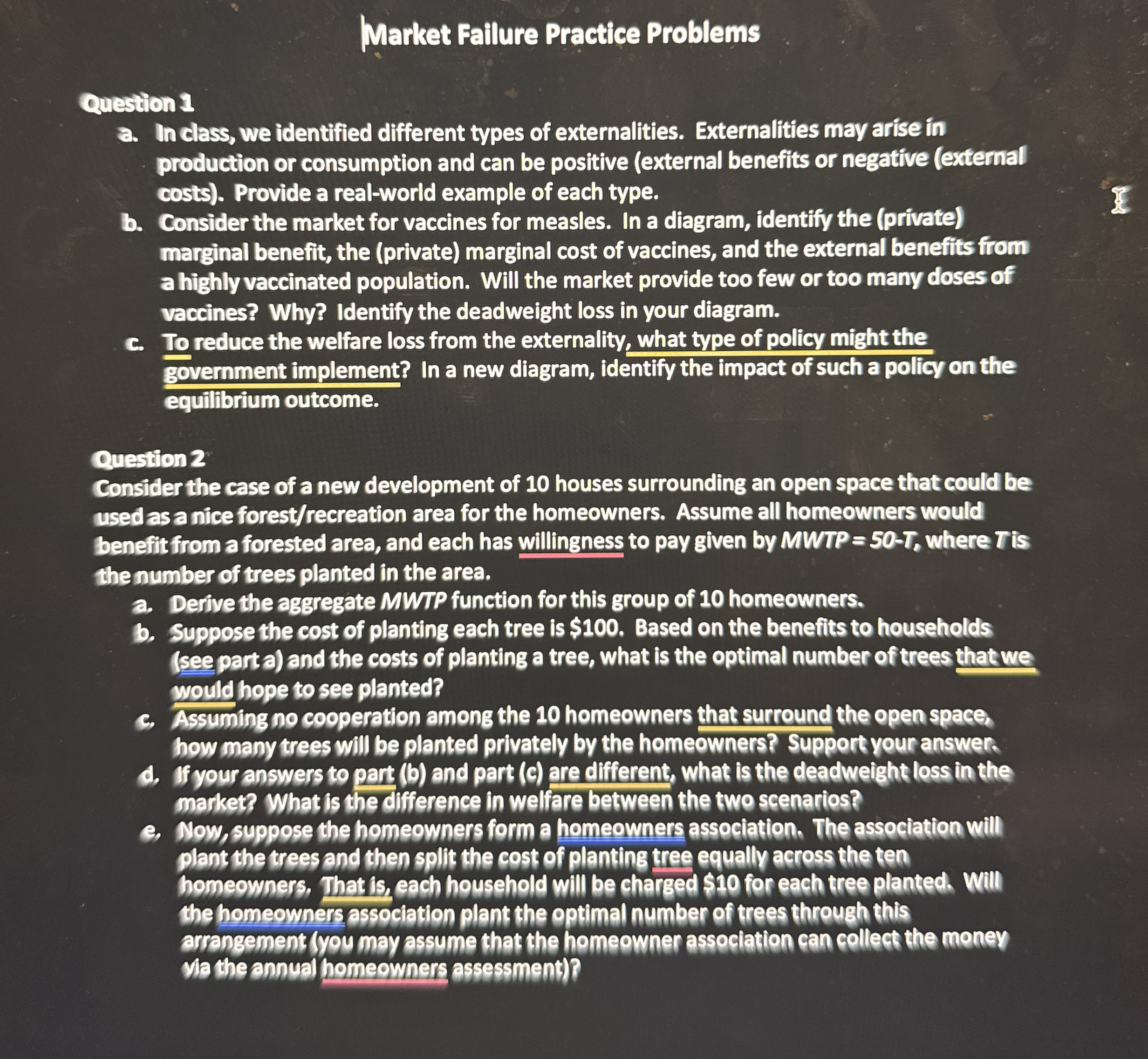
Question: Market Failure Practice Problems Question 1 a . In class, we identified different types of externalities. Externalities may arise in production or consumption and can
Market Failure Practice Problems
Question
a In class, we identified different types of externalities. Externalities may arise in production or consumption and can be positive external benefits or negative external costs Provide a realworld example of each type.
b Consider the market for vaccines for measles. In a diagram, identify the private marginal benefit, the private marginal cost of vaccines, and the external benefits from a highly vaccinated population. Will the market provide too few or too many doses of vaccines? Why? Identify the deadweight loss in your diagram.
c To reduce the welfare loss from the externality, what type of policy might the government implement? In a new diagram, identify the impact of such a policy on the equilibrium outcome.
Question
Consider the case of a new development of houses surrounding an open space that could be used as a nice forestrecreation area for the homeowners. Assume all homeowners would benefit from a forested area, and each has willingness to pay given by MWTP T where is the number of trees planted in the area.
a Derive the aggregate MWTP function for this group of homeowners.
b Suppose the cost of planting each tree is $ Based on the benefits to households see parta and the costs of planting a tree, what is the optimal number of trees that we would hope to see planted?
c Assuming no cooperation among the homeowners that surround the open space. how many trees will be planted privately by the homeowners? Support your answer.
d If your answers to part b and part c are different, what is the deadweight loss in the market? What is the difference in welfare between the two scenarios?
e Now, suppose the homeowners form a homeowners association. The association will plant the trees and then split the cost of planting tree equally across the ten homeowners, That is each household will be charged $ for each tree planted. Will the homeowners association plant the optimal number of trees through this arrangement you may assume that the homeowner association can collect the money via the annual homeowners assessment
Step by Step Solution
There are 3 Steps involved in it
1 Expert Approved Answer
Step: 1 Unlock

Question Has Been Solved by an Expert!
Get step-by-step solutions from verified subject matter experts
Step: 2 Unlock
Step: 3 Unlock
 Study Help