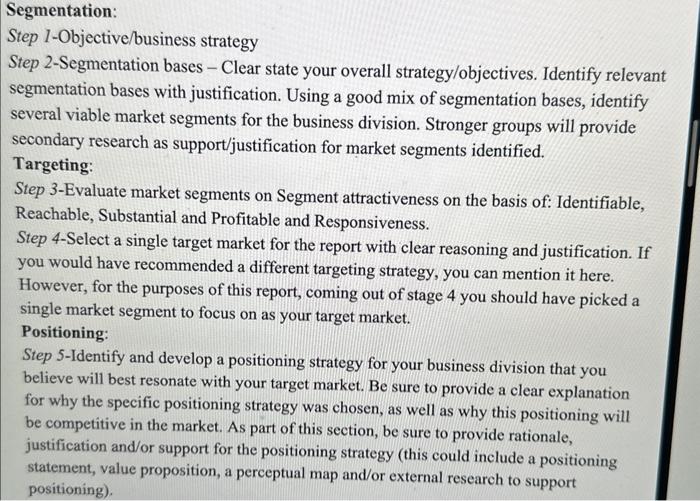
Question: MARKETING REPORT STP ( TARGETING STEP 3) step 3 - Evaluate market segments on segment attractiveness on the basis of: Identifiable, Reachable, Substantial and Profitable
MARKETING REPORT
STP ( TARGETING STEP 3)
step 3 - Evaluate market segments on segment attractiveness on the basis of: Identifiable, Reachable, Substantial and Profitable and Responsiveness.
I NEED YOU TO ANSWER THIS BASED ON CANADA GOOSE. I answered step 1,2 so use those to get an idea.
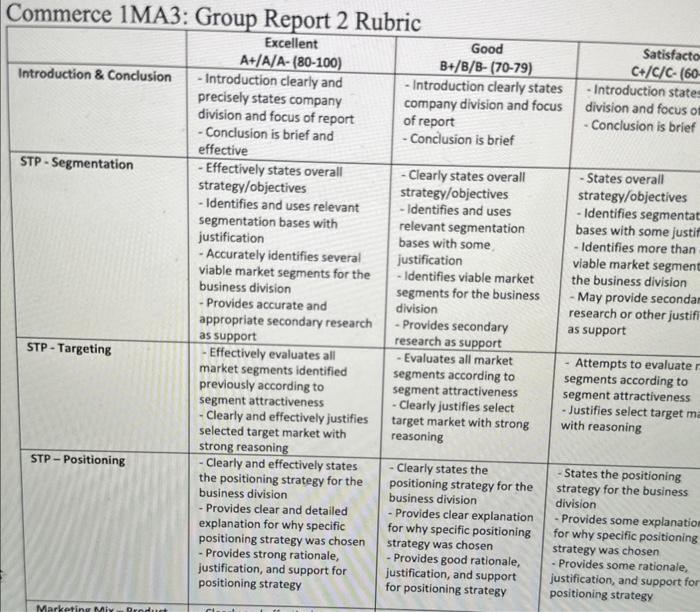
Commerce 1MA3: Group Report 2 Rubric Step 1 -Objective/business strategy Step 2-Segmentation bases - Clear state your overall strategy/objectives. Identify relevant segmentation bases with justification. Using a good mix of segmentation bases, identify several viable market segments for the business division. Stronger groups will provide secondary research as support/justification for market segments identified. Targeting: Step 3-Evaluate market segments on Segment attractiveness on the basis of: Identifiable, Reachable, Substantial and Profitable and Responsiveness. Step 4-Select a single target market for the report with clear reasoning and justification. If you would have recommended a different targeting strategy, you can mention it here. However, for the purposes of this report, coming out of stage 4 you should have picked a single market segment to focus on as your target market. Positioning: Step 5-Identify and develop a positioning strategy for your business division that you believe will best resonate with your target market. Be sure to provide a clear explanation for why the specific positioning strategy was chosen, as well as why this positioning will be competitive in the market. As part of this section, be sure to provide rationale, justification and/or support for the positioning strategy (this could include a positioning statement, value proposition, a perceptual map and/or external research to support positioning). The current objective of Canada Goose strategies involves expanding to other regions and retaining its dominant position in the Cariadian and American markets, Canada Goose marketing strategies involve paid advertising, word of mouth, and relationship marketing. The business maintains traditional brand management practises and aims to strengthen its bonds With its current clientele by enhancing their perception of the brand as premium, exclusive, and genuine (1). Canada Goose primarily relies on word of mouth due to the natural result of quality product offering for the bulk of its marketing strategy. For Canada Goose to maintain their exclusivity of the brand, they target consumers using product placement in movies, paid magazine features in upscale articles, and various prestigious sponsorships/ partners. Canada Goose has a low overall marketing cost at 10% of total costs with marketing salaries included, Which is why they can reinvest profits into the product development (2). The geographic segmentation that Canada Goose cater to are regions with cold climates because their products are advertised to increase warmth and battle the extreme cold with its high-quality materials. The demographic Canada Goose caters to are medium to high income, youth, young adults, and the generation X cohort. The young adults with low disposable income are very influenced by media to follow western brands and culture and purchase their products typically online. The generation X cohort have a higher disposable income, and purchase Canada Goose products for: outdoor work and recreation. Typically, they go to high-fashion boutiques or high-end department stores to purchase Canada Goose products. The variables in which support the product in the geographic segment are how durable, light, and warmer the jacket is compared to other brands. The demographic variables mostly come from how fashionable the products are. This is becouse most people are intivenced to bidy Canada Goose products due to the status level they give off when people are seen wearing them










 Study Help