



Question: Marketing Topic: Read this Case Study (.pdf). Create a set of marketing objectives to direct the marketing efforts for Starbucks VIA instant coffee in the
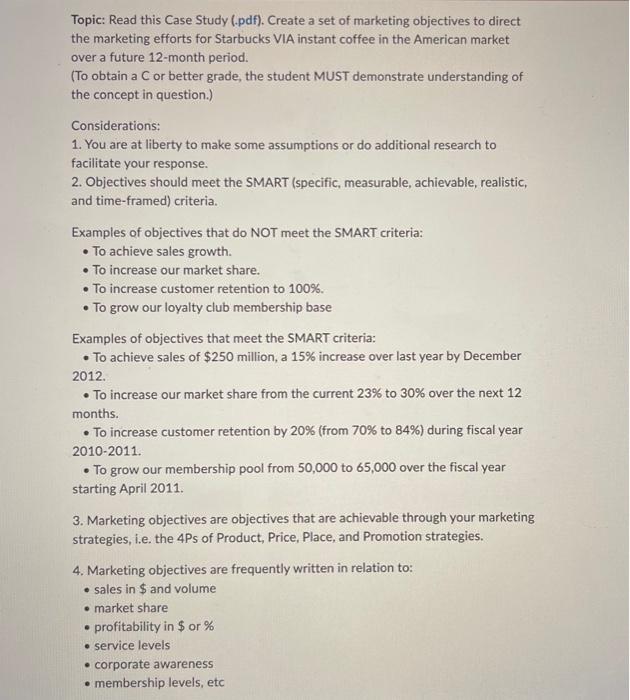
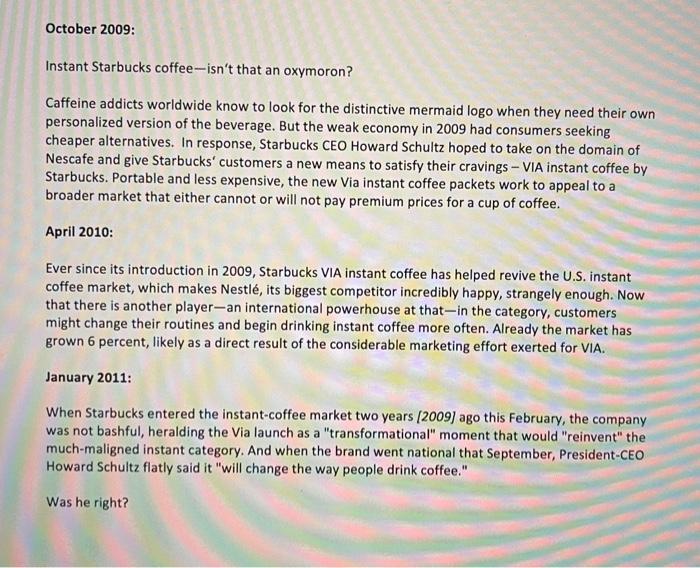
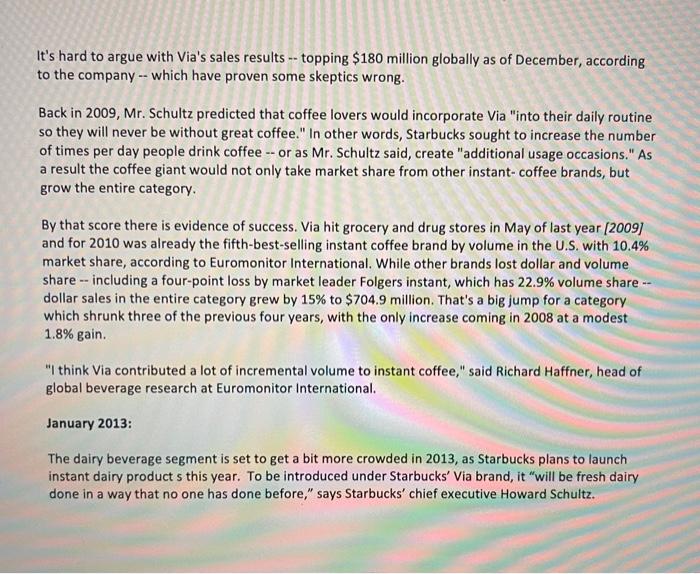
Topic: Read this Case Study (.pdf). Create a set of marketing objectives to direct the marketing efforts for Starbucks VIA instant coffee in the American market over a future 12-month period. (To obtain a C or better grade, the student MUST demonstrate understanding of the concept in question.) Considerations: 1. You are at liberty to make some assumptions or do additional research to facilitate your response. 2. Objectives should meet the SMART (specific, measurable, achievable, realistic, and time-framed) criteria. Examples of objectives that do NOT meet the SMART criteria: To achieve sales growth. To increase our market share. To increase customer retention to 100%. To grow our loyalty club membership base Examples of objectives that meet the SMART criteria: To achieve sales of $250 million, a 15% increase over last year by December 2012. To increase our market share from the current 23% to 30% over the next 12 months. To increase customer retention by 20% (from 70% to 84%) during fiscal year 2010-2011 To grow our membership pool from 50,000 to 65,000 over the fiscal year starting April 2011 3. Marketing objectives are objectives that are achievable through your marketing strategies, i.e. the 4Ps of Product, Price, Place, and Promotion strategies. . 4. Marketing objectives are frequently written in relation to: sales in $ and volume market share profitability in $ or % service levels corporate awareness membership levels, etc . October 2009: Instant Starbucks coffee--isn't that an oxymoron? Caffeine addicts worldwide know to look for the distinctive mermaid logo when they need their own personalized version of the beverage. But the weak economy in 2009 had consumers seeking cheaper alternatives. In response, Starbucks CEO Howard Schultz hoped to take on the domain of Nescafe and give Starbucks' customers a new means to satisfy their cravings - VIA instant coffee by Starbucks. Portable and less expensive, the new via instant coffee packets work to appeal to a broader market that either cannot or will not pay premium prices for a cup of coffee. April 2010: Ever since its introduction in 2009, Starbucks VIA instant coffee has helped revive the U.S. instant coffee market, which makes Nestl, its biggest competitor incredibly happy, strangely enough. Now that there is another player-an international powerhouse at that-in the category, customers might change their routines and begin drinking instant coffee more often. Already the market has grown 6 percent, likely as a direct result of the considerable marketing effort exerted for VIA. January 2011: When Starbucks entered the instant-coffee market two years (2009) ago this February, the company was not bashful, heralding the Via launch as a "transformational moment that would "reinvent" the much-maligned instant category. And when the brand went national that September, President CEO Howard Schultz flatly said it will change the way people drink coffee." Was he right? It's hard to argue with Via's sales results -- topping $180 million globally as of December, according to the company -- which have proven some skeptics wrong. Back in 2009, Mr. Schultz predicted that coffee lovers would incorporate Via "into their daily routine so they will never be without great coffee." In other words, Starbucks sought to increase the number of times per day people drink coffee -- or as Mr. Schultz said, create "additional usage occasions." As a result the coffee giant would not only take market share from other instant-coffee brands, but grow the entire category. By that score there is evidence of success. Via hit grocery and drug stores in May of last year (2009) and for 2010 was already the fifth-best-selling instant coffee brand by volume in the U.S. with 10.4% market share, according to Euromonitor International. While other brands lost dollar and volume share -- including a four-point loss by market leader Folgers instant, which has 22.9% volume share -- dollar sales in the entire category grew by 15% to $704.9 million. That's a big jump for a category which shrunk three of the previous four years, with the only increase coming in 2008 at a modest 1.8% gain. "I think Via contributed a lot of incremental volume to instant coffee," said Richard Haffner, head of global beverage research at Euromonitor International. January 2013: The dairy beverage segment is set to get a bit more crowded in 2013, as Starbucks plans to launch instant dairy product s this year. To be introduced under Starbucks' Via brand, it will be fresh dairy done in a way that no one has done before," says Starbucks' chief executive Howard Schultz
Step by Step Solution
There are 3 Steps involved in it

Get step-by-step solutions from verified subject matter experts