







Question: Mass transfer control in electrochemical process Copper electrorefining is a major industrial electrochemical process. The electrolyte for electrorefining of Cu is composed of: 50gl1H2SO4 and
Mass transfer control in electrochemical process
![and 12gl1CuSO4 [1]. At the cathode two parallel reactions can take place:](https://dsd5zvtm8ll6.cloudfront.net/si.experts.images/questions/2024/09/66f159f6595b3_23766f159f5eb808.jpg)
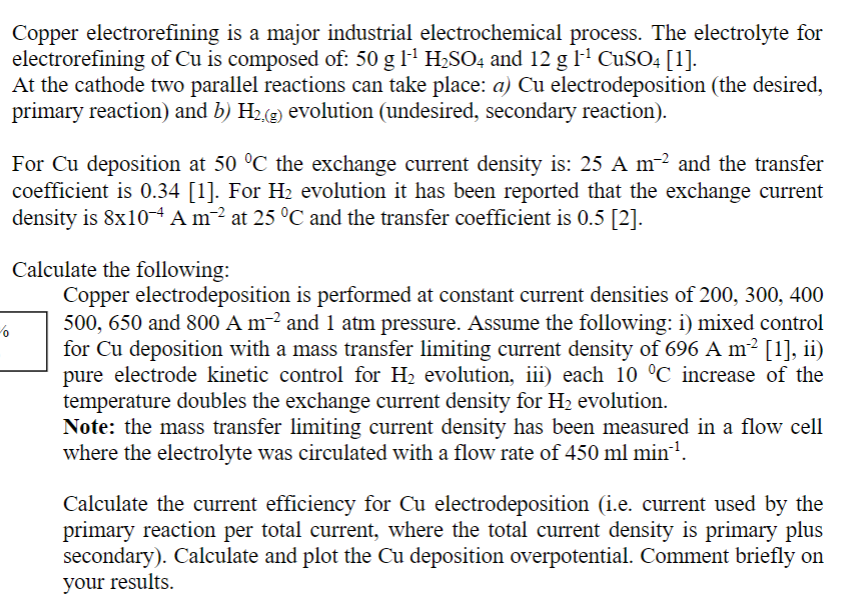
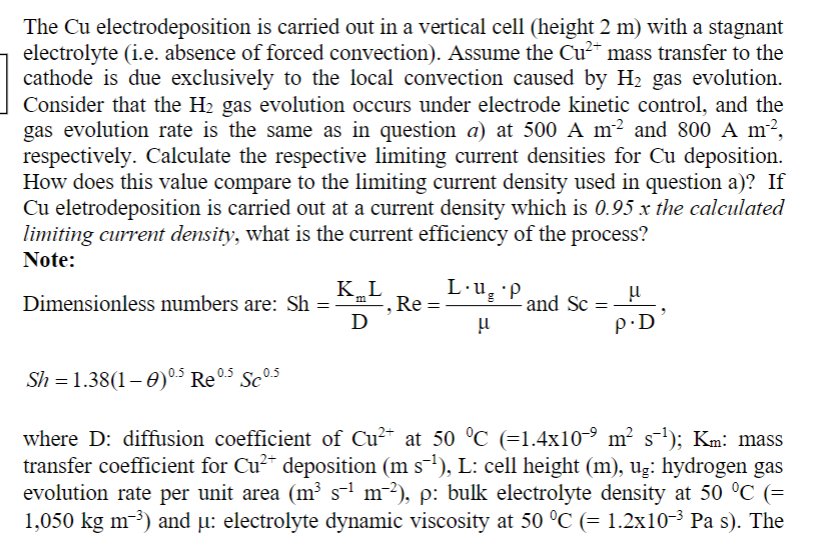
Copper electrorefining is a major industrial electrochemical process. The electrolyte for electrorefining of Cu is composed of: 50gl1H2SO4 and 12gl1CuSO4 [1]. At the cathode two parallel reactions can take place: a) Cu electrodeposition (the desired, primary reaction) and b) H2,(g) evolution (undesired, secondary reaction). For Cu deposition at 50C the exchange current density is: 25Am2 and the transfer coefficient is 0.34 [1]. For H2 evolution it has been reported that the exchange current density is 8104Am2 at 25C and the transfer coefficient is 0.5 [2]. Calculate the following: Copper electrodeposition is performed at constant current densities of 200, 300, 400 500, 650 and 800Am2 and 1 atm pressure. Assume the following: i) mixed control for Cu deposition with a mass transfer limiting current density of 696Am2[1], ii) pure electrode kinetic control for H2 evolution, iii) each 10C increase of the temperature doubles the exchange current density for H2 evolution. Note: the mass transfer limiting current density has been measured in a flow cell where the electrolyte was circulated with a flow rate of 450mlmin1. Calculate the current efficiency for Cu electrodeposition (i.e. current used by the primary reaction per total current, where the total current density is primary plus secondary). Calculate and plot the Cu deposition overpotential. Comment briefly on your results. The Cu electrodeposition is carried out in a vertical cell (height 2m ) with a stagnant electrolyte (i.e. absence of forced convection). Assume the Cu2+ mass transfer to the cathode is due exclusively to the local convection caused by H2 gas evolution. Consider that the H2 gas evolution occurs under electrode kinetic control, and the gas evolution rate is the same as in question a ) at 500Am2 and 800Am2, respectively. Calculate the respective limiting current densities for Cu deposition. How does this value compare to the limiting current density used in question a)? If Cu eletrodeposition is carried out at a current density which is 0.95x the calculated limiting current density, what is the current efficiency of the process? Note: Dimensionless numbers are: Sh=DKmL,Re=Lug and Sc=D, Sh=1.38(1)0.5Re0.5Sc0.5 where D: diffusion coefficient of Cu2+ at 500C(=1.4109m2s1);Km : mass transfer coefficient for Cu2+ deposition (ms1), L: cell height (m), ug : hydrogen gas evolution rate per unit area (m3s1m2), : bulk electrolyte density at 50C(= 1,050kgm3) and : electrolyte dynamic viscosity at 50C(=1.2103Pas). The H2 gas is evolved as spherical bubbles and the fractional electrode surface coverage by H2,(g) is 0.4
Step by Step Solution
There are 3 Steps involved in it

Get step-by-step solutions from verified subject matter experts
 Study Help