







Question: Mastery Problem: Activity-Based Costing (Basic) Indirect costs are allocated to the cost of a product in a manufacturing environment, or to the cost of a
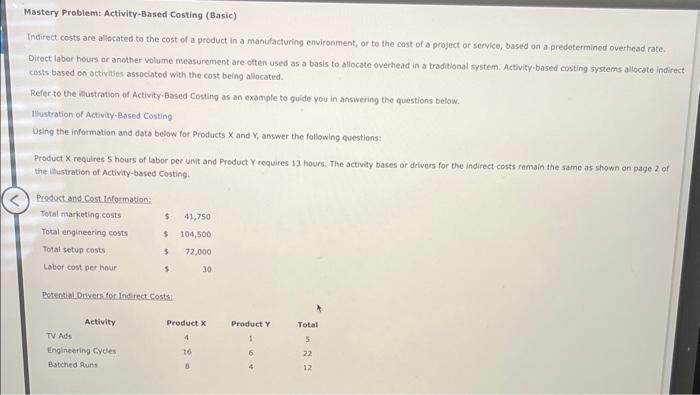
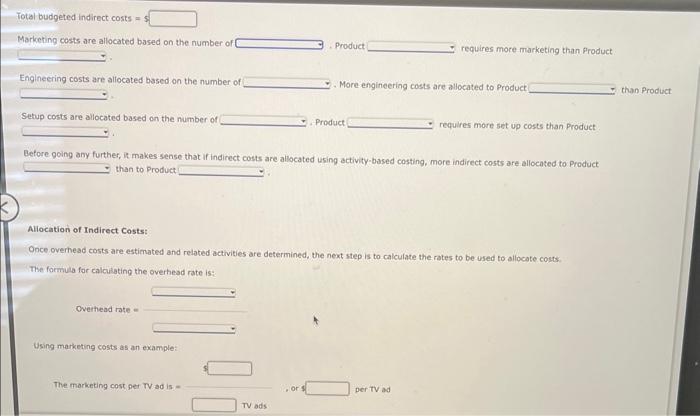
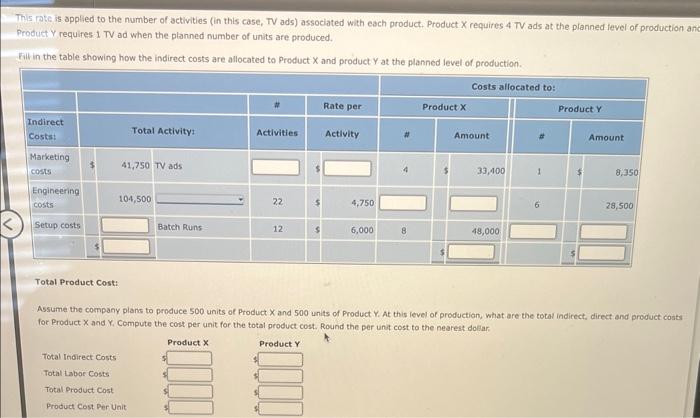
Mastery Problem: Activity-Based Costing (Basic) Indirect costs are allocated to the cost of a product in a manufacturing environment, or to the cost of a project or service, based on a predetermined overhead rate. Direct labor hours or another volume measurement are often used as a basis to allocate overhead in a traditional system. Activity-based costing systems allocate indirect costs based on activities associated with the cost being allocated. Refer to the illustration of Activity. Based Costing as an example to guide yeu in answering the questions below. Hustration of Activity-Based Costing Using the information and data below for Products X and Y, answer the following questions: Product X requires 5 hours of labor per unit and Product Y requires 13 hours. The activity bases or deivers for the indirect costs renain the same as shown on page 2 of the llistration of Activity-based Costing. porental Drivers for ind rect costs: Total budgeted indirect costs =5 Marketing costs are allocated based on the number of Product requires more marketing than Product Englneering costs are allocated based on the number of More engineering costs are allocated to Product Setup costs are allocated based on the number of Product requires more set up costs than Product Betore going any further, it makes sense that if indirect costs are allocated using activity-based costing, more indirect costs are allocated to Product than to Product/ Allocation of Indirect Costs: Once overhead costs are estimated and related activities are determined, the next step is to calculate the rates to be used to allocote costs: The formula for calculating the overhead rate is: Overthead rate = Using marketing costs as an example: The marketing cost get TV ad is = , or's per TV ad TV ads This rate is applied to the number of activities (in this case, TV ads) associated with each product. Product X requires 4 TV ads at the planned fevel of production ar Product Y requires 1 TV ad when the planned number of units are produced. Fill in the table showing how the indirect costs are allocated to Product X and product Y at the planned level of groduction. Total Product Cost: Assume the company plans to produce 500 units of Product X and 500 units of Product Y. At this level of production, what are the total indirect, direct and product costs for Product X and Y. Compute the cost per unit for the total product cost. Round the per unt cost to the nearest dollar
Step by Step Solution
There are 3 Steps involved in it

Get step-by-step solutions from verified subject matter experts
 Study Help