







Question: MAT 331, Spring 2024 Project 2: Motorized Gliders and Differential Equations Due (midnight) Friday, April 26 In class (and in the text), we have been
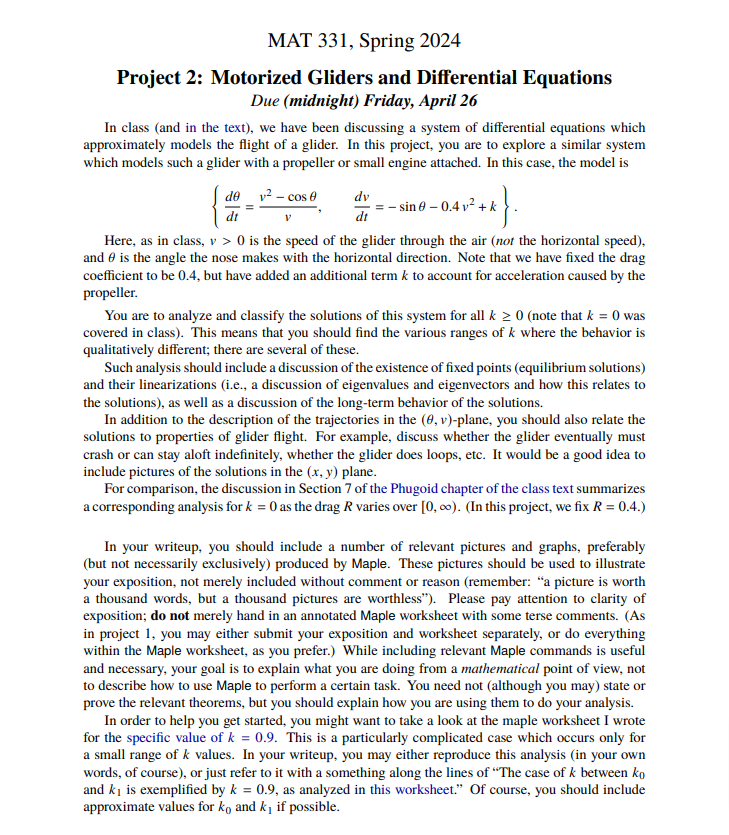
MAT 331, Spring 2024 Project 2: Motorized Gliders and Differential Equations Due (midnight) Friday, April 26 In class (and in the text), we have been discussing a system of differential equations which approximately models the flight of a glider. In this project. you are to explore a similar system which models such a glider with a propeller or small engine attached. In this case, the model is 40 V-cosf dv ; {I=%, d:zsin_lv'+k}. Here, as in class, v = 0 is the speed of the glider through the air (nor the horizontal speed), and # is the angle the nose makes with the horizontal direction. Note that we have fixed the drag coefficient to be 0.4, but have added an additional term k to account for acceleration caused by the propeller. You are to analyze and classify the solutions of this system for all & = 0 (note that = 0 was covered in class). This means that you should find the various ranges of k& where the behavior is qualitatively different; there are several of these. Such analysis should include a discussion of the existence of fixed points {(equilibrium solutions) and their linearizations (i.e., a discussion of eigenvalues and eigenvectors and how this relates to the solutions), as well as a discussion of the long-term behavior of the solutions. In addition to the description of the trajectories in the (#, v)-plane, vou should also relate the solutions to properties of glider flight. For example, discuss whether the glider eventually must crash or can stay aloft indefinitely, whether the glider does loops, etc. It would be a good idea to include pictures of the solutions in the (x, v) plane. For comparison, the discussion in Section 7 of the Phugoid chapter of the class text summarizes acorresponding analysis for k = 0 as the drag R varies over [0, eo). (In this project, we fix R = 0.4.) In your writeup, you should include a number of relevant pictures and graphs, preferably {but not necessarily exclusively) produced by Maple. These pictures should be used to illustrate your exposition, not merely included without comment or reason (remember: \"a picture is worth a thousand words, but a thousand pictures are worthless). Please pay attention to clarity of exposition; do not merely hand in an annotated Maple worksheet with some terse comments. (As in project 1, you may either submit your exposition and worksheet separately, or do everything within the Maple worksheet, as you prefer.) While including relevant Maple commands is useful and necessary, your goal is to explain what you are doing from a mathematical point of view, not to describe how to use Maple to perform a certain task. You need not (although you may) state or prove the relevant theorems, but you should explain how you are using them to do your analysis. In order to help you get started, you might want to take a look at the maple worksheet [ wrote for the specific value of & = 0.9. This is a particularly complicated case which occurs only for a small range of &k values. In your writeup, you may either reproduce this analysis (in your own words, of course), or just refer to it with a something along the lines of \"The case of & between kg and & is exemplified by k = 0.9, as analyzed in this worksheet.\" Of course, you should include approximate values for &y and &, if possible
Step by Step Solution
There are 3 Steps involved in it

Get step-by-step solutions from verified subject matter experts
 Study Help