







Question: Materials: Astrolabe, Star Chart, Red Flashlight, Clear Sky Purpose: The exercise is designed to give you an understanding of the terms altitude angle and
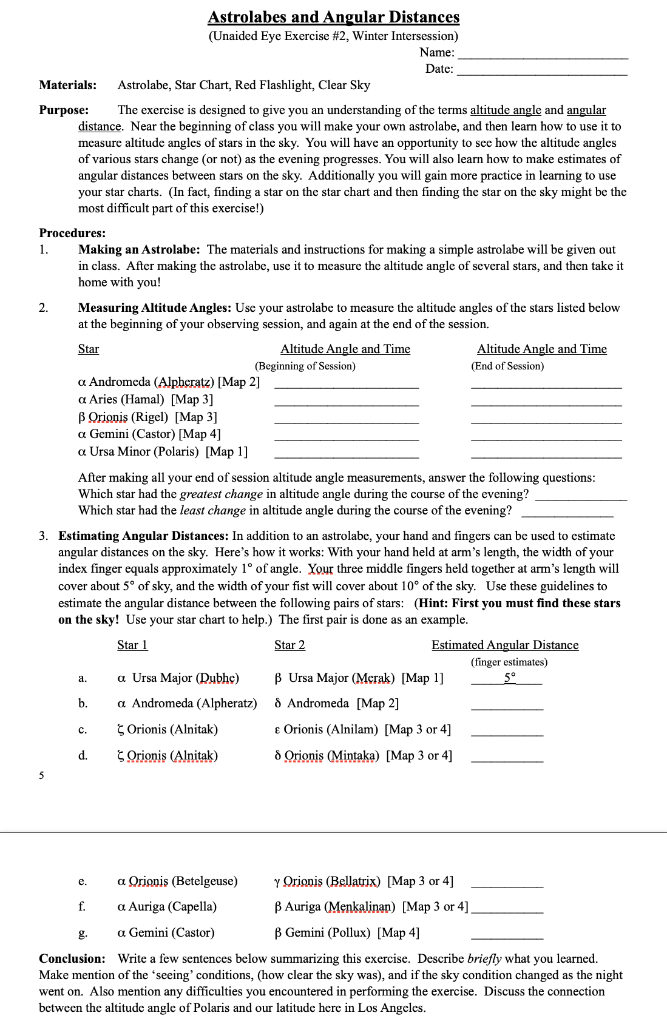
Materials: Astrolabe, Star Chart, Red Flashlight, Clear Sky Purpose: The exercise is designed to give you an understanding of the terms altitude angle and angular distance. Near the beginning of class you will make your own astrolabe, and then learn how to use it to measure altitude angles of stars in the sky. You will have an opportunity to see how the altitude angles of various stars change (or not) as the evening progresses. You will also learn how to make estimates of angular distances between stars on the sky. Additionally you will gain more practice in learning to use your star charts. (In fact, finding a star on the star chart and then finding the star on the sky might be the most difficult part of this exercise!) Procedures: 1. 2. Making an Astrolabe: The materials and instructions for making a simple astrolabe will be given out in class. After making the astrolabe, use it to measure the altitude angle of several stars, and then take it home with you! Measuring Altitude Angles: Use your astrolabe to measure the altitude angles of the stars listed below at the beginning of your observing session, and again at the end of the session. Star a Andromeda (Alpberatz) [Map 2] a Aries (Hamal) [Map 3] Orionis (Rigel) [Map 3] a Gemini (Castor) [Map 4] a Ursa Minor (Polaris) [Map 1] Astrolabes and Angular Distances (Unaided Eye Exercise #2, Winter Intersession) Name: Date: a. b. After making all your end of session altitude angle measurements, answer the following questions: Which star had the greatest change in altitude angle during the course of the evening? Which star had the least change in altitude angle during the course of the evening? C. 3. Estimating Angular Distances: In addition to an astrolabe, your hand and fingers can be used to estimate angular distances on the sky. Here's how it works: With your hand held at arm's length, the width of your index finger equals approximately 1 of angle. Your three middle fingers held together at arm's length will cover about 5 of sky, and the width of your fist will cover about 10 of the sky. Use these guidelines to estimate the angular distance between the following pairs of stars: (Hint: First you must find these stars on the sky! Use your star chart to help.) The first pair is done as an example. Star 1 Star 2 d. e. (Beginning of Session) f. Altitude Angle and Time a Ursa Major (Dubhe) a Andromeda (Alpheratz) Orionis (Alnitak) Orionis (Alnitak) Altitude Angle and Time (End of Session) Estimated Angular Distance (finger estimates) B Ursa Major (Merak) [Map 1] 8 Andromeda [Map 2] & Orionis (Alnilam) [Map 3 or 4] 8 Orionis (Mintaka) [Map 3 or 4] a Orionis (Betelgeuse) y Orionis (Bellatrix) [Map 3 or 4] a Auriga (Capella) B Auriga (Menkalinan) [Map 3 or 4]. g. a Gemini (Castor) Gemini (Pollux) [Map 4] Conclusion: Write a few sentences below summarizing this exercise. Describe briefly what you learned. Make mention of the 'seeing' conditions, (how clear the sky was), and if the sky condition changed as the night went on. Also mention any difficulties you encountered in performing the exercise. Discuss the connection between the altitude angle of Polaris and our latitude here in Los Angeles.
Step by Step Solution
3.43 Rating (150 Votes )
There are 3 Steps involved in it

Get step-by-step solutions from verified subject matter experts
 Study Help