







Question: Math 151 HW1B Directions: . Use only the material in Section 2.1 and the class videos for this home- work. No credit awarded for solutions
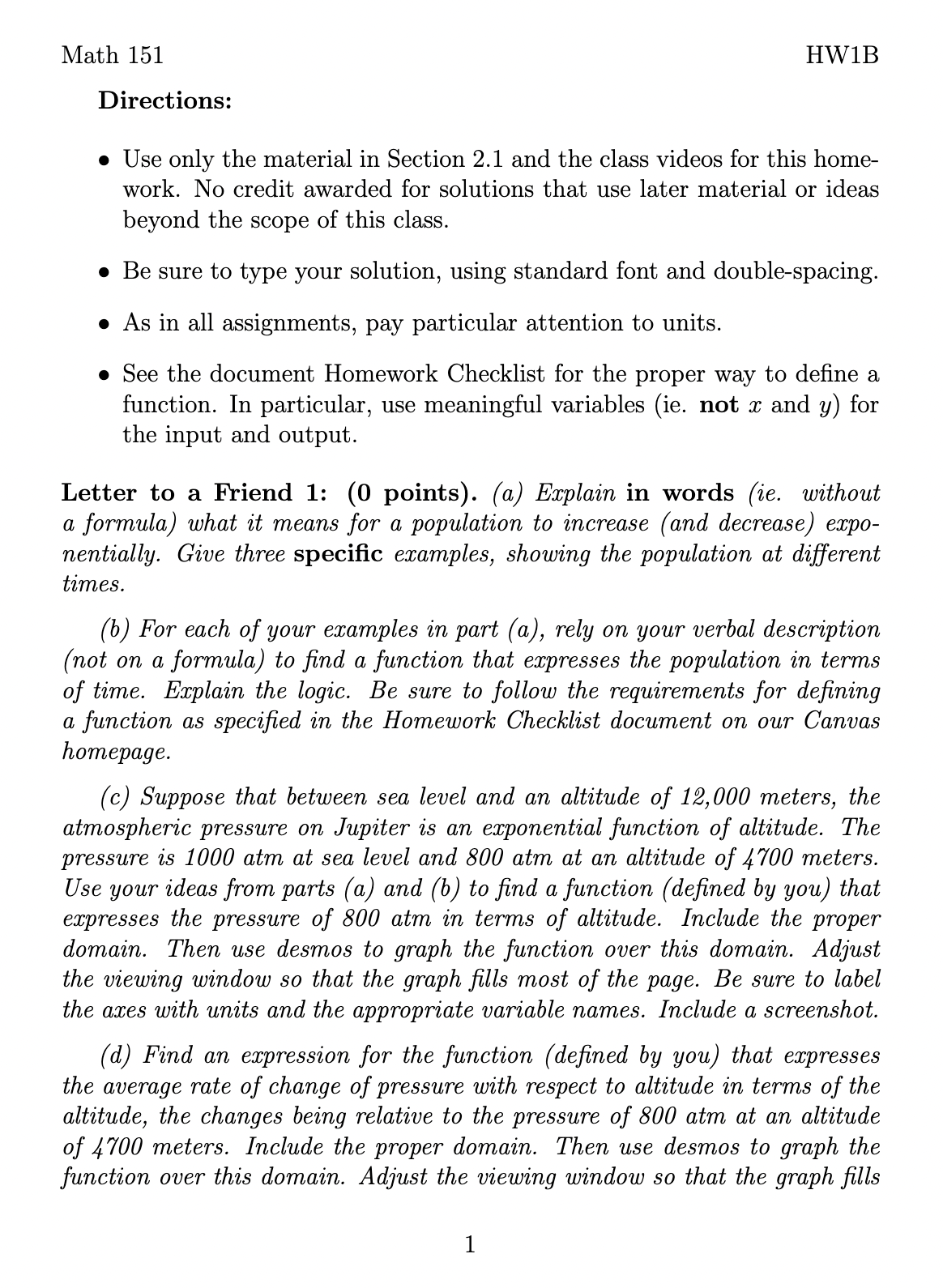
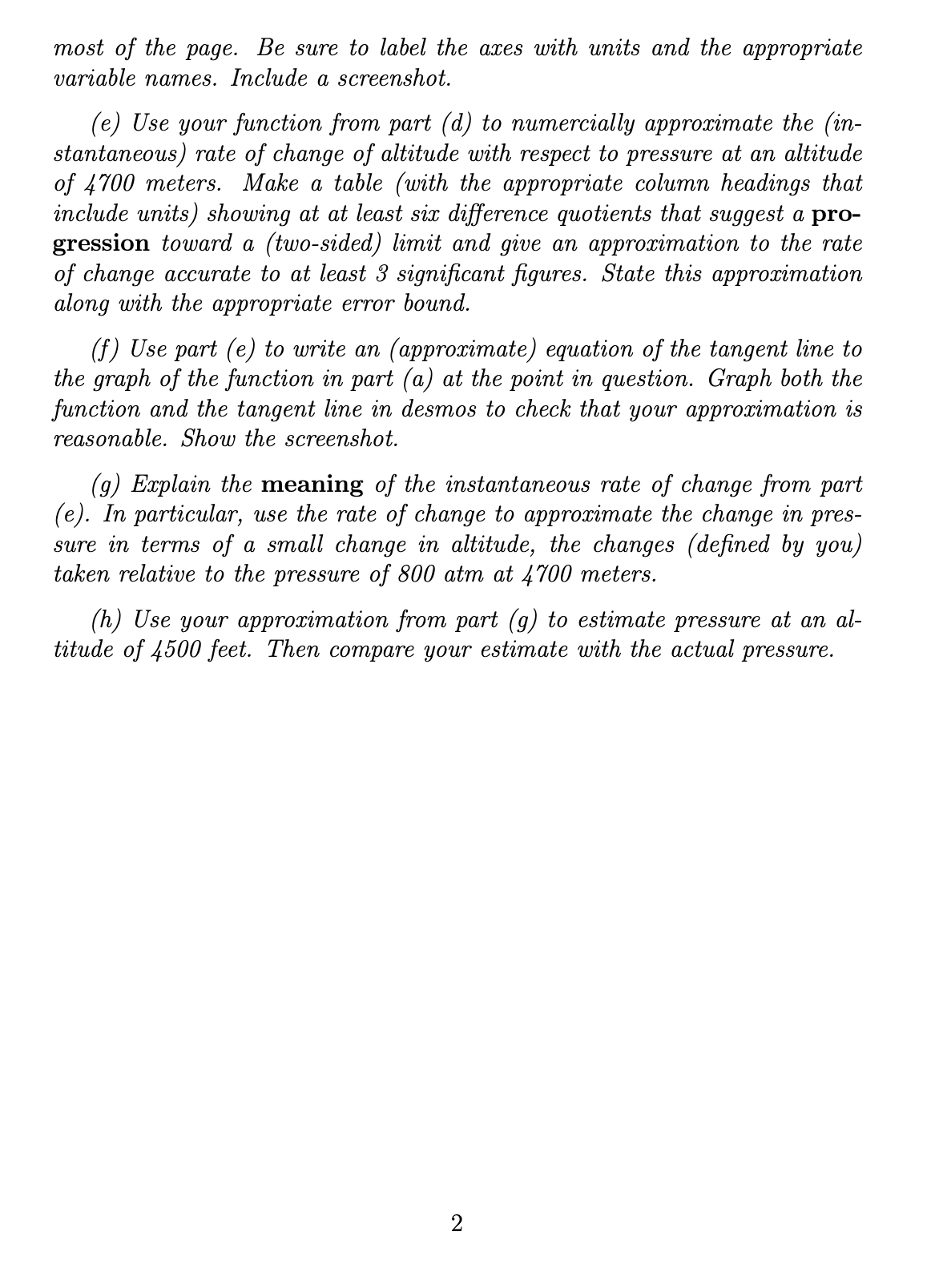
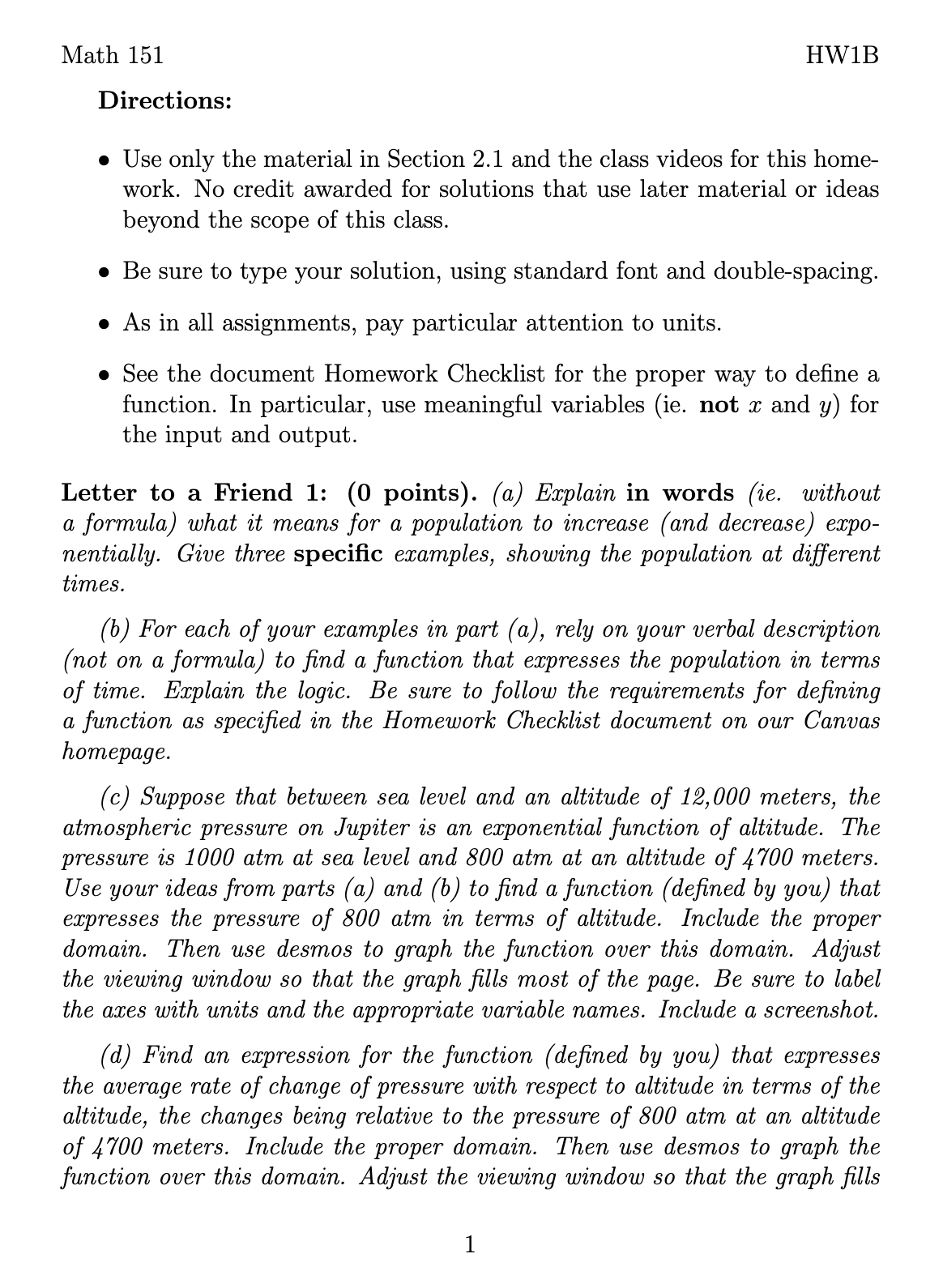
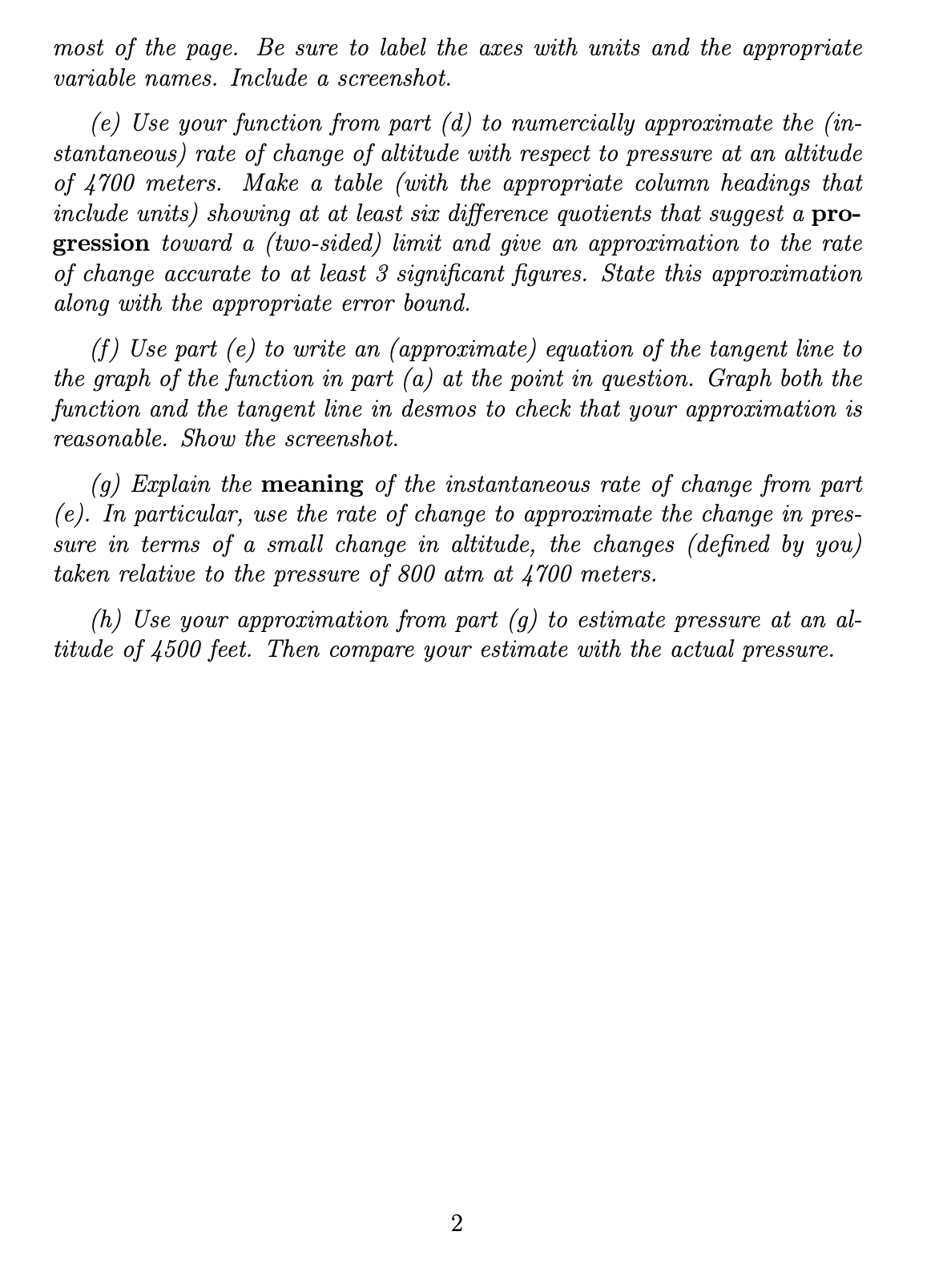
Math 151 HW1B Directions: . Use only the material in Section 2.1 and the class videos for this home- work. No credit awarded for solutions that use later material or ideas beyond the scope of this class. . Be sure to type your solution, using standard font and double-spacing. . As in all assignments, pay particular attention to units. . See the document Homework Checklist for the proper way to define a function. In particular, use meaningful variables (ie. not x and y) for the input and output. Letter to a Friend 1: (0 points). (a) Explain in words (ie. without a formula) what it means for a population to increase (and decrease) expo- nentially. Give three specific examples, showing the population at different times. (b) For each of your examples in part (a), rely on your verbal description (not on a formula) to find a function that expresses the population in terms of time. Explain the logic. Be sure to follow the requirements for defining a function as specified in the Homework Checklist document on our Canvas homepage. (c) Suppose that between sea level and an altitude of 12,000 meters, the atmospheric pressure on Jupiter is an exponential function of altitude. The pressure is 1000 atm at sea level and 800 atm at an altitude of 4700 meters. Use your ideas from parts (a) and (b) to find a function (defined by you) that expresses the pressure of 800 atm in terms of altitude. Include the proper domain. Then use desmos to graph the function over this domain. Adjust the viewing window so that the graph fills most of the page. Be sure to label the axes with units and the appropriate variable names. Include a screenshot. (d) Find an expression for the function (defined by you) that expresses the average rate of change of pressure with respect to altitude in terms of the altitude, the changes being relative to the pressure of 800 atm at an altitude of 4700 meters. Include the proper domain. Then use desmos to graph the function over this domain. Adjust the viewing window so that the graph fills 1most of the page. Be sure to label the axes with units and the appropriate variable names. Include a screenshot. (e) Use your function from part (d) to numercially approximate the (in- stantaneous) rate of change of altitude with respect to pressure at an altitude of 4700 meters. Make a table (with the appropriate column headings that include units) showing at at least six dierence quotients that suggest a pro- gression toward a (two-sided) limit and give an approximation to the rate of change accurate to at least 5' signicant gures. State this approximation along with the appropriate error bound. (f ) Use part (c) to write an (approximate) equation of the tangent line to the graph of the function in part (a) at the point in question. Graph both the function and the tangent line in desmos to check that your approximation is reasonable. Show the screenshot. (g) Explain the meaning of the instantaneous rate of change from part (e). In particular, use the rate of change to approximate the change in pres- sure in terms of a small change in altitude, the changes (dened by you) taken relative to the pressure of 800 atm at 4700 meters. (h) Use your approximation from part (g) to estimate pressure at an al titude of 4500 feet. Then compare your estimate with the actual pressure
Step by Step Solution
There are 3 Steps involved in it

Get step-by-step solutions from verified subject matter experts
 Study Help