







Question: MATH 4044 - Statistics for Data Sciences Case Study SP5 2024 Due 2nd June 2024 by 11:59pm Instructions . This assignment is worth 35% of

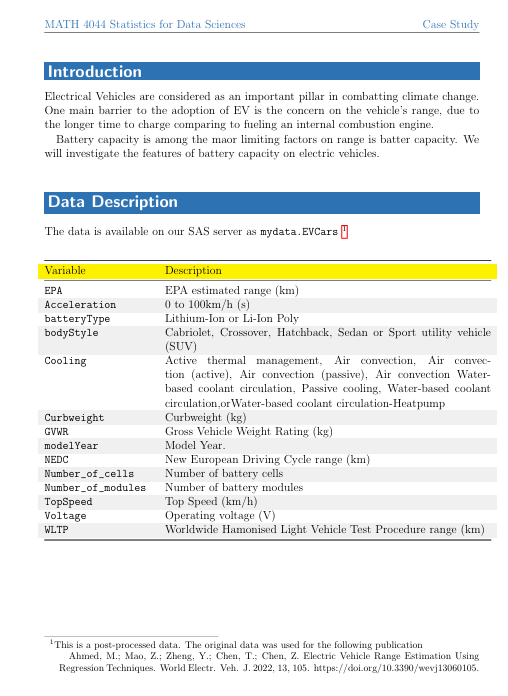
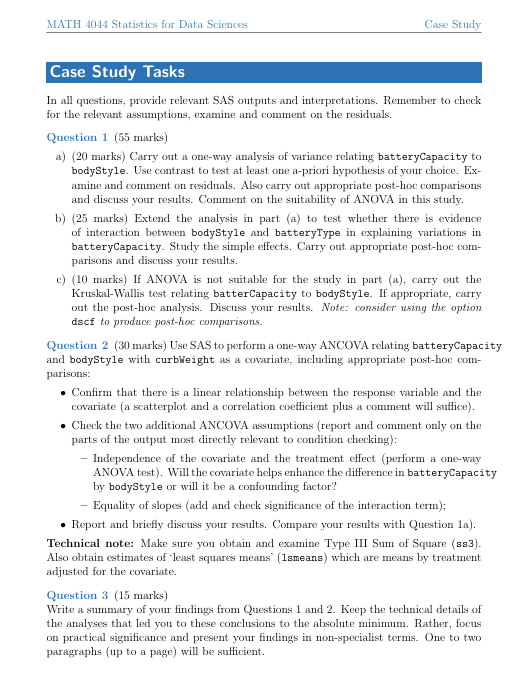
MATH 4044 - Statistics for Data Sciences Case Study SP5 2024 Due 2nd June 2024 by 11:59pm Instructions . This assignment is worth 35% of your final mark. It is due no later than 2nd June 2024 by 11:59pm. . You will need to submit your assignment via learnonline. . The submitted assignment needs to be a single file, in either a Microsoft Word (doe or doex) or pdf file format, 25 pages at most excluding any appendices. . The assignment is out of 100 marks. To achieve maximum marks for each question. you should aim to: - Complete the requested statistical analysis in SAS using appropriate tasks or procedures (40%%). - Include only the output most relevant to the question and interpret all key results (40%). Do not include every piece of output produced by SAS! Discuss the results more broadly in the context of the given scenario (20%). . Assignments submitted late, without an extension being granted, will attract a penalty of 10 marks per each working day or any part thereof beyond the due date and time.MATH 4044 Statistics for Data Sciences Case Study Introduction Electrical Vehicles are considered as an important pillar in combatting climate change. One main barrier to the adoption of EV is the concern on the vehicle's range, due to the longer time to charge comparing to fueling an internal combustion engine. Battery capacity is among the maor limiting factors on range is batter capacity. We will investigate the features of battery capacity on electric vehicles. Data Description The data is available on our SAS server as mydata. EVCars I Variable Description EPA EPA estimated range (km) Acceleration 0 to 100km/h (s) batteryType Lithium-Ion or Li-Ion Poly bodyStyle Cabriolet. Crossover, Hatchback, Sedan or Sport utility vehicle (SUV) Cooling Active thermal management, Air convection. Air conver- tion (active). Air convection (passive), Air convection Water- based coolant circulation, Passive cooling, Water-based coolant circulation, or Water-based coolant circulation-Heatpump Curbweight Curbweight (kg) GVWR Gross Vehicle Weight Rating (kg) modelYear Model Year- NEDC New European Driving Cycle range (km) Number_of_cells Number of battery cells Number_of_modules Number of battery modules TopSpeed Top Speed (km/h) Voltage Operating voltage (V) WLTP Worldwide Hamonised Light Vehicle Test Procedure range (km) This is a post-processed data. The original data was used for the following publication Ahmed, M.; Man, Z.; Zheng, Y.; Chen, T.; Chen, Z. Electric Vehicle Range Estimation Using Regression Techniques. World Electr. Veh. J. 2022, 13, 105. https://dotorg/10.3390/wevj13060105.MATH 4044 Statistics for Data Sciences Case Study Case Study Tasks In all questions, provide relevant SAS outputs and interpretations. Remember to check for the relevant assumptions, examine and comment on the residuals. Question 1 (55 marks) a) (20 marks) Carry out a one-way analysis of variance relating batteryCapacity to bodyStyle. Use contrast to test at least one a-priori hypothesis of your choice. Ex- amine and comment on residuals. Also carry out appropriate post-hoc comparisons and discuss your results. Comment on the suitability of ANOVA in this study. b) (25 marks) Extend the analysis in part (a) to test whether there is evidence of interaction between bodyStyle and batteryType in explaining variations in batteryCapacity. Study the simple effects. Carry out appropriate post-hoc com- parisons and discuss your results. c) (10 marks) If ANOVA is not suitable for the study in part (a), carry out the Kruskal-Wallis test relating batterCapacity to bodyStyle. If appropriate, carry out the post-hoc analysis. Discuss your results. Note: consider using the option decf to produce post-hoc comparisons. Question 2 (30 marks) Use SAS to perform a one-way ANCOVA relating batteryCapacity and bodyStyle with curbWeight as a covariate, including appropriate post-hoc com- parisons: . Confirm that there is a linear relationship between the response variable and the covariate (a scatterplot and a correlation coefficient plus a comment will suffice). . Check the two additional ANCOVA assumptions (report and comment only on the parts of the output most directly relevant to condition checking): - Independence of the covariate and the treatment effect (perform a one-way ANOVA test). Will the covariate helps enhance the difference in batteryCapacity by bodyStyle or will it be a confounding factor? - Equality of slopes (add and check significance of the interaction term); . Report and briefly discuss your results. Compare your results with Question la). Technical note: Make sure you obtain and examine Type III Sum of Square (ss3). Also obtain estimates of 'least squares means' (lameans) which are means by treatment adjusted for the covariate. Question 3 (15 marks) Write a summary of your findings from Questions 1 and 2. Keep the technical details of the analyses that led you to these conclusions to the absolute minimum. Rather, focus on practical significance and present your findings in non-specialist terms. One to two paragraphs (up to a page) will be sufficient
Step by Step Solution
There are 3 Steps involved in it

Get step-by-step solutions from verified subject matter experts
 Study Help