







Question: question: output: Question 01 - Computer-Assisted Instruction (70 points) Part (a): Computer-Assisted Instruction - Computer- assisted instruction (CAI) refers to the use of computers in
question: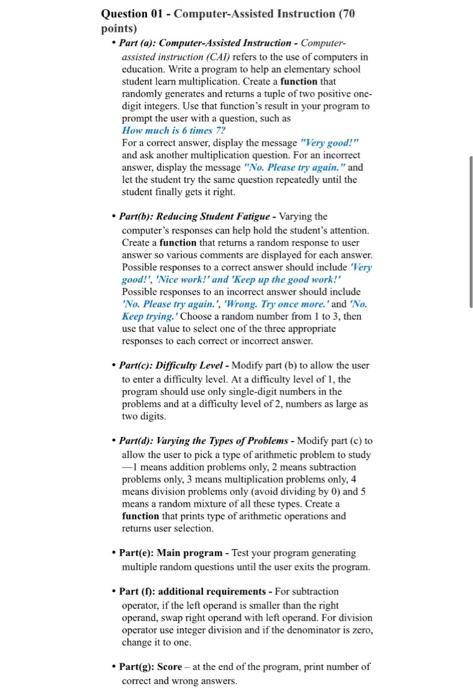
output:
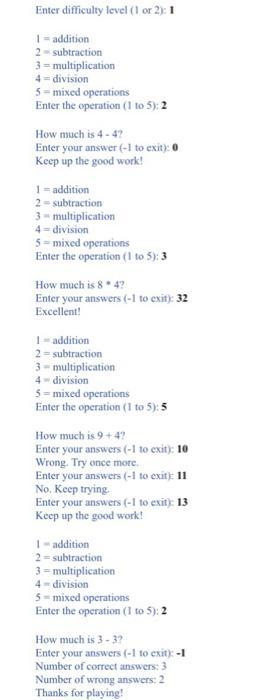
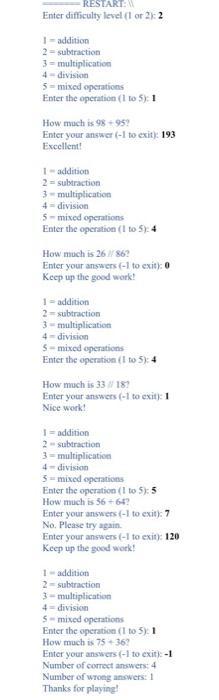
Question 01 - Computer-Assisted Instruction (70 points) Part (a): Computer-Assisted Instruction - Computer- assisted instruction (CAI) refers to the use of computers in education. Write a program to help an elementary school student learn multiplication. Create a function that randomly generates and returns a tuple of two positive one- digit integers. Use that function's result in your program to prompt the user with a question, such as How much is 6 times 7? For a correct answer, display the message "Very good!" and ask another multiplication question. For an incorrect answer, display the message "No. Please try again." and let the student try the same question repeatedly until the student finally gets it right. Part(b): Reducing Student Fatigue - Varying the computer's responses can help hold the student's attention. Create a function that returns a random response to user answer so various comments are displayed for each answer. Possible responses to a correct answer should include 'Very good!", "Nice work!' and 'Keep up the good work!" Possible responses to an incorrect answer should include 'No. Please try again.', 'Wrong. Try once more.' and 'No. Keep trying. Choose a random number from 1 to 3, then use that value to select one of the three appropriate responses to each correct or incorrect answer. Part(c): Difficulty Level-Modify part (b) to allow the user to enter a difficulty level. At a difficulty level of 1, the program should use only single-digit numbers in the problems and at a difficulty level of 2, numbers as large as two digits. Part(d): Varying the Types of Problems - Modify part (c) to allow the user to pick a type of arithmetic problem to study -I means addition problems only, 2 means subtraction problems only, 3 means multiplication problems only, 4 means division problems only (avoid dividing by 0) and 5 means a random mixture of all these types. Create a function that prints type of arithmetic operations and returns user selection. Part(e): Main program - Test your program generating multiple random questions until the user exits the program. Part (f): additional requirements - For subtraction operator, if the left operand is smaller than the right operand, swap right operand with left operand. For division operator use integer division and if the denominator is zero, change it to one. Part(g): Score - at the end of the program, print number of correct and wrong answers.
Step by Step Solution
3.44 Rating (160 Votes )
There are 3 Steps involved in it
Question code import random imported for generating random numbers This function is for printing the result of the leavegame Two variables are passed number of correct answer and number of wrong answe... View full answer

Get step-by-step solutions from verified subject matter experts
 Study Help