







Question: mathlab. SEQUENCE GENERATION Objective: To generate some sequences that feature prominently in the study of discrete signals and systems. Commands: linspace() cos() imago plot() xlabel()
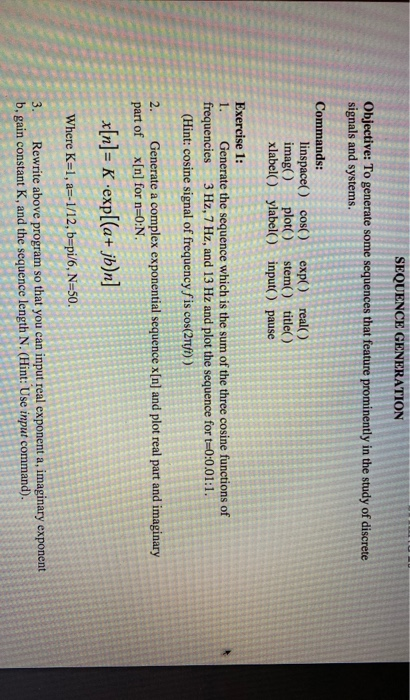
SEQUENCE GENERATION Objective: To generate some sequences that feature prominently in the study of discrete signals and systems. Commands: linspace() cos() imago plot() xlabel() ylabel() expo real stem) title() input() pause Exercise 1: 1. Generate the sequence which is the sum of the three cosine functions of frequencies 3 Hz, 7 Hz, and 13 Hz and plot the sequence for t=0:0.01:1. (Hint: cosine signal of frequencyf is cos(21tft)) 2. Generate a complex exponential sequence x[n) and plot real part and imaginary part of x[n] for n=0:N. x[n] = K exp[(a+ jb)n] Where K=1, a=-1/12, b=pi/6, N=50. 3. Rewrite above program so that you can input real exponent a, imaginary exponent b. gain constant K, and the sequence length N. (Hint: Use input command). SEQUENCE GENERATION Objective: To generate some sequences that feature prominently in the study of discrete signals and systems. Commands: linspace() cos() imago plot() xlabel() ylabel() expo real stem) title() input() pause Exercise 1: 1. Generate the sequence which is the sum of the three cosine functions of frequencies 3 Hz, 7 Hz, and 13 Hz and plot the sequence for t=0:0.01:1. (Hint: cosine signal of frequencyf is cos(21tft)) 2. Generate a complex exponential sequence x[n) and plot real part and imaginary part of x[n] for n=0:N. x[n] = K exp[(a+ jb)n] Where K=1, a=-1/12, b=pi/6, N=50. 3. Rewrite above program so that you can input real exponent a, imaginary exponent b. gain constant K, and the sequence length N. (Hint: Use input command)
Step by Step Solution
There are 3 Steps involved in it

Get step-by-step solutions from verified subject matter experts
 Study Help