







Question: MATLAB BIOINFORMATICS HOMEWORK HELP start code with this: % A trial sequence with all amino acids: % ARNDCQEGHILKMFPSTWYV % The trial sequences in the HW
MATLAB BIOINFORMATICS HOMEWORK HELP
start code with this:
% A trial sequence with all amino acids:
% ARNDCQEGHILKMFPSTWYV
% The trial sequences in the HW description:
% ARNDCQE
% ARNCDE
% Ask the user for protein sequence 1.
prompt = 'Enter the first amino acid sequence of length 1 to 25: ';
seq1 = input(prompt, 's');
len1 = length(seq1);
fprintf(1, 'Seq 1 %s has %d residues ', seq1, len1);
% Ask the user for protein sequence 2.
prompt = 'Enter the second amino acid sequence of length 1 to 25: ';
seq2 = input(prompt, 's');
len2 = length(seq2);
fprintf(1, 'Seq 2 %s has %d residues ', seq2, len2);
% Initialize a 25x25 matrix of zeros.
A = zeros(25,25);
% The supplied initMatrix must be modified!
A = initMatrix(A, seq1, seq2);
% Print the matrix A.
printMatrix(A, seq1, seq2);
end
% Print out a matrix
function mat = initMatrix(mat, seq1, seq2)
numRows = length(seq1) + 1;
numCols = length(seq2) + 1;
mat(1,1) = 0; % Init the value at (1,1) to 0.
% Initialize the first column.
for i=2:numRows
% Do something here!
end
% Initialize the first row.
for c=2:numCols
% Do something here!
end
% Init the rest of the matrix.
for r=2:numRows
for c=2:numCols
% Do something here!
end
end
end
% Print out a matrix
function printMatrix(mat, seq1, seq2)
len1 = length(seq1);
len2 = length(seq2);
% Print the first row of sequence letters
fprintf(1,'\t\t');
for r=1:len2
fprintf(1,'%2c\t', seq2(r));
end
fprintf(1,' ');
% Print the first row of scores.
fprintf(1,'\t');
for c=1:len2+1
fprintf('%2d\t', mat(1,c));
end
fprintf(1,' ');
% Print the rest of the scores.
for r=2:len1+1
% Print the first letter of vertical sequence
fprintf(1, '%c\t', seq1(r-1));
for c=1:len2+1
fprintf(1,'%2d\t',mat(r,c));
end
fprintf(1,' ');
end
end
function value = scorePair(char1, char2)
% Order: ARNDCQEGHILKMFPSTWYV
i1 = aaToInt(char1);
i2 = aaToInt(char2);
A = [
4 -1 -2 -2 0 -1 -1 0 -2 -1 -1 -1 -1 -2 -1 1 0 -3 -2 0;
- 1 5 0 -2 -3 1 0 -2 0 -3 -2 2 -1 -3 -2 -1 -1 -3 -2 -3;
- 2 0 6 1 -3 0 0 0 1 -3 -3 0 -2 -3 -2 1 0 -4 -2 -3;
- 2 -2 1 6 -3 0 2 -1 -1 -3 -4 -1 -3 -3 -1 0 -1 -4 -3 -3;
0 -3 -3 -3 9 -3 -4 -3 -3 -1 -1 -3 -1 -2 -3 -1 -1 -2 -2 -1;
- 1 1 0 0 -3 5 2 -2 0 -3 -2 1 0 -3 -1 0 -1 -2 -1 -2;
- 1 0 0 2 -4 2 5 -2 0 -3 -3 1 -2 -3 -1 0 -1 -3 -2 -2;
0 -2 0 -1 -3 -2 -2 6 -2 -4 -4 -2 -3 -3 -2 0 -2 -2 -3 -3;
- 2 0 1 -1 -3 0 0 -2 8 -3 -3 -1 -2 -1 -2 -1 -2 -2 2 -3;
- 1 -3 -3 -3 -1 -3 -3 -4 -3 4 2 -3 1 0 -3 -2 -1 -3 -1 3;
- 1 -2 -3 -4 -1 -2 -3 -4 -3 2 4 -2 2 0 -3 -2 -1 -2 -1 1;
- 1 2 0 -1 -3 1 1 -2 -1 -3 -2 5 -1 -3 -1 0 -1 -3 -2 -2;
- 1 -1 -2 -3 -1 0 -2 -3 -2 1 2 -1 5 0 -2 -1 -1 -1 -1 1;
- 2 -3 -3 -3 -2 -3 -3 -3 -1 0 0 -3 0 6 -4 -2 -2 1 3 -1;
- 1 -2 -2 -1 -3 -1 -1 -2 -2 -3 -3 -1 -2 -4 7 -1 -1 -4 -3 -2;
1. -1 1 0 -1 0 0 0 -1 -2 -2 0 -1 -2 -1 4 1 -3 -2 -2;
0 -1 0 -1 -1 -1 -1 -2 -2 -1 -1 -1 -1 -2 -1 1 5 -2 -2 0;
- 3 -3 -4 -4 -2 -2 -3 -2 -2 -3 -2 -3 -1 1 -4 -3 -2 11 2 -3;
- 2 -2 -2 -3 -2 -1 -2 -3 2 -1 -1 -2 -1 3 -3 -2 -2 2 7 -1;
0 -3 -3 -3 -1 -2 -2 -3 -3 3 1 -2 1 -1 -2 -2 0 -3 -1 4];
value = A(i1, i2);
end
function value = aaToInt(aa)
switch aa
case 'A',
value = 1;
case 'R',
value = 2;
case 'N',
value = 3;
case 'D',
value = 4;
case 'C',
value = 5;
case 'Q',
value = 6;
case 'E',
value = 7;
case 'G',
value = 8;
case 'H',
value = 9;
case 'I',
value = 10;
case 'L',
value = 11;
case 'K',
value = 12;
case 'M',
value = 13;
case 'F',
value = 14;
case 'P',
value = 15;
case 'S',
value = 16;
case 'T',
value = 17;
case 'W',
value = 18;
case 'Y',
value = 19;
case 'V',
value = 20;
otherwise,
value = 1;
end
end
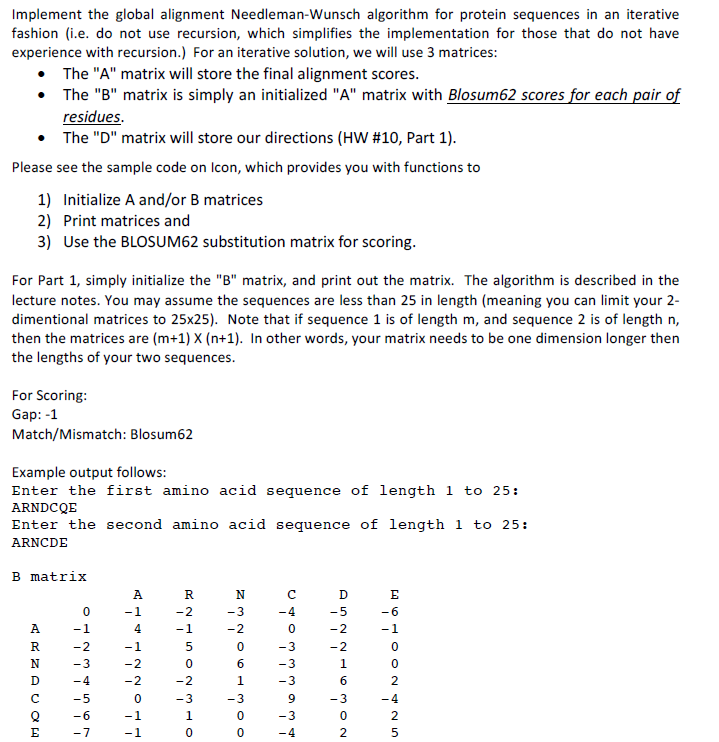
Implement the global alignment Needleman-Wunsch algorithm for protein sequences in an iterative fashion (i.e. do not use recursion, which simplifies the implementation for those that do not have experience with recursion.) For an iterative solution, we will use 3 matrices: The "A" matrix will store the final alignment scores The "B" matrix is simply an initialized "A" matrix with Blosum62 scores for each pair of residues The "D" matrix will store our directions (HW #10, Part 1) . Please see the sample code on Icon, which provides you with functions to 1) Initialize A and/or B matrices Print matrices and 2) 3) Use the BLOSUM62 substitution matrix for scoring For Part 1, simply initialize the "B" matrix, and print out the matrix. The algorithm is described in the lecture notes. You may assume the sequences are less than 25 in length (meaning you can limit your 2 dimentional matrices to 25x25). Note that if sequence 1 is of length m, and sequence 2 is of length n, then the matrices are (m+1) X (n+1). In other words, your matrix needs to be one dimension longer then the lengths of your two sequences For Scoring Gap: -1 Match/Mismatch: Blosum62 Example output follows Enter the first amino acid sequence of length 1 to 25: ARNDCQE Enter the second amino acid sequence of length 1 to 25: ARNCDE B matrix 2 2 2 2 Implement the global alignment Needleman-Wunsch algorithm for protein sequences in an iterative fashion (i.e. do not use recursion, which simplifies the implementation for those that do not have experience with recursion.) For an iterative solution, we will use 3 matrices: The "A" matrix will store the final alignment scores The "B" matrix is simply an initialized "A" matrix with Blosum62 scores for each pair of residues The "D" matrix will store our directions (HW #10, Part 1) . Please see the sample code on Icon, which provides you with functions to 1) Initialize A and/or B matrices Print matrices and 2) 3) Use the BLOSUM62 substitution matrix for scoring For Part 1, simply initialize the "B" matrix, and print out the matrix. The algorithm is described in the lecture notes. You may assume the sequences are less than 25 in length (meaning you can limit your 2 dimentional matrices to 25x25). Note that if sequence 1 is of length m, and sequence 2 is of length n, then the matrices are (m+1) X (n+1). In other words, your matrix needs to be one dimension longer then the lengths of your two sequences For Scoring Gap: -1 Match/Mismatch: Blosum62 Example output follows Enter the first amino acid sequence of length 1 to 25: ARNDCQE Enter the second amino acid sequence of length 1 to 25: ARNCDE B matrix 2 2 2 2
Step by Step Solution
There are 3 Steps involved in it

Get step-by-step solutions from verified subject matter experts
 Study Help