







Question: Matlab coding Plot the Kohler curve for a solute mass of 10-17 g, 10-16 g, and 10-15 g and a temperature of 5 C to
Matlab coding 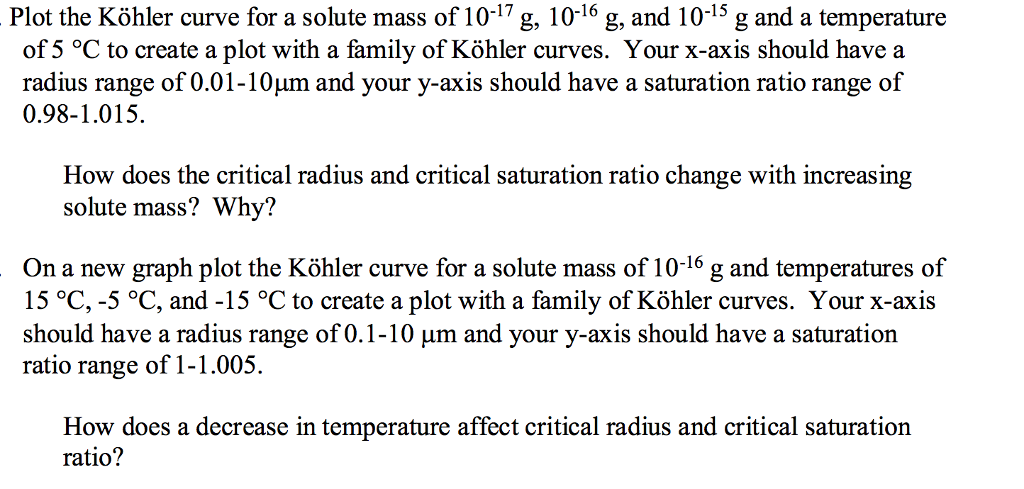 Plot the Kohler curve for a solute mass of 10-17 g, 10-16 g, and 10-15 g and a temperature of 5 C to create a plot with a family of Kohler curves. Your x-axis should have a radius range of 0.01-10m and your y-axis should have a saturation ratio range of 0.98-1.015.
- Plot the Khler curve for a solute mass of 10-17 g, 10-16 g, and 10-15 g and a temperature of 5 C to create a plot with a family of Khler curves. Your x-axis should have a radius range of 0.01-10pm and your y-axis should have a saturation ratio range of 0.98-1.015. How does the critical radius and critical saturation ratio change with increasing solute mass? Why? On a new graph plot the Khler curve for a solute mass of 10-16 g and temperatures of 15 C, -5 C, and -15 C to create a plot with a family of Khler curves. Your x-axis should have a radius range of 0.1-10 um and your y-axis should have a saturation ratio range of 1-1.005. How does a decrease in temperature affect critical radius and critical saturation ratio? - Plot the Khler curve for a solute mass of 10-17 g, 10-16 g, and 10-15 g and a temperature of 5 C to create a plot with a family of Khler curves. Your x-axis should have a radius range of 0.01-10pm and your y-axis should have a saturation ratio range of 0.98-1.015. How does the critical radius and critical saturation ratio change with increasing solute mass? Why? On a new graph plot the Khler curve for a solute mass of 10-16 g and temperatures of 15 C, -5 C, and -15 C to create a plot with a family of Khler curves. Your x-axis should have a radius range of 0.1-10 um and your y-axis should have a saturation ratio range of 1-1.005. How does a decrease in temperature affect critical radius and critical saturation ratio
Step by Step Solution
There are 3 Steps involved in it

Get step-by-step solutions from verified subject matter experts
 Study Help