







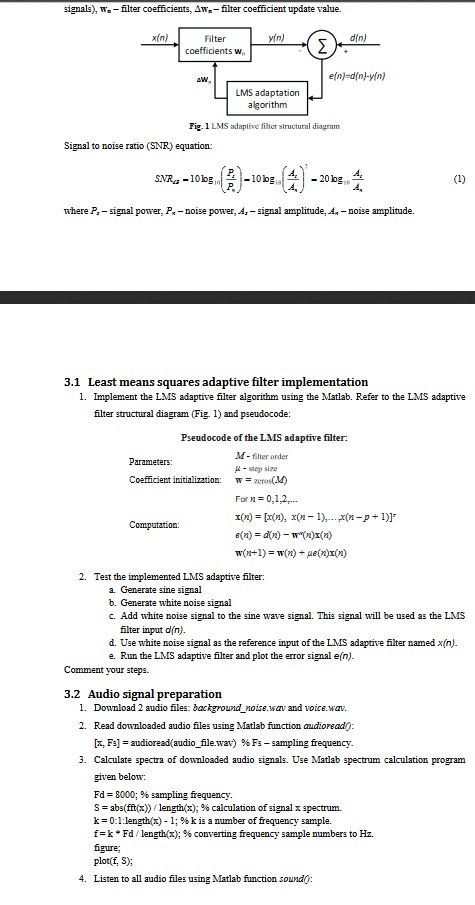
Question: MATLAB CODING:DIGITAL SIGNAL PROCESSING signals), wn-filter coefficients. _ filter coefficient update value. xin) Filter coefficients w in) din) eln)-d(n)-yln) Aw LMS adaptation algorithm Fig. 1
MATLAB CODING:DIGITAL SIGNAL PROCESSING
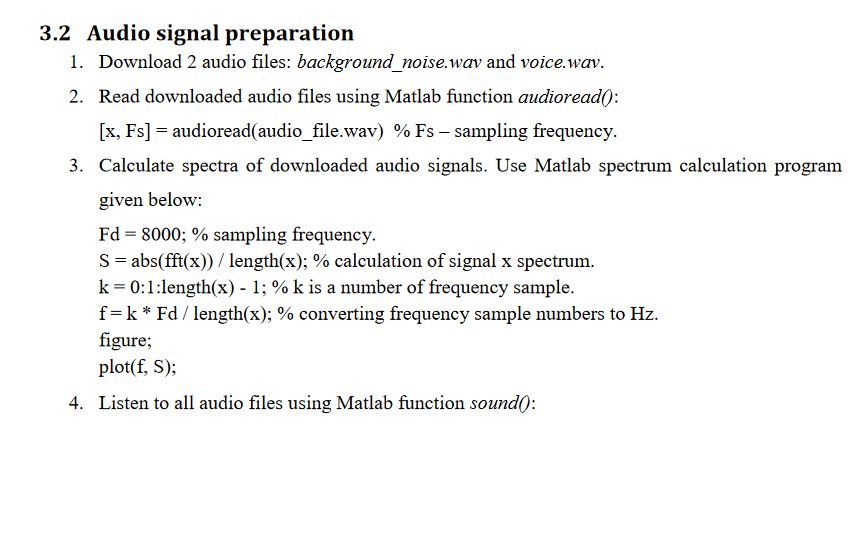
signals), wn-filter coefficients. _ filter coefficient update value. xin) Filter coefficients w in) din) eln)-d(n)-yln) Aw LMS adaptation algorithm Fig. 1 LMS adaptive filher structural diagram Signal to noise ratio (SNR) equation: na,.iobg(2).iobr(2)20h. where P,-signal power. P-noise power, signal amplitude 4-noise amplitude. 3.1 Least means squares adaptive filter implementation 1. Implement the LMS adaptive filter algorithm using the Matlab. Refer to the LMS adaptive filter structural diagram (Fig. 1) and pseudocode: Pseudocode of the LMS adaptive filter: M filter order -siep size w=zeros(U) For n = 0,1,2, Parameters Coefficient initialization: x(n)-[n), x(n-1)n-1) 2. Test the implemented LMS adaptive filter: a. Generate sine signal b. Generate white noise signal c. Add white noise signal to the sine wave signal. This signal will be used as the LMS filter input din) d. Use white noise signal as the reference input of the LMS adaptive filter named x(n). e. Run the LMS adaptive filter and plot the error signal e(n). Comment your steps 3.2 Audio signal preparation 1. Download 2 audio files: background noie.wav and voice.wav. 2. Read downloaded audio files using Matlab function audioread [x, Fs] = audioread(audio file.wav) 96 Fs-sampling frequency. 3. Calculate spectra of downloaded audio signals. Use Matlab spectrum calculation program given below Fd = 8000.96 sampling frequency s-abs(fft(x)) / length(x); % calculation of signal spectrum. k = 0: 1:length(x)-1 ; % k is a number of frequency sample. f-k Fd lengthx);converting frequency sample numbers to Hz. figure; plot(f, S); Listen to all audio files using 4. Matlab function sound: signals), wn-filter coefficients. _ filter coefficient update value. xin) Filter coefficients w in) din) eln)-d(n)-yln) Aw LMS adaptation algorithm Fig. 1 LMS adaptive filher structural diagram Signal to noise ratio (SNR) equation: na,.iobg(2).iobr(2)20h. where P,-signal power. P-noise power, signal amplitude 4-noise amplitude. 3.1 Least means squares adaptive filter implementation 1. Implement the LMS adaptive filter algorithm using the Matlab. Refer to the LMS adaptive filter structural diagram (Fig. 1) and pseudocode: Pseudocode of the LMS adaptive filter: M filter order -siep size w=zeros(U) For n = 0,1,2, Parameters Coefficient initialization: x(n)-[n), x(n-1)n-1) 2. Test the implemented LMS adaptive filter: a. Generate sine signal b. Generate white noise signal c. Add white noise signal to the sine wave signal. This signal will be used as the LMS filter input din) d. Use white noise signal as the reference input of the LMS adaptive filter named x(n). e. Run the LMS adaptive filter and plot the error signal e(n). Comment your steps 3.2 Audio signal preparation 1. Download 2 audio files: background noie.wav and voice.wav. 2. Read downloaded audio files using Matlab function audioread [x, Fs] = audioread(audio file.wav) 96 Fs-sampling frequency. 3. Calculate spectra of downloaded audio signals. Use Matlab spectrum calculation program given below Fd = 8000.96 sampling frequency s-abs(fft(x)) / length(x); % calculation of signal spectrum. k = 0: 1:length(x)-1 ; % k is a number of frequency sample. f-k Fd lengthx);converting frequency sample numbers to Hz. figure; plot(f, S); Listen to all audio files using 4. Matlab function sound
Step by Step Solution
There are 3 Steps involved in it

Get step-by-step solutions from verified subject matter experts
 Study Help