







Question: MATLAB function num_laplace () that numerically computes the Laplace transform of a continuous time signal The function num_laplace () takes as inputs the following: one
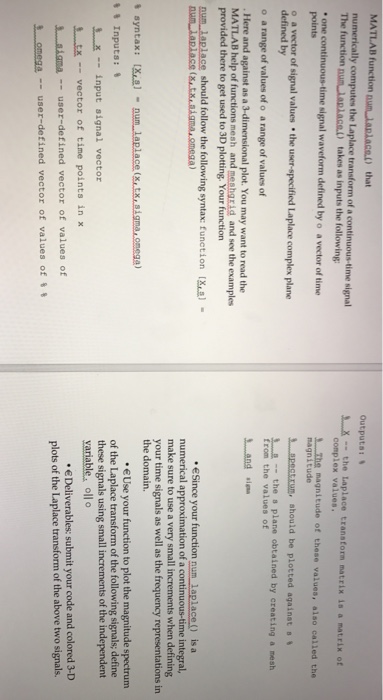
MATLAB function num_laplace () that numerically computes the Laplace transform of a continuous time signal The function num_laplace () takes as inputs the following: one continuous-time signal waveform defined by o a vector of time points a vector of signal values the user-specified Laplace complex plane defined by a range of values of a range of values of Here and against as a 3-dimensional plot. You may want to read the MATLAB help of functions mesh and meshgrid and see the examples provided there to get used to 3D plotting. Your function num_laplace should follow the following syntax: function [x, a] = num_Laplace (x, tx, sigma, omega) syntax: [x, s] = num_laplace (x, tx, sigma, omega) Inputs: % % x -- input signal vector % tx -- vector of time points in x % sigma -- user-defined vector of values of % omega -- omega user-defined vector of values of % % outputs: % % x -- the Laplace transform matrix is a matrix of complex values. % The magnitude of these values, also called the magnitude % spectrum, should be plotted against $ % % s -- the s plane obtained by creating a mesh from the values of % and Since your function num_laplace () is a numerical approximation of a continuous-time integral, make sure to use a very small increments when defining your time signals as well as the frequency representations the domain. Use your function to plot the magnitude of the Laplace transform of the following signals; define these signals using small increments of the independent variable. Deliverables: submit your code and colored 3-D plots of the Laplace transform of the above two signals
Step by Step Solution
There are 3 Steps involved in it

Get step-by-step solutions from verified subject matter experts
 Study Help