







Question: Matlab only Problem Statement: You have a continuous information source that has zero-mean, unit variance Gaussian distribution. Generate a sequence of 500 numbers from this
Matlab only
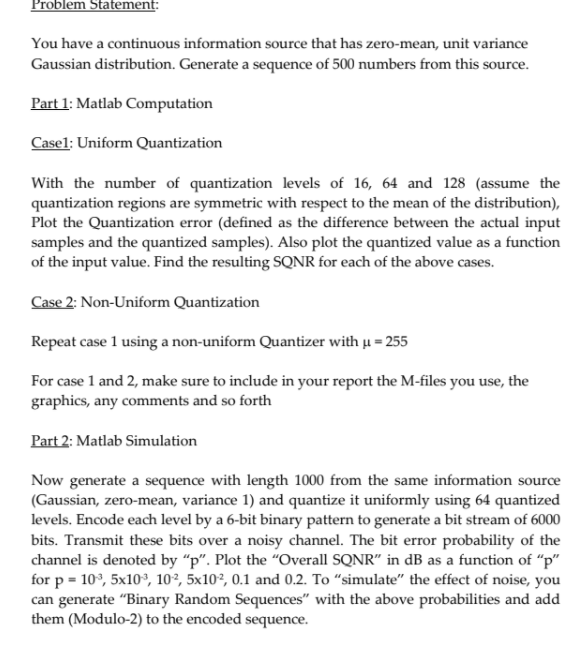
Problem Statement: You have a continuous information source that has zero-mean, unit variance Gaussian distribution. Generate a sequence of 500 numbers from this source. Part 1: Matlab Computation Casel: Uniform Quantization With the number of quantization levels of 16, 64 and 128 (assume the quantization regions are symmetric with respect to the mean of the distribution), Plot the Quantization error (defined as the difference between the actual input samples and the quantized samples). Also plot the quantized value as a function of the input value. Find the resulting SQNR for each of the above cases. Case 2: Non-Uniform Quantization Repeat case 1 using a non-uniform Quantizer with ?-255 For case 1 and 2, make sure to include in your report the M-files you use, the graphics, any comments and so forth Part 2: Matlab Simulation Now generate a sequence with length 1000 from the same information source Gaussian, zero-mean, variance 1) and quantize it uniformly using 64 quantized levels. Encode each level by a 6-bit binary pattern to generate a bit stream of 6000 bits. Transmit these bits over a noisy channel. The bit error probability of the channel is denoted by "p". Plot the "Overall SQNR" in dB as a function of "p" for p 103, 5x10*, 102, 5x10², 0.1 and 0.2. To "simulate" the effect of noise, you can generate "Binary Random Sequences" with the above probabilities and add them (Modulo-2) to the encoded sequence. Problem Statement: You have a continuous information source that has zero-mean, unit variance Gaussian distribution. Generate a sequence of 500 numbers from this source. Part 1: Matlab Computation Casel: Uniform Quantization With the number of quantization levels of 16, 64 and 128 (assume the quantization regions are symmetric with respect to the mean of the distribution), Plot the Quantization error (defined as the difference between the actual input samples and the quantized samples). Also plot the quantized value as a function of the input value. Find the resulting SQNR for each of the above cases. Case 2: Non-Uniform Quantization Repeat case 1 using a non-uniform Quantizer with ?-255 For case 1 and 2, make sure to include in your report the M-files you use, the graphics, any comments and so forth Part 2: Matlab Simulation Now generate a sequence with length 1000 from the same information source Gaussian, zero-mean, variance 1) and quantize it uniformly using 64 quantized levels. Encode each level by a 6-bit binary pattern to generate a bit stream of 6000 bits. Transmit these bits over a noisy channel. The bit error probability of the channel is denoted by "p". Plot the "Overall SQNR" in dB as a function of "p" for p 103, 5x10*, 102, 5x10², 0.1 and 0.2. To "simulate" the effect of noise, you can generate "Binary Random Sequences" with the above probabilities and add them (Modulo-2) to the encoded sequence
Step by Step Solution
There are 3 Steps involved in it

Get step-by-step solutions from verified subject matter experts
 Study Help