







Question: MATLAB ONLY . The velocity.dat file can be found at NMM toolbox directory of MATLAB. 31. (3 (Adapted from Akai [3].) A coast-down test can
MATLAB ONLY
. The velocity.dat file can be found at NMM toolbox directory of MATLAB.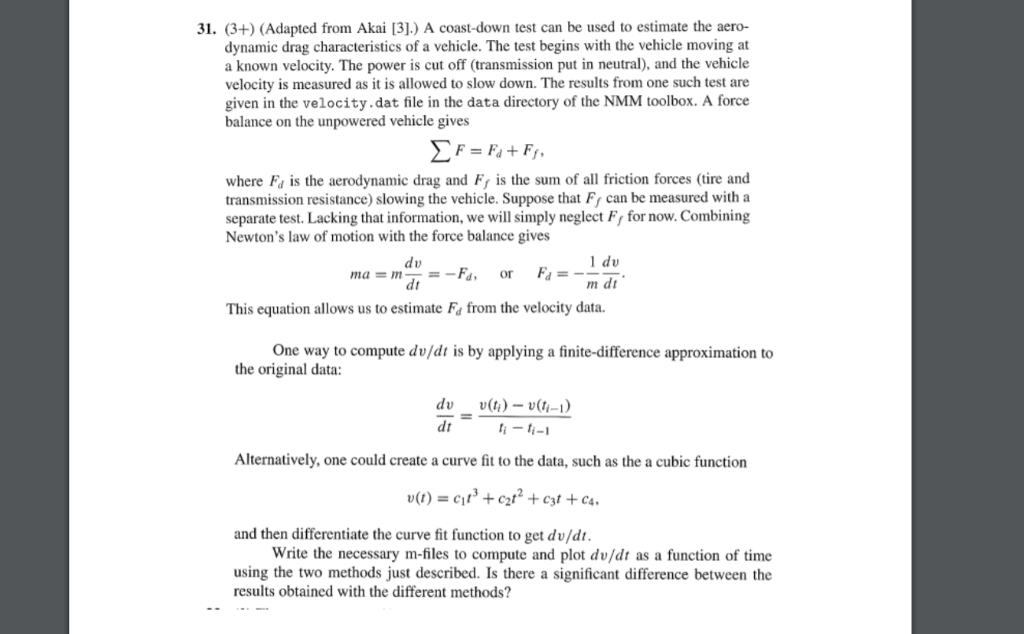
31. (3 (Adapted from Akai [3].) A coast-down test can be used to estimate the aero- dynamic drag characteristics of a vehicle. The test begins with the vehicle moving at a known velocity. The power is cut off (transmission put in neutral), and the vehicle velocity is measured as it is allowed to slow down. The results from one such test are given in the velocity.dat file in the data directory of the NMM toolbox. A force balance on the unpowered vehicle gives where Fa is the aerodynamic drag and F is the sum of all friction forces (tire and transmission resistance) slowing the vehicle. Suppose that Fr can be measured with a separate test. Lacking that information, we will simply neglect F for now. Combining Newton's law of motion with the force balance gives dt m dt This equation allows us to estimate Fa from the velocity data. One way to compute dv/dt is by applying a finite-difference approximation to the original data: dv v(t) -v(-i) Alternatively, one could create a curve fit to the data, such as the a cubic function and then differentiate the curve fit function to get dv/dt Write the necessary m-files to compute and plot dv/dt as a function of time using the two methods just described. Is there a significant difference between the results obtained with the different methods? 31. (3 (Adapted from Akai [3].) A coast-down test can be used to estimate the aero- dynamic drag characteristics of a vehicle. The test begins with the vehicle moving at a known velocity. The power is cut off (transmission put in neutral), and the vehicle velocity is measured as it is allowed to slow down. The results from one such test are given in the velocity.dat file in the data directory of the NMM toolbox. A force balance on the unpowered vehicle gives where Fa is the aerodynamic drag and F is the sum of all friction forces (tire and transmission resistance) slowing the vehicle. Suppose that Fr can be measured with a separate test. Lacking that information, we will simply neglect F for now. Combining Newton's law of motion with the force balance gives dt m dt This equation allows us to estimate Fa from the velocity data. One way to compute dv/dt is by applying a finite-difference approximation to the original data: dv v(t) -v(-i) Alternatively, one could create a curve fit to the data, such as the a cubic function and then differentiate the curve fit function to get dv/dt Write the necessary m-files to compute and plot dv/dt as a function of time using the two methods just described. Is there a significant difference between the results obtained with the different methods
Step by Step Solution
There are 3 Steps involved in it

Get step-by-step solutions from verified subject matter experts
 Study Help