







Question: Matlab problem: This problem implements log linear learning over stages t = 0, 1, 2, ..., T for a two player matrix game. MATLAB problem:
Matlab problem: This problem implements log linear learning over stages t = 0, 1, 2, ..., T for a two player matrix game.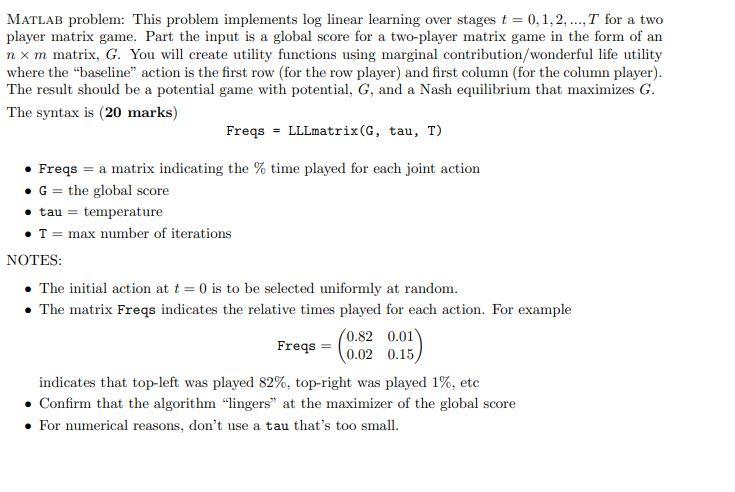
MATLAB problem: This problem implements log linear learning over stages t = 0,1,2,..., T for a two player matrix game. Part the input is a global score for a two-player matrix game in the form of an nx m matrix, G. You will create utility functions using marginal contribution/wonderful life utility where the "baseline" action is the first row (for the row player) and first column (for the column player). The result should be a potential game with potential, G, and a Nash equilibrium that maximizes G. The syntax is (20 marks) Freqs = LLLmatrix(G, tau, T) Freqs = a matrix indicating the % time played for each joint action G = the global score tau = temperature T = max number of iterations NOTES: The initial action at t=0 is to be selected uniformly at random. . The matrix Freqs indicates the relative times played for each action. For example (0.82 0.01 Freqs 0.02 0.15) indicates that top-left was played 82%, top-right was played 1%, etc . Confirm that the algorithm "lingers" at the maximizer of the global score . For numerical reasons, don't use a tau that's too small. ( MATLAB problem: This problem implements log linear learning over stages t = 0,1,2,..., T for a two player matrix game. Part the input is a global score for a two-player matrix game in the form of an nx m matrix, G. You will create utility functions using marginal contribution/wonderful life utility where the "baseline" action is the first row (for the row player) and first column (for the column player). The result should be a potential game with potential, G, and a Nash equilibrium that maximizes G. The syntax is (20 marks) Freqs = LLLmatrix(G, tau, T) Freqs = a matrix indicating the % time played for each joint action G = the global score tau = temperature T = max number of iterations NOTES: The initial action at t=0 is to be selected uniformly at random. . The matrix Freqs indicates the relative times played for each action. For example (0.82 0.01 Freqs 0.02 0.15) indicates that top-left was played 82%, top-right was played 1%, etc . Confirm that the algorithm "lingers" at the maximizer of the global score . For numerical reasons, don't use a tau that's too small. (
Step by Step Solution
There are 3 Steps involved in it

Get step-by-step solutions from verified subject matter experts
 Study Help