







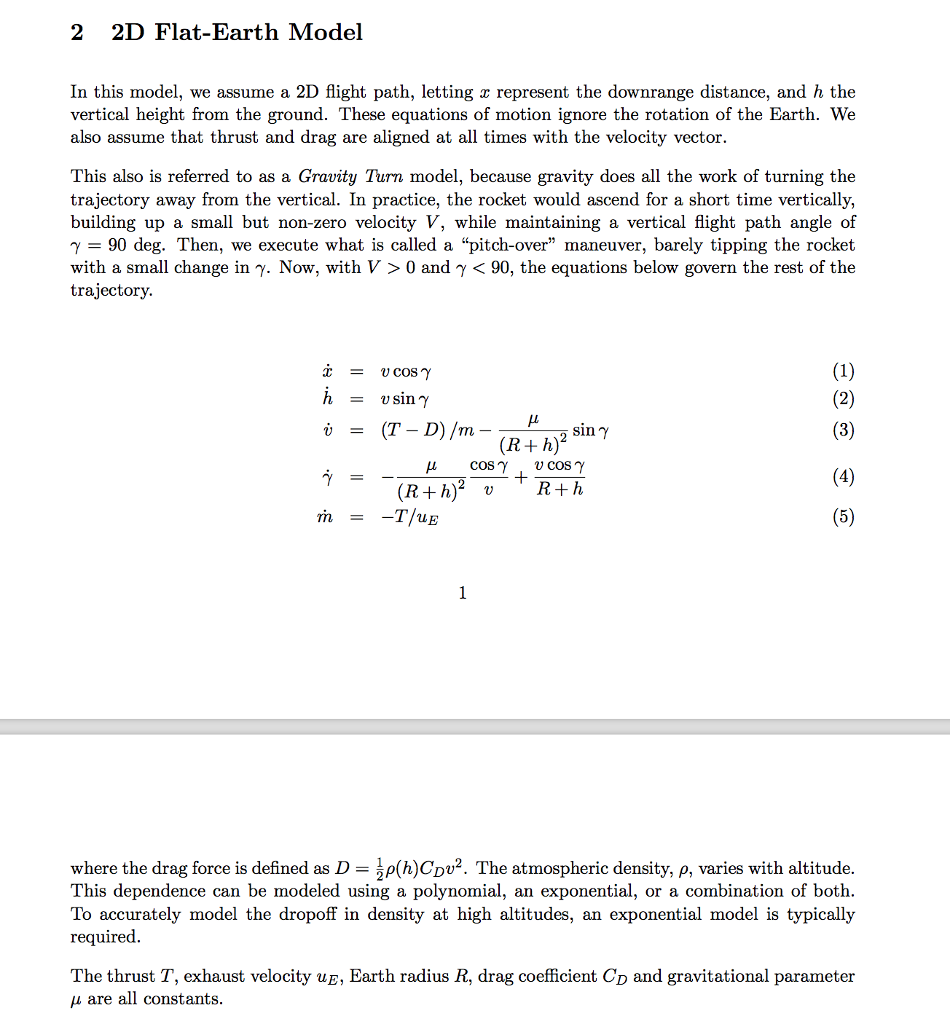
Question: Matlab: Write a right-hand-side m-file for rocket dynamics using the given parameters. The required function AtmDensityEarth.m is included here. Use the 2D-gravity turn model detailed
Matlab: Write a "right-hand-side" m-file for rocket dynamics using the given parameters. The required function AtmDensityEarth.m is included here.
Use the 2D-gravity turn model detailed in the attached image. The purpose of rhs m-file is to test modified eular and runge cutta functions on.
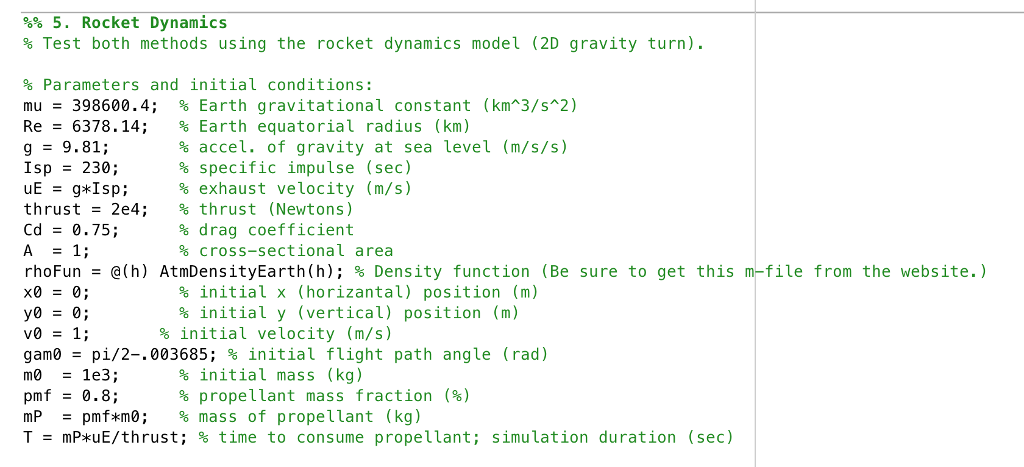
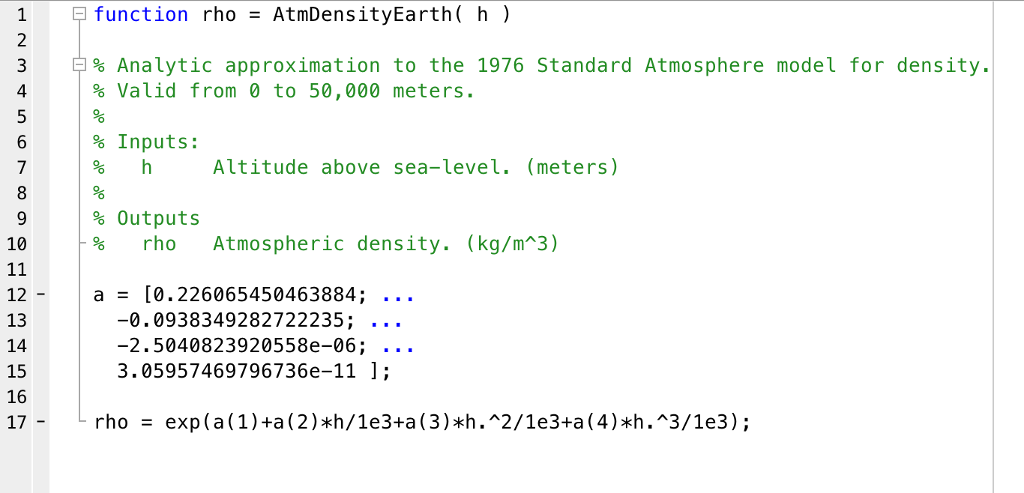
%% 5 . Rocket Dynamics % Test both methods using the rocket dynamics model (2D gravity turn). % Parameters and initial conditions: mu = 398600.4; % Earth gravitational constant (km^3/s^2) Re = 6378.14; % Earth equatorial radius (km) g = 9.81; Isp230; UE = g*Isp; thrust 2e4; % thrust (Newtons) Cd = 0.75; A = 1. rhoFun -@(h) AtmDensityEarth(h); % Density function (Be sure to get this m-file from the website.) x0 = 0; y0 = 0; ve = 1; gam0 pi/2-.003685; % initial flight path angle (rad ) m0 = 1e3 ; pmf = 0.8; mP pmfwm0 ; % mass of propellant (kg) T = mP*ut/thrust; % time to consume propellant; simulation duration (sec) % accel. of gravity at sea level (m/s/s) % specific impulse (sec) % exhaust velocity (m/s) % drag coefficient % cross-sectional area % initial x (horizantal) position (m) % initial y (vertical) position (m) % initial velocity (m/s) % initial mass (kg) % propellant mass fraction (%) %% 5 . Rocket Dynamics % Test both methods using the rocket dynamics model (2D gravity turn). % Parameters and initial conditions: mu = 398600.4; % Earth gravitational constant (km^3/s^2) Re = 6378.14; % Earth equatorial radius (km) g = 9.81; Isp230; UE = g*Isp; thrust 2e4; % thrust (Newtons) Cd = 0.75; A = 1. rhoFun -@(h) AtmDensityEarth(h); % Density function (Be sure to get this m-file from the website.) x0 = 0; y0 = 0; ve = 1; gam0 pi/2-.003685; % initial flight path angle (rad ) m0 = 1e3 ; pmf = 0.8; mP pmfwm0 ; % mass of propellant (kg) T = mP*ut/thrust; % time to consume propellant; simulation duration (sec) % accel. of gravity at sea level (m/s/s) % specific impulse (sec) % exhaust velocity (m/s) % drag coefficient % cross-sectional area % initial x (horizantal) position (m) % initial y (vertical) position (m) % initial velocity (m/s) % initial mass (kg) % propellant mass fraction (%)
Step by Step Solution
There are 3 Steps involved in it

Get step-by-step solutions from verified subject matter experts
 Study Help