



Question: May I ask for your help with my homework in Human Factors Project ? If you can send me a 2 pages analysis similar to
May I ask for your help with my homework in Human Factors Project? If you can send me a 2 pages analysis similar to the below sample "A" paper would be perfect.
The assignment is "Human Factors is an applied science, and the class is intended to be applied. You will choose a topic and update using literature review techniques and a survey of the latest research. The papers will revolve around a Human Factors topic which will be discussed further." The sample of my homework as below attachment.
Please send me the link to the article as well.
Thank you so much,
Likhit
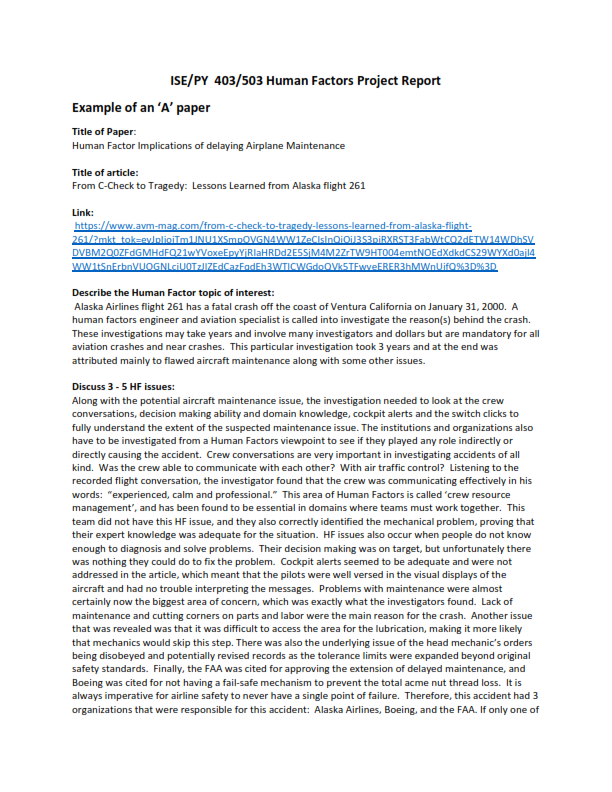
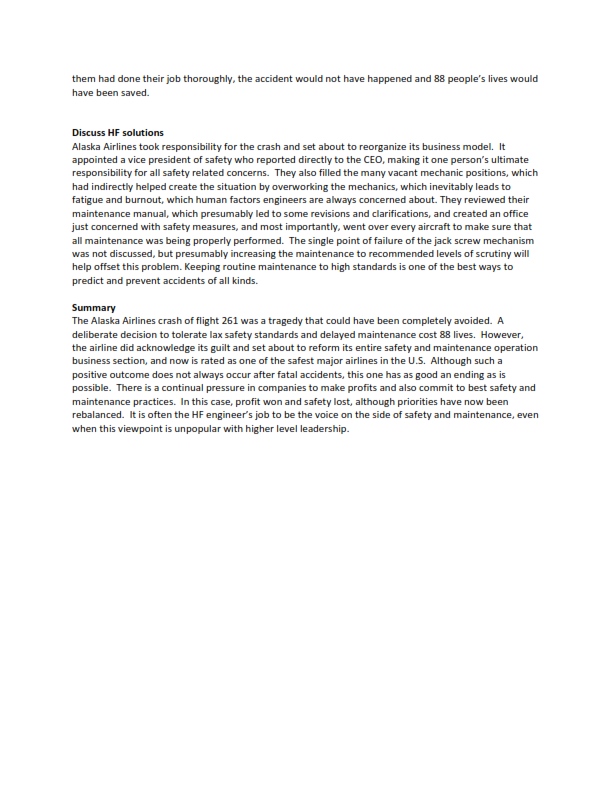
ISE/PY 403/503 Human Factors Project Report Example of an 'A' paper Title of Paper: Human Factor Implications of delaying Airplane Maintenance Title of article: From C-Check to Tragedy: Lessons Learned from Alaska flight 261 Link: https://www.avm-mag.com/from-c-check-to-tragedy-lessons-learned-from-alaska-flight- 261/7mkt tokewlplioiTm 1NUT (X5mDOVGN4WW17eClsInQiQi1353piRXRST3FabWtCO2dETW14WDhSV DVBM200ZFdGMHdFQ21wYVoxeEpyYiRlaHRDd2ESSjM4M2ZrTW9HTO04emtNOEdXdkdCS29WYXd0ajl4 WW.It5nErbnVUOGNIciUOT:JIZEdCazFadEh3WTICWGdoOVk5TEwweEBER3hMWnUifQ%30%% 30 Describe the Human Factor topic of interest: Alaska Airlines flight 261 has a fatal crash off the coast of Ventura California on January 31, 2000. A human factors engineer and aviation specialist is called into investigate the reason(s) behind the crash. These investigations may take years and involve many investigators and dollars but are mandatory for all aviation crashes and near crashes. This particular investigation took 3 years and at the end was attributed mainly to flawed aircraft maintenance along with some other issues. Discuss 3 - 5 HF issues: Along with the potential aircraft maintenance issue, the investigation needed to look at the crew conversations, decision making ability and domain knowledge, cockpit alerts and the switch clicks to fully understand the extent of the suspected maintenance issue. The institutions and organizations also have to be investigated from a Human Factors viewpoint to see if they played any role indirectly or directly causing the accident. Crew conversations are very important in investigating accidents of all kind. Was the crew able to communicate with each other? With air traffic control? Listening to the recorded flight conversation, the investigator found that the crew was communicating effectively in his words: "experienced, calm and professional." This area of Human Factors is called 'crew resource management', and has been found to be essential in domains where teams must work together. This team did not have this HF issue, and they also correctly identified the mechanical problem, proving that their expert knowledge was adequate for the situation. HF issues also occur when people do not know enough to diagnosis and solve problems. Their decision making was on target, but unfortunately there was nothing they could do to fix the problem. Cockpit alerts seemed to be adequate and were not addressed in the article, which meant that the pilots were well versed in the visual displays of the aircraft and had no trouble interpreting the messages. Problems with maintenance were almost certainly now the biggest area of concern, which was exactly what the investigators found. Lack of maintenance and cutting corners on parts and labor were the main reason for the crash. Another issue that was revealed was that it was difficult to access the area for the lubrication, making it more likely that mechanics would skip this step. There was also the underlying issue of the head mechanic's orders being disobeyed and potentially revised records as the tolerance limits were expanded beyond original safety standards. Finally, the FAA was cited for approving the extension of delayed maintenance, and Boeing was cited for not having a fail-safe mechanism to prevent the total acme nut thread loss. It is always imperative for airline safety to never have a single point of failure. Therefore, this accident had 3 organizations that were responsible for this accident: Alaska Airlines, Boeing, and the FAA. If only one ofthem had done their job thoroughly, the accident would not have happened and 88 people's lives would have been saved. Discuss HF solutions Alaska Airlines took responsibility for the crash and set about to reorganize its business model. It appointed a vice president of safety who reported directly to the CEO, making it one person's ultimate responsibility for all safety related concerns. They also filled the many vacant mechanic positions, which had indirectly helped create the situation by overworking the mechanics, which inevitably leads to fatigue and burnout, which human factors engineers are always concerned about. They reviewed their maintenance manual, which presumably led to some revisions and clarifications, and created an office just concerned with safety measures, and most importantly, went over every aircraft to make sure that all maintenance was being properly performed. The single point of failure of the jack screw mechanism was not discussed, but presumably increasing the maintenance to recommended levels of scrutiny will help offset this problem. Keeping routine maintenance to high standards is one of the best ways to predict and prevent accidents of all kinds. Summary The Alaska Airlines crash of flight 261 was a tragedy that could have been completely avoided. A deliberate decision to tolerate lax safety standards and delayed maintenance cost 88 lives. However, the airline did acknowledge its guilt and set about to reform its entire safety and maintenance operation business section, and now is rated as one of the safest major airlines in the U.5. Although such a positive outcome does not always occur after fatal accidents, this one has as good an ending as is possible. There is a continual pressure in companies to make profits and also commit to best safety and maintenance practices. In this case, profit won and safety lost, although priorities have now been rebalanced. It is often the HF engineer's job to be the voice on the side of safety and maintenance, even when this viewpoint is unpopular with higher level leadership
Step by Step Solution
There are 3 Steps involved in it

Get step-by-step solutions from verified subject matter experts