







Question: MBA ( FT ) DATE: 1 0 / 0 1 / 2 0 2 4 MULTIPLE CHOICE QUESTION ( TOTAL MARKS: 2 0 ) The
MBA FT
DATE:
MULTIPLE CHOICE QUESTION TOTAL MARKS:
The complete absorption of one company by another, wherein the acquiring firm retains its identity and the acquired firm ceases to exist as a separate entity, is called a:
a merger.
b consolidation.
c tender offer.
d spinoff.
e edivestiture.
A reason for acquisitions is synergy. Synergy includes:
a Revenue enhancements
b Cost reductions
c Lower taxes
d All of the above
e None of the above
DaimlerBenz's acquisition of Chrysler is an example of:
a Horizontal merger
b Vertical merger
c Crossborder merger
d Both A and
e Both B and C
The following reasons are good motives for mergers except:
a Economies of scale
b Complementary resources
c Diversification
d Unused tax shields
Firm A has a value of million, and has a value of million. Merging the two would allow a cost savings with a present value of million. Firm A purchases B for million. What is the gain from this merger?
a million
b million
c million
d million
Firm A is planning to
Bidding companies often pay too much for the acquired firm. The hubris hypothesis explains this by suggesting that the bidders
a Have too little information to make an optimal decision.
b Have big egos and this impedes rational decisionmaking.
c Have difficulty in thinking strategically over the longterm.
d Are overly influenced by the tax consequences of an acquisition.
Suppose that the market price of Company is per share and that of Company is If offers threefourths a share of common stock for each share of Y the ratio of exchange of market prices would be:
a
b
c
d
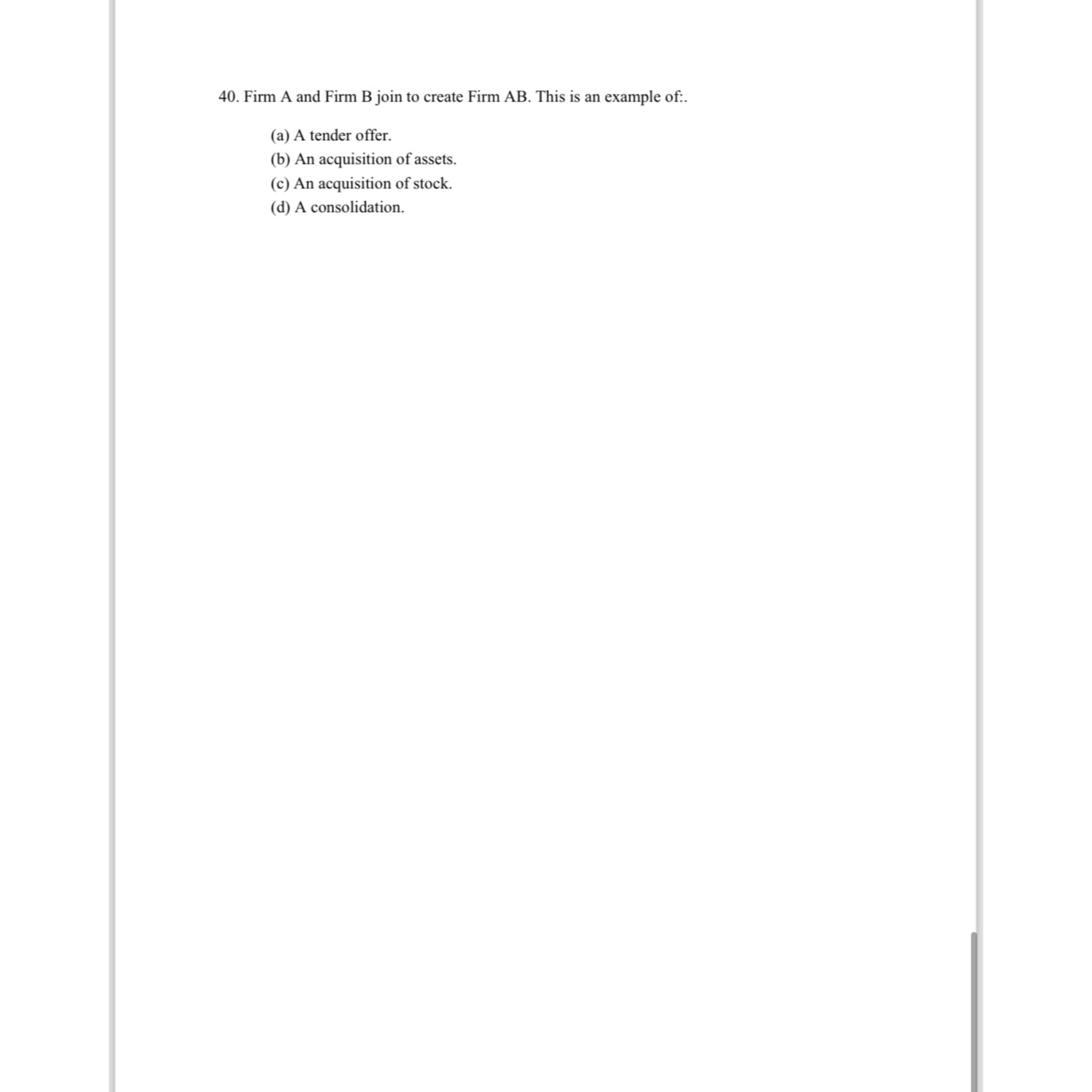
In consolidation of A Limited and B Limited into C Limited
a All three companies will cease to exist
b No company will cease to exist
c A and B will cease to exist but not C
Which of the following is required for an acquisition to be considered taxfree?
I. continuity of equity interest
II a business purpose, other than avoiding taxes, for the acquisition
III. payment in the form of equity shares for the acquired firm
IV cash payment for the equity of the acquired firm
a I and II only
b II and III only
c II and IV only
d I, II and III only
e I, II and IV only
Which one of the following statements is correct?
a If an acquisition is made with cash then the cost of that acquisition is dependent upon the acquisition gains.
b Acquisitions made by exchanging shares of stock are normally taxable transactions.
c The increase in value from writing up assets is considered a taxable gain.
d Target firm shareholders demand a higher selling price when an acquisition is a nontaxable event.
e Acquisitions based on legitimate business purposes are not taxable transactions regardless of the means of financing used.
Goodwill created by an acquisition:
a affects the cash flows of the acquiring firm on an annual basis for a period of years.
b must be reviewed each year to determine its current value to the firm.
c reduces the taxable income of the firm as it is expensed.
d has no effect on the reported earnings of a firm when it is expensed.
e is recorded in an amount equal to the fair market value of the assets of the target firm.
Which of the following are examples of cost reductions which can result from an acquisition?
I. spreading overhead
II eliminating duplicate back office functions by sharing central facilities
III. buying raw materials in larger quantities at a lower per unit cost
IV gaining economies of scale
a I and III only
b II and IV only
c I, II and IV only
d II III, and IV only
e I, II III, and IV
A potential merger which has synergy:
a should be rejected due to the projected negative cash flows.
b should be rejected because synergy destroys firm value.
c has a net present value of zero and thus returns the minimal required rate of return.
d creates value and therefore should be pursued.
e reduces the anticipated net income of the acquiring firm.
A proposed acquisition may create synergy by:
I. increasing the market power of the combined firm.
II improving the distribution network of the acquiring firm.
III. providing the combined firm with a strategic advantage.
IV reducing the utilization of the acquiring firm's assets.
a I and III only
b II and III only
c I and IV only
d I, II and III only
e I, II III, and IV
a I and IV only
b II and III acquire Firm B If Firm A prefers to make a cash offer for the merger it indicates that:
a Firm As managers are optimistic about the post merger value of A
b Firm As managers are pessimistic about the post merger value of A
c Firm As managers are neutral about the post merger value of A
d None of the above
Step by Step Solution
There are 3 Steps involved in it
1 Expert Approved Answer
Step: 1 Unlock

Question Has Been Solved by an Expert!
Get step-by-step solutions from verified subject matter experts
Step: 2 Unlock
Step: 3 Unlock
 Study Help