



Question: MBA Inc. assembles lawn mowers and snow blowers from subassemblies and component parts provided by reliable vendors. Both products ( end items ) utilize the
MBA Inc. assembles lawn mowers and snow blowers from subassemblies and component parts
provided by reliable vendors. Both products end items utilize the same small engines, many of the same
parts and require the same assembly time and employee labor skills.
On December the Production Planning Committee of MBA Inc. is due to adopt an aggregate
plan for the coming year. The available planning information is as follows:
Information: Demand Forecasts
Quarter Lawn Mowers Snow Blowers
Q I
Q II
Q III
Q IV
Quarter I Beginning Inventory: Mowers ; blowers
Output and Costs:
Regular Time $ per unit
Overtime $ per unit
Subcontract $ per unit
Part Time $ per unit
Inventory $ per unit per quarter based on avg. inventory during each quarter
Backorders $ per unit per period based on backorders at end of period
Hiring $ per employee FullTime or PartTime
Layoff $ per employee no cost if PartTime
Production Rates:
Regular units per FullTime employee per quarter of either unit
Overtime up to units per FullTime employee per quarter of either unit
Temporary units per Temporary employee per quarter of either unit
Subcontract Maximum subcontract output available is units per quarter
Given all of this planning information, develop a series of aggregate plans to meet the criteria presented in
the following series of problems. All plans must include full costs and hiringlayoff actions, as needed. Show
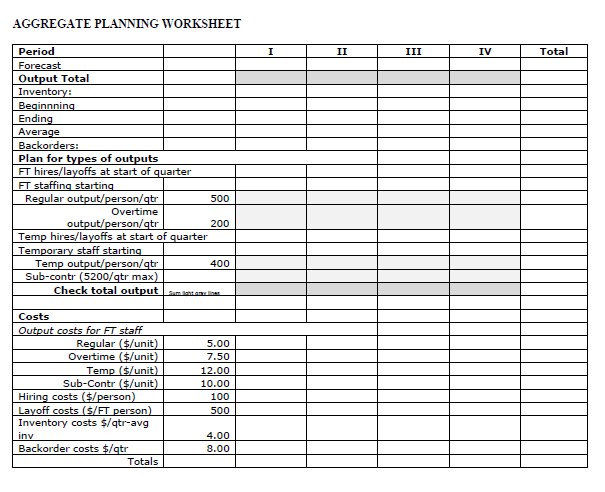
all plans using one of the worksheets at the end of this document.
A Develop an aggregate plan which utilizes a level constant rate of output each quarter using
only fulltime employees without overtime. Ending inventory for quarter IV is ; this
means, of course, that there will be no backorders at the end of quarter IV Backorders may
occur at the end of the other quarters.
B If each shipping container for a completed mower or blower requires cu ft of space, what
is the maximum amount of cubic feet of space that would be needed in the finished goods
warehouse if your plan A is adopted? Assume that sales and production occur at a steady,
daily rate within each quarter.
C If the cost of each completed end item is $ what is the maximum amount of capital
that will be tied up in finished goods inv
entory during the year? Continue with the
assumption given for B
Suppose that on December the longrange weather forecast is released by the weather service
and more snow than normal is predicted. As a result, the Marketing Dept. raises their forecast for
Quarter I sales of blowers from to units all other forecasts remain unchanged You
will now have to develop and analyze several alternative plans for next year. Each of these plans
must meet the other criteria listed in problem with the same starting inventory and FullTime work
force.
a Total beginning inventory of units.
b Ending Qtr IV inventory of units which means no backorders; backorders can occur
at the end of other quarters
c Each plan must have the same level total output rate each quarter.
A Develop a plan that uses overtime by regular, fulltime employees to meet the new demand
conditions.
B Plan B will use full time employees for regular output no overtime plus subcontracting
to meet the new demand conditions.
C Hire an additional fulltime employee or employees at the start of Qtr I and employ those
hires for the full year.
The VP of Marketing is not all that happy with the large volume of backorders in your plan from
question A She asks that you develop a plan that results in no backorders at any time during the
year. The VP of manufacturing says that he will insist that any such plan specify level output each
quarter. The VP of Finance states that you no longer need to have a Qtr IV ending inventory of
units.
Using the original forecast data, beginning inventory, starting number of full time employees, etc.
from problem deOn Dec. the VP Finance informs you that the availability of capital will be extremely tight next
year. As a consequence, he asks you to develop a radically different type of aggregate plan based
on a "Chase" strategy. Ending inventory and backorders is to be zero at the end of each quarter.
The VP Manufacturing says he realizes this type of strategy will require him to abandon his beloved
"level" strategy and for you to vary the total output rate from one quarter to another. The
productivity planning factors for each type of output are repeated here note that there are some
limits in a couple of the categories
Option Productivity Limitations
FullTime Employees unitsworkerqtr
Overtime FTE Up to unitsworkerqtr
Subcontract Up to unitsqtr
Finally, the personnel manager informs you that due to end of the year rewuirements, only not full time employees will be on your payroll as of the begining of Qtr These requirements will occur at the end of the prior year As such, you do not show a layoff adjustmrent at the start of QRT
Using the original forecasts and begining inventory information for problem develop a "chase" plan following the guidlines noted above.
Step by Step Solution
There are 3 Steps involved in it
1 Expert Approved Answer
Step: 1 Unlock

Question Has Been Solved by an Expert!
Get step-by-step solutions from verified subject matter experts
Step: 2 Unlock
Step: 3 Unlock