







Question: MC Questions 16-23 ... Geometric Returns, Unit Values, Arithmetic Returns, and Standard Deviations The following 8 questions refer to the follow returns for stocks for
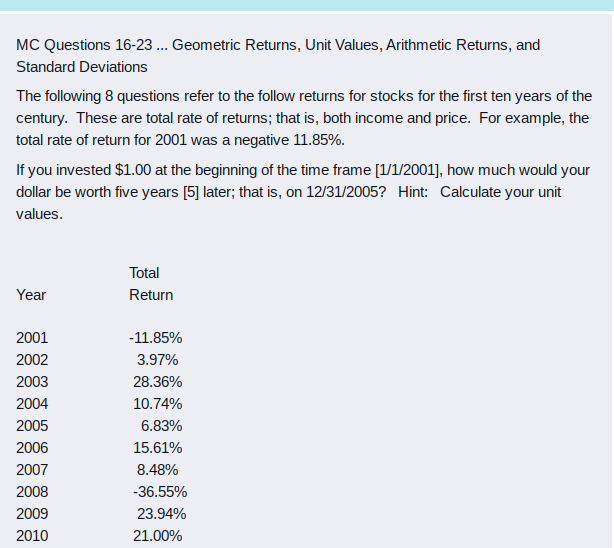
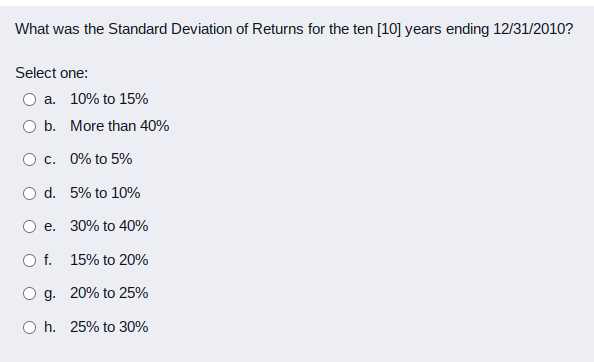
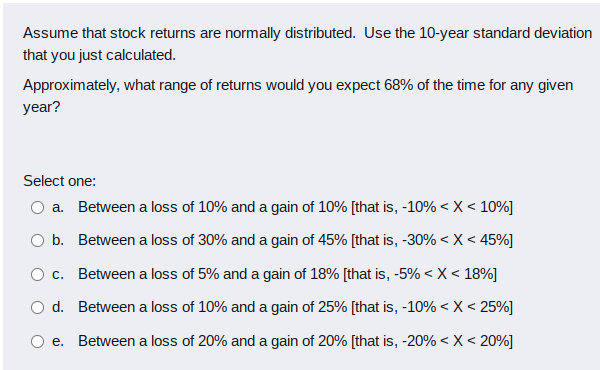
MC Questions 16-23 ... Geometric Returns, Unit Values, Arithmetic Returns, and Standard Deviations The following 8 questions refer to the follow returns for stocks for the first ten years of the century. These are total rate of returns; that is, both income and price. For example, the total rate of return for 2001 was a negative 11.85%. If you invested $1.00 at the beginning of the time frame [11/2001], how much would your dollar be worth five years [5] later; that is, on 12/31/2005? Hint: Calculate your unit values. Total Return Year 2001 2002 2003 2004 2005 2006 2007 2008 2009 2010 -11.85% 3.97% 28.36% 10.74% 6.83% 15.61% 8.48% -36.55% 23.94% 21.00% What was the Standard Deviation of Returns for the ten [10] years ending 12/31/2010? Select one: a. 10% to 15% O b. More than 40% O c. 0% to 5% O d. 5% to 10% e. 30% to 40% O f. 15% to 20% g. 20% to 25% O h. 25% to 30% Assume that stock returns are normally distributed. Use the 10-year standard deviation that you just calculated. Approximately, what range of returns would you expect 68% of the time for any given year? Select one: O a Between a loss of 10% and a gain of 10% (that is, -10%
Step by Step Solution
There are 3 Steps involved in it

Get step-by-step solutions from verified subject matter experts
 Study Help