







Question: ME 0 2 1 - Engineering Computing - Fall 2 0 2 4 Assignment HW 0 3 b Moving Averages Moving averages are a way
ME Engineering Computing Fall
Assignment HW b
"Moving Averages"
Moving averages are a way of filtering data, often used to "smooth" spikes or random fluctuations in the data.
There are several methods of generating a moving average from a raw data set. For our purposes, the moving
average at an index will be the average of the data at that index and the data within an "index radius" or
sometimes "window halfsize" of that data. The radius can generally be any nonnegative integer. If the radius is
then the moving average is the same as the data, because we are averaging that data point with that points
before and after it With a radius of each moving average point would be the data at that point averaged with
the data one point before and one point after it Et cetera.
Obvious question: What do we do near the first and last points in the data set, where the radius would have us
include data points in the average that aren't in the data? For example, with a radius of the moving average for
the first data point should include that data point averaged with the two points before it and two points after it
But, there aren't two points before it And, for the second data point, there is only one point before it so there is
no way to use the two points before it A similar issue would exist for the last two data points in the set. For our
purposes, we do not average in points that are not in the data set, just using those that are.
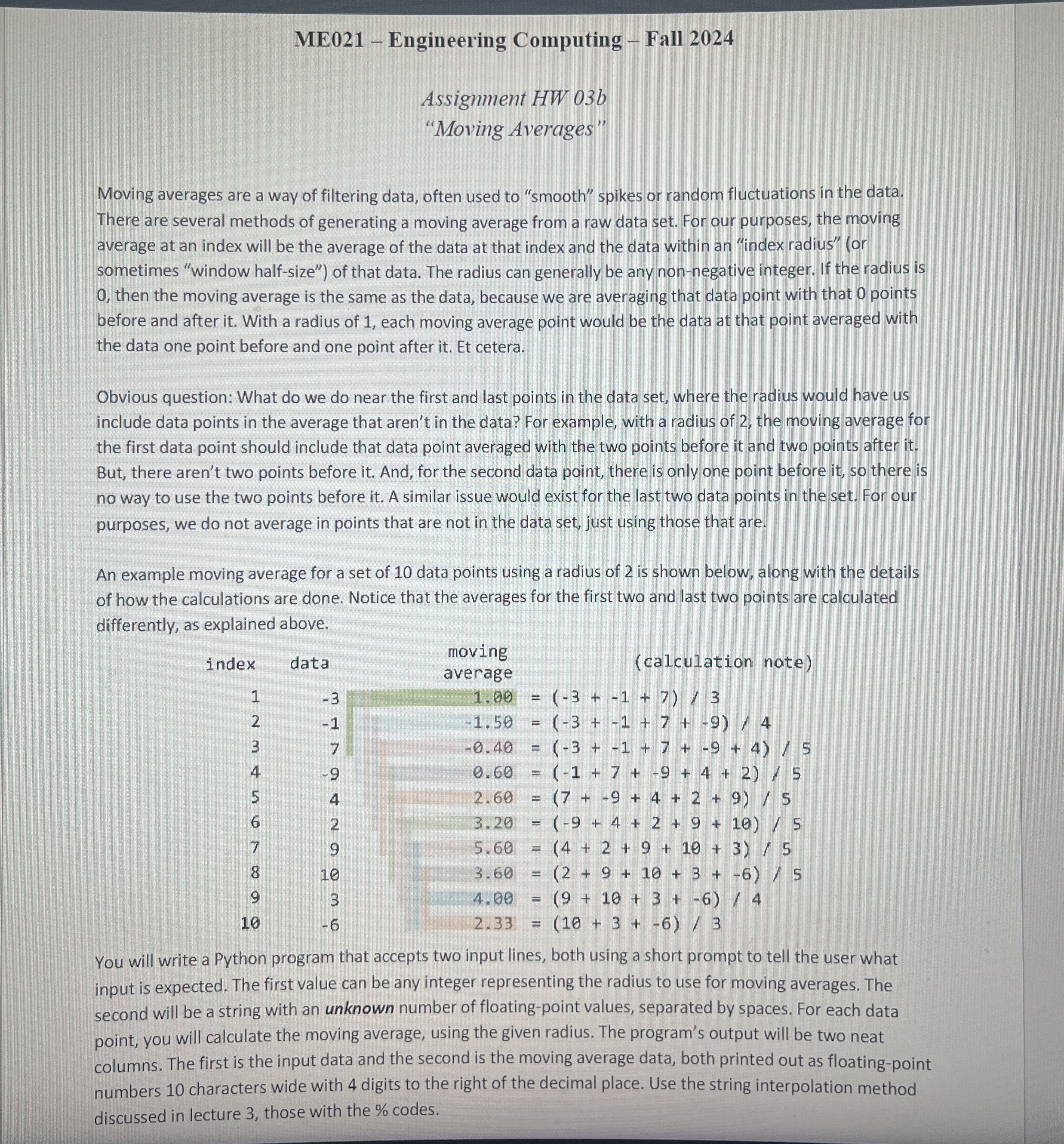
An example moving average for a set of data points using a radius of is shown below, along with the details
of how the calculations are done. Notice that the averages for the first two and last two points are calculated
differently, as explained above.
Step by Step Solution
There are 3 Steps involved in it
1 Expert Approved Answer
Step: 1 Unlock

Question Has Been Solved by an Expert!
Get step-by-step solutions from verified subject matter experts
Step: 2 Unlock
Step: 3 Unlock
 Study Help