



Question: Measure the following quantities: R - Range (at the location where projectile hits the ground) TE - Flight Time (at the location where projectile
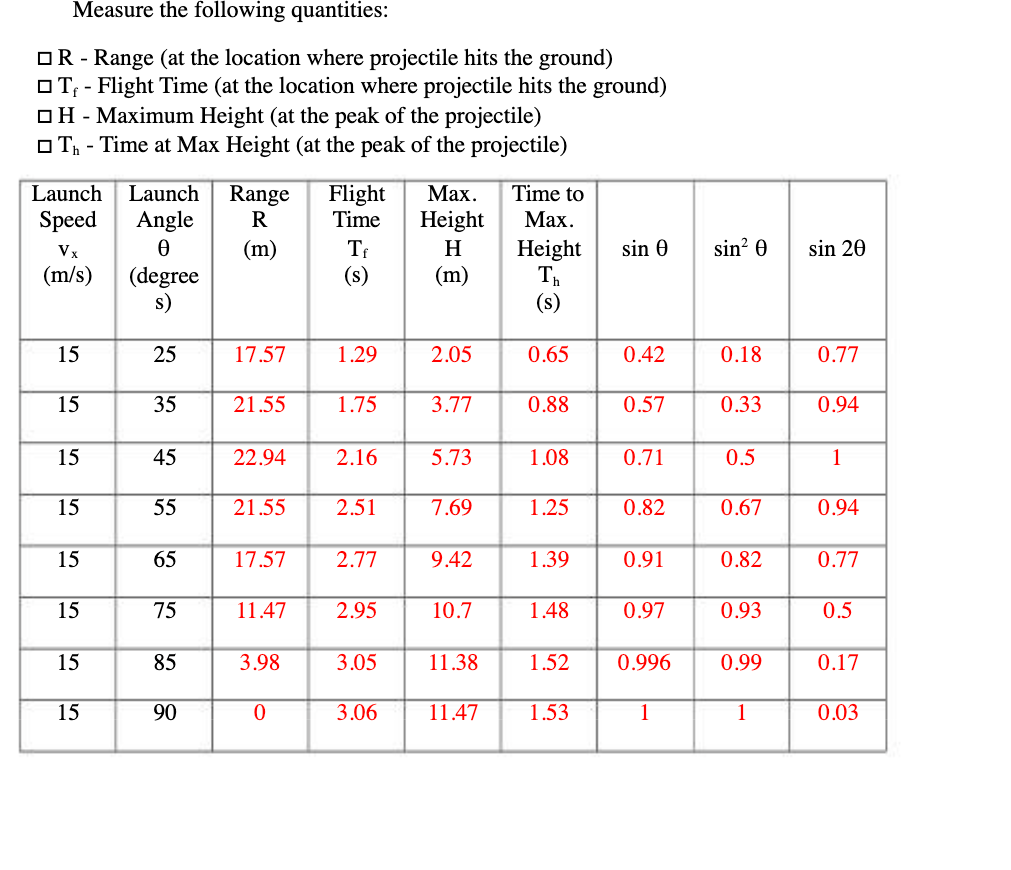
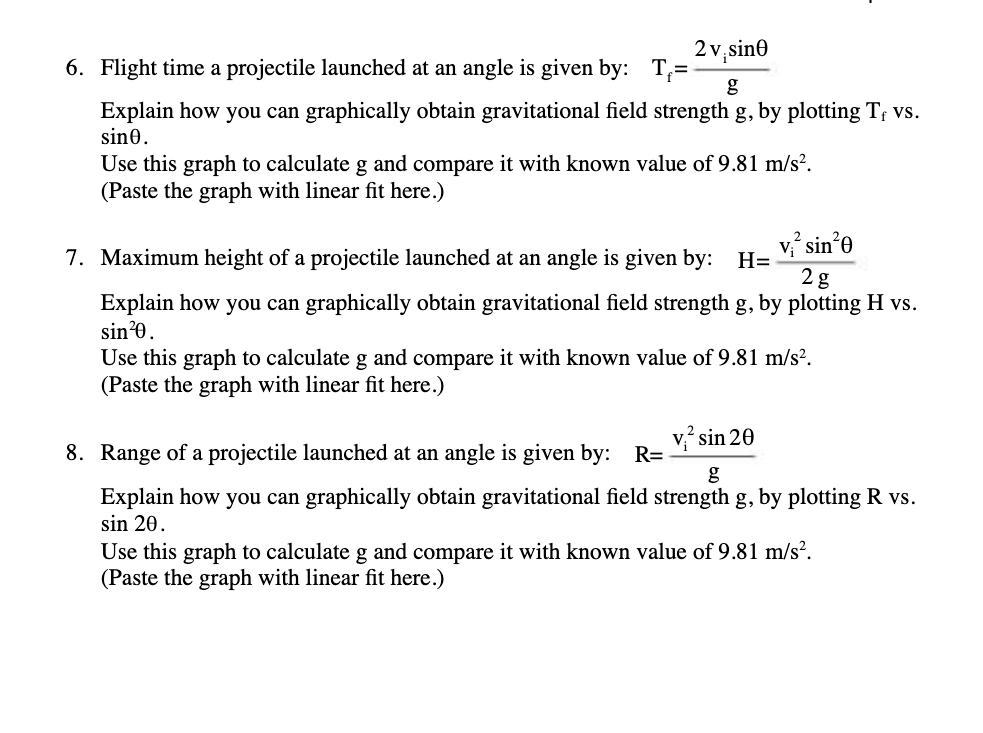
Measure the following quantities: R - Range (at the location where projectile hits the ground) TE - Flight Time (at the location where projectile hits the ground) H - Maximum Height (at the peak of the projectile) T - Time at Max Height (at the peak of the projectile) Launch Speed Launch Range Angle R Flight Max. Time Height Time to Max. Vx (m) Tf H Height sin 0 sin 0 sin 20 (m/s) (degree s) (s) (m) Th (s) 15 15 55 25 17.57 1.29 2.05 0.65 0.42 0.18 0.77 35 21.55 1.75 3.77 0.88 0.57 0.33 0.94 15 45 22.94 2.16 5.73 1.08 0.71 0.5 1 15 55 21.55 2.51 7.69 1.25 0.82 0.67 0.94 15 65 17.57 2.77 9.42 1.39 0.91 0.82 0.77 15 75 11.47 2.95 10.7 1.48 0.97 0.93 0.5 15 85 3.98 3.05 11.38 1.52 0.996 0.99 0.17 15 90 0 3.06 11.47 1.53 1 1 0.03 2 v,sine 6. Flight time a projectile launched at an angle is given by: T= g Explain how you can graphically obtain gravitational field strength g, by plotting T vs. sin0. Use this graph to calculate g and compare it with known value of 9.81 m/s. (Paste the graph with linear fit here.) 7. Maximum height of a projectile launched at an angle is given by: H= v sin0 2 g Explain how you can graphically obtain gravitational field strength g, by plotting H vs. sin0. Use this graph to calculate g and compare it with known value of 9.81 m/s. (Paste the graph with linear fit here.) 8. Range of a projectile launched at an angle is given by: R= V sin 20 g Explain how you can graphically obtain gravitational field strength g, by plotting R vs. sin 20. Use this graph to calculate g and compare it with known value of 9.81 m/s. (Paste the graph with linear fit here.)
Step by Step Solution
There are 3 Steps involved in it

Get step-by-step solutions from verified subject matter experts