Measuring is the Easy Part Discussion
Please read and analyze the following insert from chapter 15; page 438:
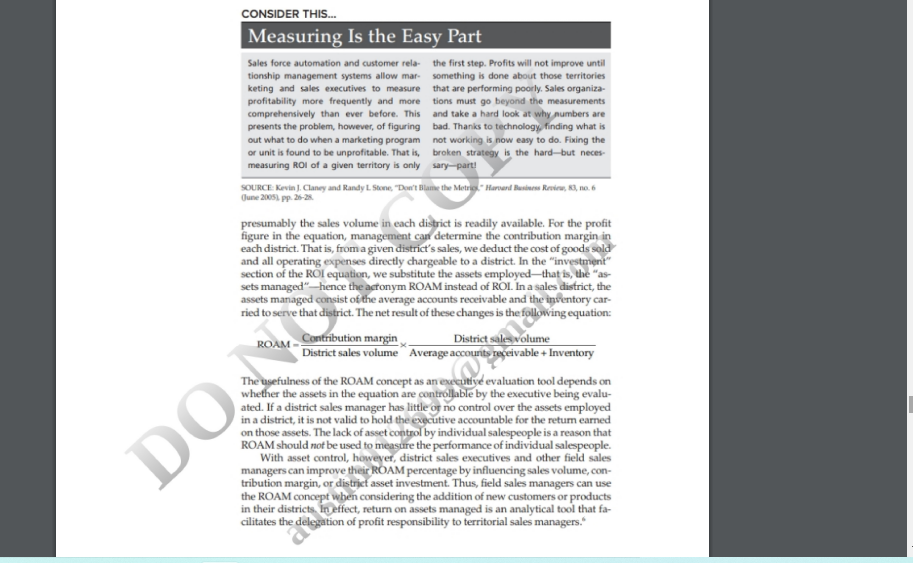
" Salesforce automation and CRM allow marketing and sales executives to measure profitability more frequently and more comprehensively than ever before. This presents the problem, however, of figuring out what to do when a marketing program or unit is found to be unprofitable. That is, measuring the ROI of a given territory is only the first step.
Profits will not improve until something is done about those territories that are performing poorly. Sales organizations must go beyond the measurements and take a hard look at why numbers are bad. Thanks to technology, finding what is not working is now easy to do. Fixing that broken strategy is the hard--but necessary--part!"
Source: Kevin J. Claney and randy L. Stone, "Don't Blame the Metrics," Harvard Business Review, 83 no. 6 (June 2005), pp 26-28
Based on what you have learned about cost and profitability analysis, why do you believe that fixing what is broken is the hard thing to do? What roadblocks and constraints get in the way of fixing the issue?
CONSIDER THIS... Measuring Is the Easy Part Sales force automation and customer rela- the first step. Profits will not improve until tionship management systems allow mar. something is done about those territories keting and sales executives to measure that are performing poorly Sales organiza- profitability more frequently and more tions must go beyond the measurements comprehensively than ever before. This and take a hard look at why numbers are presents the problem, however, of figuring bad. Thanks to technology finding what is out what to do when a marketing program not working is now easy to do. Fixing the or unit is found to be unprofitable. That is, broken strategy is the hard--but neces measuring ROI of a given territory is only sary-part! SOURCE: Kevin J. Claney and Randy L. Stone, "Don't Blame the Metro Harvard Business Review, 83, no.6 June 2005 pp. 26-28 presumably the sales volume in each district is readily available. For the profit figure in the equation, management can determine the contribution margin in each district. That is, from a given district's sales, we deduct the cost of goods sold and all operating expenses directly chargeable to a district. In the "investment" section of the Rol equation, we substitute the assets employed that is, the "as- sets managed" hence the actonym ROAM instead of ROI. In a sales district, the assets managed consist of the average accounts receivable and the inventory car- ried to serve that district. The net result of these changes is the following equation: ROAM Contribution margin District : District sales volume Average account aceivable + Inventory The usefulness of the ROAM concept as an exe evaluation tool depends on whether the assets in the equation are controllable by the executive being evalu- ated. If a district sales manager has little or no control over the assets employed in a district, it is not valid to hold the executive accountable for the retum earned on those assets. The lack of asset control by individual salespeople is a reason that ROAM should not be used to measure the performance of individual salespeople. With asset control, however, district sales executives and other field sales managers can improve their ROAM percentage by influencing sales volume, con- tribution margin, or district asset investment. Thus, field sales managers can use the ROAM concept when considering the addition of new customers or products in their districts effect, return on assets managed is an analytical tool that fa- cilitates the delegation of profit responsibility to territorial sales managers. DO




